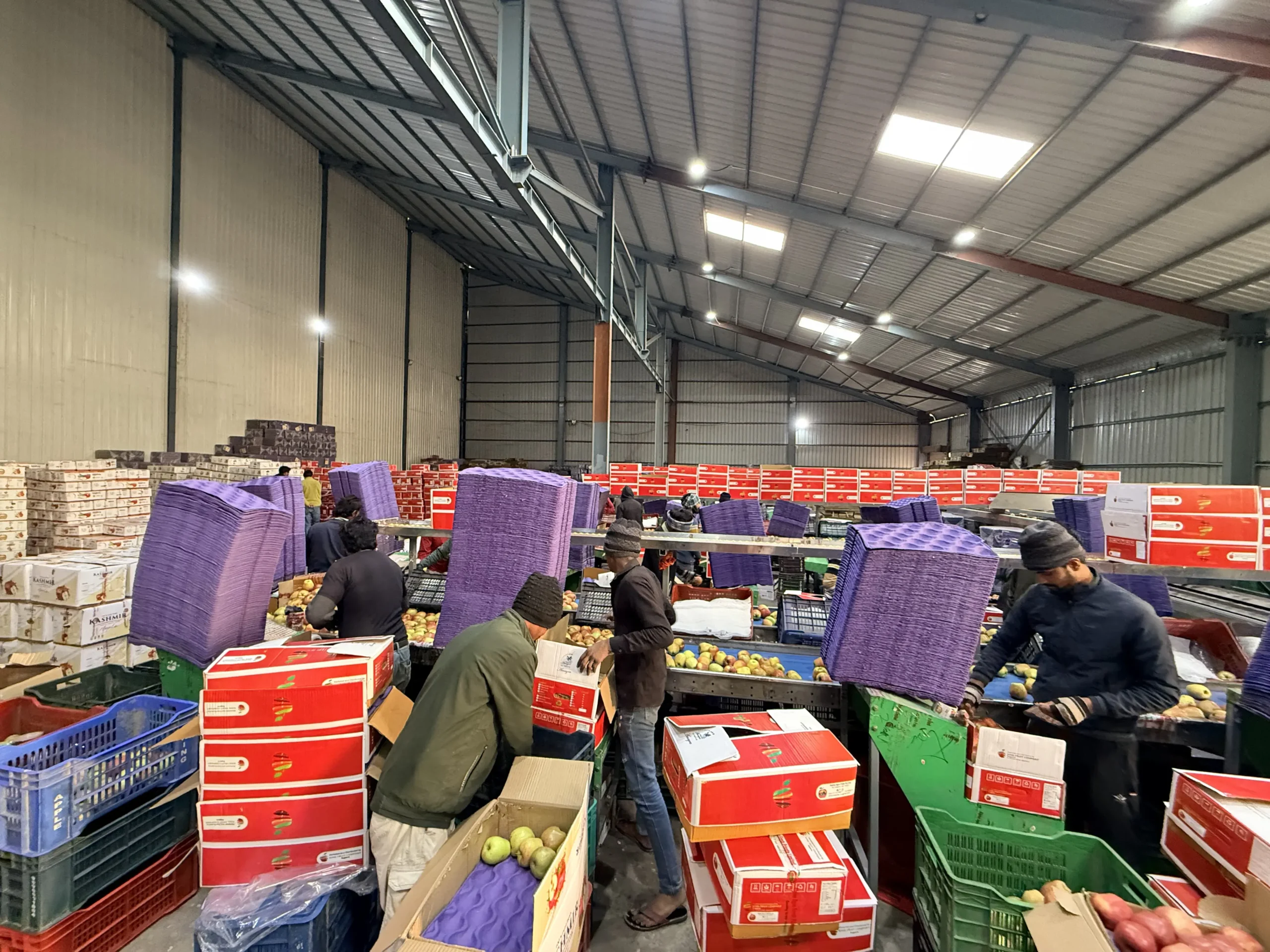
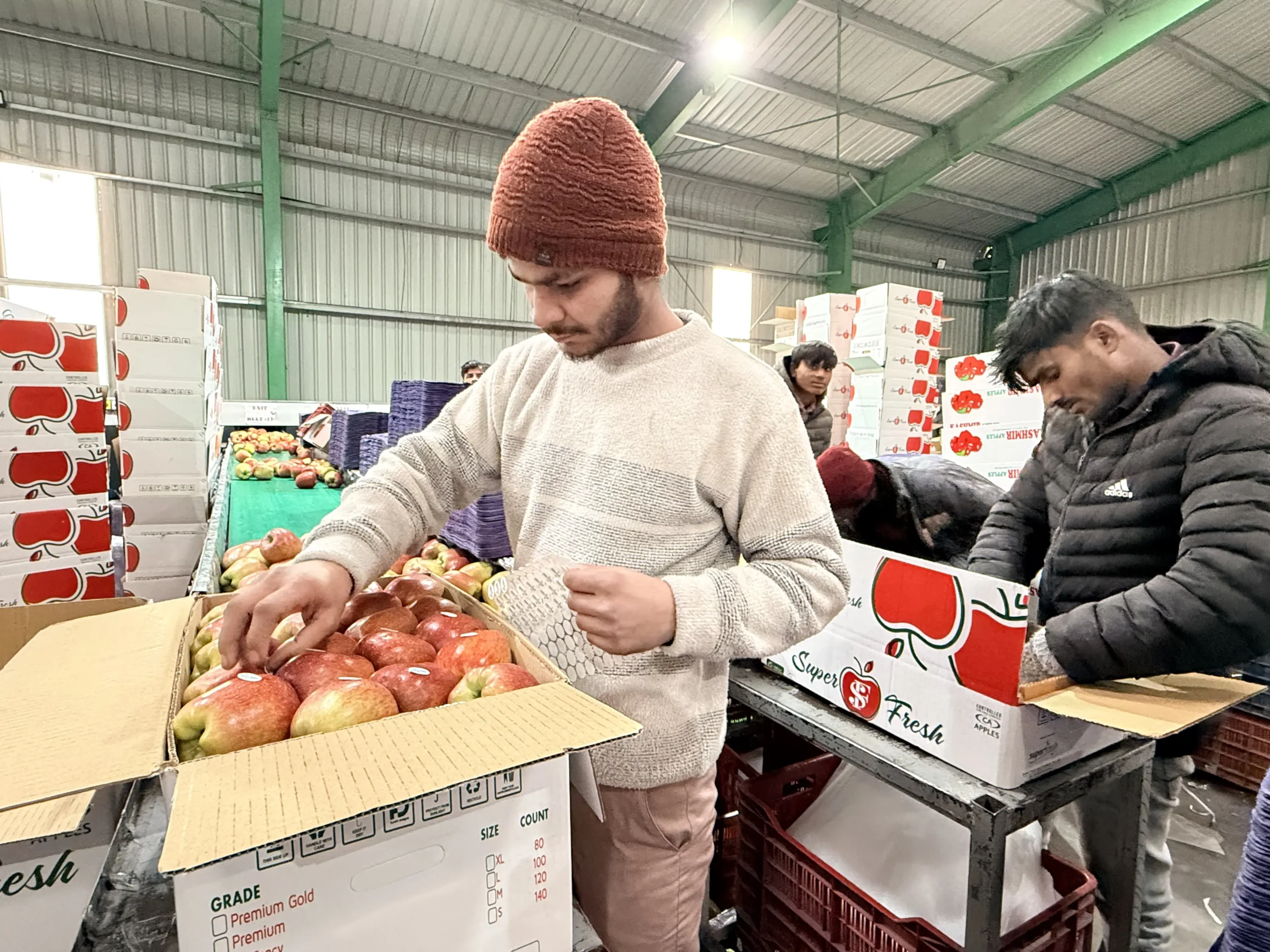
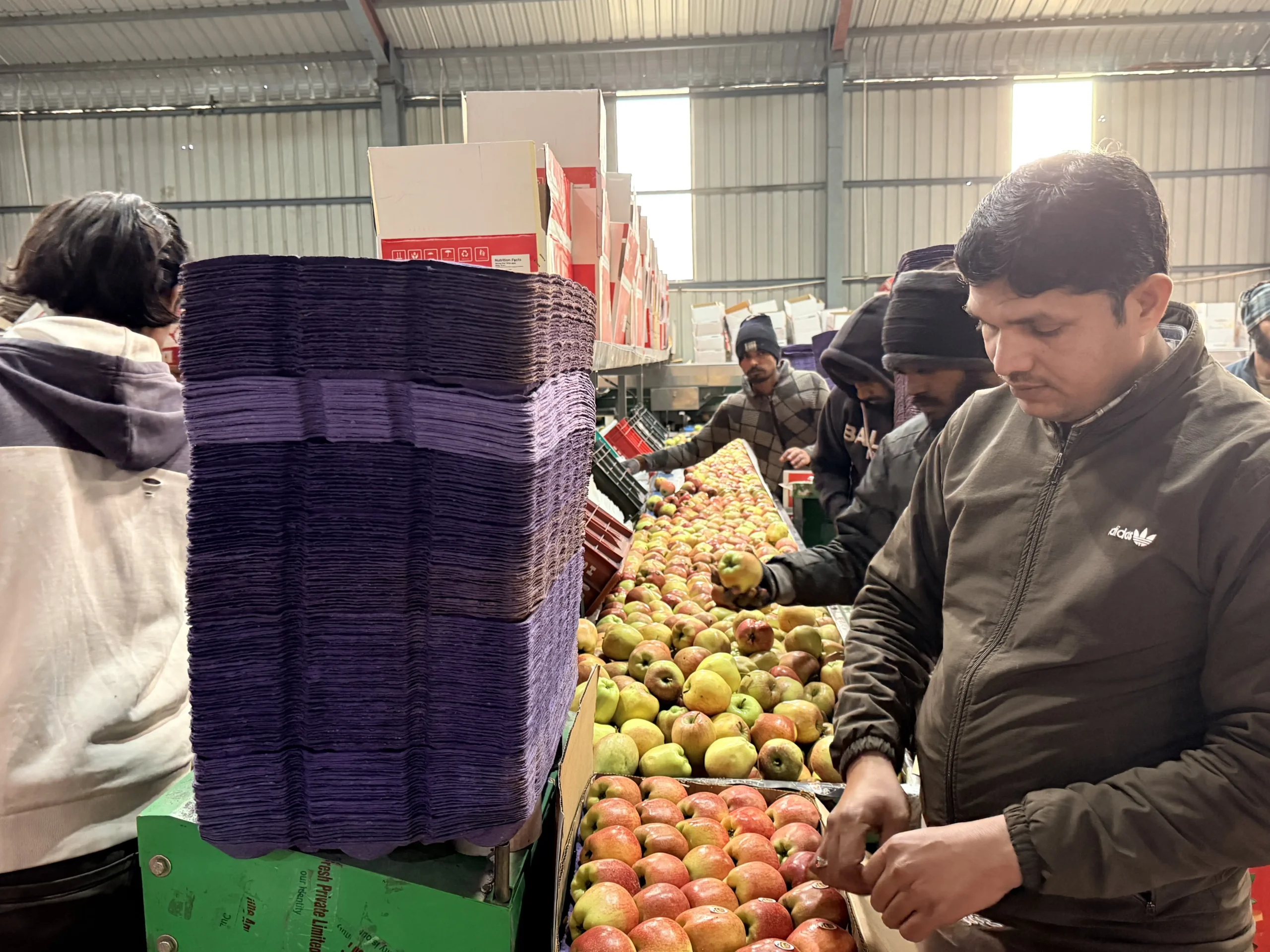
PULWAMA, Jammu & Kashmir: Hundreds of miles away from home, Mohamed Yaqoob stacks red apples in the icy aisles of a refrigerated warehouse in Kashmir, an annual sojourn that helps him earn a living and fuel his family’s dreams.
For over a decade, Yaqoob has been leaving his small home in Gonda district of Uttar Pradesh every summer to spend nearly 11 months packing apples inside cold storage units in mountainous Kashmir, India’s largest producer of the fruit. There the apples are chilled at between 0 to 3 degrees Celsius to keep them fresh and provide supply months later.
Yaqoob is among hundreds of migrants pouring into the Industrial Growth Centre (IGC) Lassipora every year in Jammu & Kashmir’s Pulwama district, home to what the government says is South Asia’s largest controlled-atmosphere (CA) apple storage hub. With nearly 60 CA units, the cluster employs 8,700 non-locals, says a top facility manager.
“Since (2009) I have been working in apple CA stores to make a living,” the 40-year-old told The Migration Story as he moved quickly between stacks of cartons in the biting cold. “Here the work is lighter than masonry or carpentry, and it feels cleaner and more hygienic,” said Yaqoob, the sole breadwinner of his family.
Workers like him sort, pack and label apples before placing them in sealed chambers where oxygen, carbon dioxide, nitrogen levels and humidity and temperature are regulated to extend the fruit’s shelf life for months at different CA storage facilities in the sprawling IGC, which was established in 1989 to boost manufacturing and processing units in Jammu & Kashmir.
From food processing and agro-based enterprises to steel, textile and pharmaceuticals units, the IGC hosts more than 800 factories, drawing migrants from across the country. They also form a crucial lifeline for the booming apple industry in Kashmir.
Nearby at Alpine Agro Fresh, one of the largest facilities at the hub with a storage capacity of 10,000 metric tonnes – or enough to fill 800 standard shipping containers – 150 of 210 workers are migrants, mostly from Uttar Pradesh.
“Non-local workers are punctual and dedicated. We have tried hiring local labourers many times, but the level of commitment is often not the same,” Malik Wajid Mushtaq, the 32-year-old owner of Alpine Agro Fresh, told The Migration Story. “Even a slight change in weather can affect attendance. Migrant workers, on the other hand, come here with a clear purpose – to work, to earn and to build something for their families.”
Jammu & Kashmir’s apple industry supports nearly 3.3 million people, with around 700,000 families directly or indirectly dependent on it, according to government data.
The scale of the industry is visible in orchards and markets, but much of its labour unfolds behind insulated walls, in refrigerated corridors where migrants spend long hours stacking fruit.
Yasir Manzoor, the company’s human resources manager, echoed Mushtaq, saying migrant workers comprised a significant chunk of the workforce due to their skills and punctuality.
“We offer salaries around 17,000 to 18,000 rupees. They work from 9AM to 6PM and often prefer overtime to earn more, which is not always the case with locals,” he said.
‘INVISIBLE’ MIGRANT WORKERS
About 400,000 non-local migrant workers are employed across Jammu & Kashmir in various sectors including CA stores, according to the local labour commission department.
Such internal migration is set to grow as economic slowdown and joblessness hit rural India, home to 60% of its 1.4 billion people, say migration and economic experts.
Naseem Ahmed, 28, is one of the migrants powering this surge.
Ahmed arrived in Kashmir six years ago after working at Delhi’s Azadpur fruit market, and has since risen to a supervisory role at Alpine Agro Fresh.
“I have gained mastery in apple packing, and now I lead the team,” he said, pausing to inspect a row of trays. “When I first came, there were only a few CA stores. It was like love at first sight with apples,” said Ahmed, who earns a monthly 17,000 rupees which he sends back home to his wife and six children.
He soon became a link between the Kashmir Valley and his native village in Rewari, Uttar Pradesh. Through word of mouth and personal contacts, he has helped bring nearly 300 labourers to Kashmir over the years, placing them across different storage units.
Thanks to the expansion of CA cold storages, apples in Kashmir are no longer limited to the harvest months. They are now sold well into the winter.
The steady growth of CA stores has started to reshape the Valley’s fruit economy, offering growers a measure of stability in a state where local livelihoods are often one of the first victims of unrest stemming from hostilities between India and Pakistan.
The government has outlined plans to further expand capacity by 53,000 metric tonnes over the next five years.
With industry expansion, however, labour rights experts warn that migrants, who often lack local safety nets, could face heightened exploitation risks, from wage theft to hazardous working conditions.
Mohammad Ashraf Wani, an advocate who deals with labour-related issues at the Jammu & Kashmir High Court, said that many migrant workers in industrial units remain largely unregulated and unaware of their legal protections.
“There has to be strict enforcement of safety standards in factories. In cases of death or injury, families are entitled to proper compensation, and employer negligence can invite criminal liability,” he said.
Wani noted that compliance with the Minimum Wages Act alone was not enough. “Employers must also ensure provident fund contributions and insurance coverage. If disputes arise, workers can approach labour courts or industrial tribunals.”
Nirmal Gorana, national convenor of the Delhi-based National Campaign Committee for Eradication of Bonded Labour, said migrant workers often faced identity-based exploitation and loss of dignity.
“Most of the workers leave home in distress, and then their bargaining power remains minimal,” he said.
He added that another issue was the lack of documentation and formal registration. “Many migrants do not carry proper documents, and there is no effective registration system in J&K. That makes them invisible in the system.”
For women migrants, he warned, the struggle was more. “Living conditions are often unsuitable for families. There are problems related to accommodation, access to washrooms and community toilets, especially when children are involved.”
Gorana also pointed to gaps in travel support. “Often, workers are brought with travel arranged by contractors, but when they leave, they are on their own. There has to be coordination between source and destination states to ensure protection and accountability,” he said.
‘SACRIFICES TO SUPPORT FAMILIES’
Suhail Ahmad, a manager at Super Fresh Agri Products Private Limited, a newly-established cold storage unit, said migrants made up nearly half of their workforce.
“They start work early (and work) late into the evening and have become the backbone of operations, especially during the peak season,” the 29-year-old said.
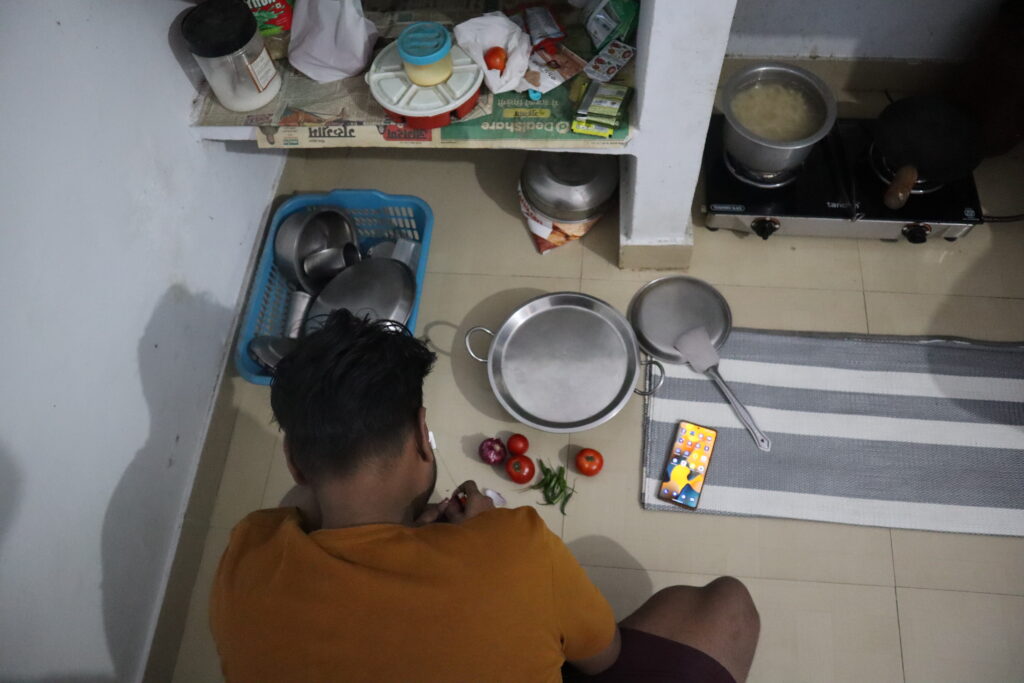
During a break, a group of workers sat near a stack of crates, talking about what keeps them coming back every year. Free accommodation, they said, made a considerable difference.
“We prefer to stay in Kashmir because free accommodation is provided and food is inexpensive,” said 33-year-old Naseer Ahmed, who works at Al Meezan Agro Fresh, a nearby unit with a capacity of 5,000 metric tonnes.
Ahmed, a 28-year-old packer with nearly a decade of experience working with apples, said he had come to enjoy the work over the years. Recalling the years of political unrest in the Valley between 2016 and 2019, he said the storage units insulated them from the uncertainty outside.
“Even during difficult times, we stayed back and kept working inside the industries. Season after season, we continued to store apples to earn our livelihoods and keep the apple trade running,” he added.
Industries in the Valley have long battled disruptions, with many shuttered or defunct amid cycles of political unrest. Those that continue to operate rely heavily on migrant workers from states such as Bihar, West Bengal, Uttar Pradesh, Rajasthan, Haryana and Punjab.
From cold storage facilities to plywood units and small manufacturing hubs, these workers fill a critical labour gap, taking on jobs that many locals are hesitant to pursue as most tend to their own apple orchards and farms, and help keep small industries running.
For thousands of migrants, Kashmir’s apple economy provides what home lacks: steady seasonal work, even at modest wages.
A senior official in Jammu & Kashmir’s Industries Department said the Valley continued to face a shortage of skilled labour, which is one of the main reasons migrant workers remain central to the functioning of CA store units.
“There is a dearth of skilled labourers locally, and migrants often come with experience and a strong work ethic,” the official said, adding that Kashmiri youth often preferred careers in Science or social sciences, and urged authorities to open industrial training centres to help develop their skills.
“Many of them arrive from very difficult backgrounds like poverty, limited opportunities and unstable livelihoods back home. Their lives are full of struggle, and they are willing to make sacrifices to support their families.”
He added that even modest wages in Kashmir made a difference for them. “For example, if they earn 18,000 rupees here, they may not get even 5,000 rupees in their native state. Not everyone has the means to go abroad for work due to visa constraints, so Kashmir becomes a closer and more accessible option.”
“With the direct train service now partially operational and expected to run fully soon, it will become even easier for migrant workers to come and work in the Valley.”
While the new train service brings hope of frequent and easier home visits, Ahmed, the supervisor at Alpine Agro Fresh, admitted that he would still largely miss festivals, birthdays and his children’s milestones as he would have to prioritise work to make ends meet.
“Who wants to live miles away from his children, working a 9-to-5 job in a place that never feels like home?,” said Ahmed.
“We do it only to fill our stomachs.”
Irfan Amin Malik is a journalist based in Jammu and Kashmir who regularly reports on business and climate change.