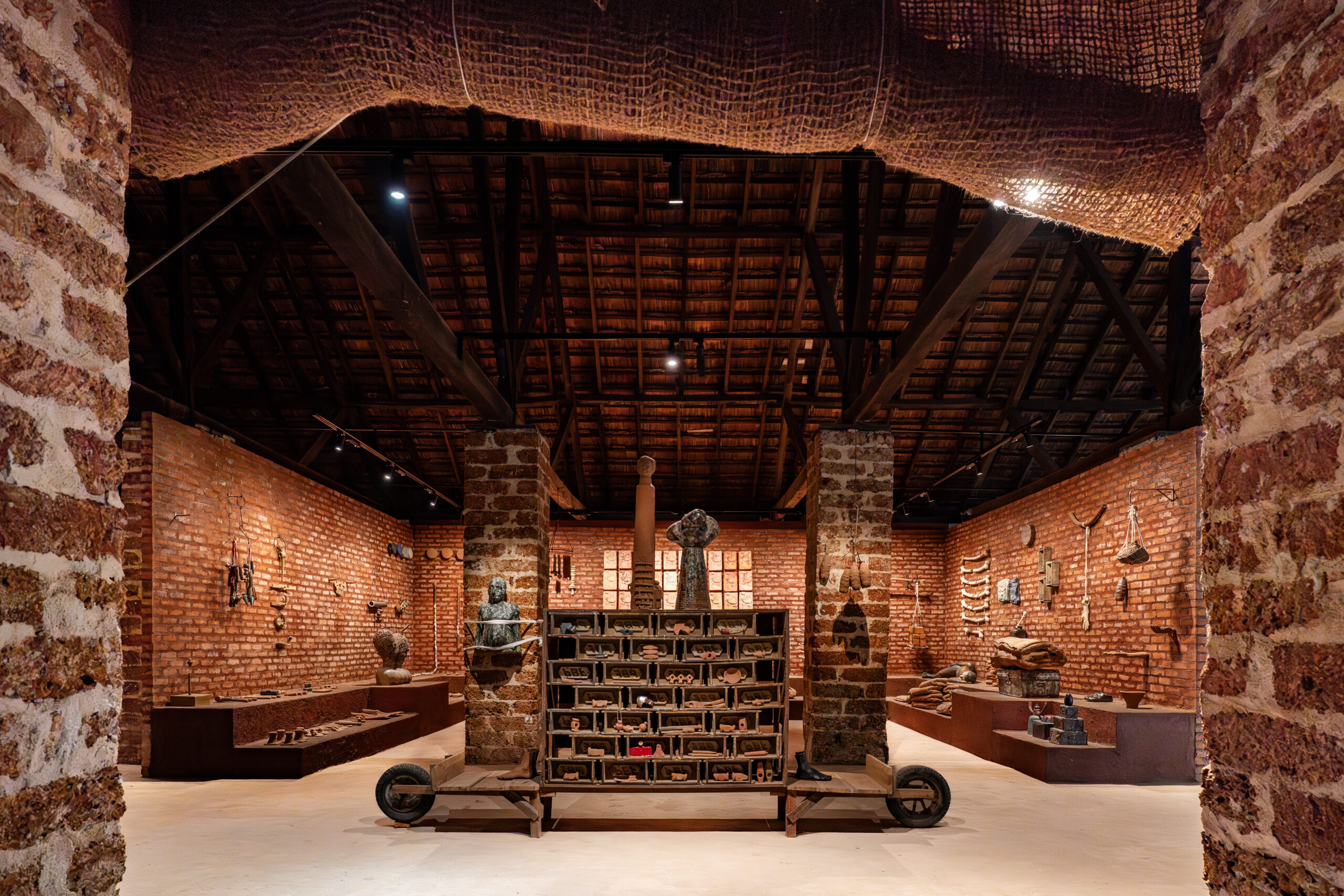
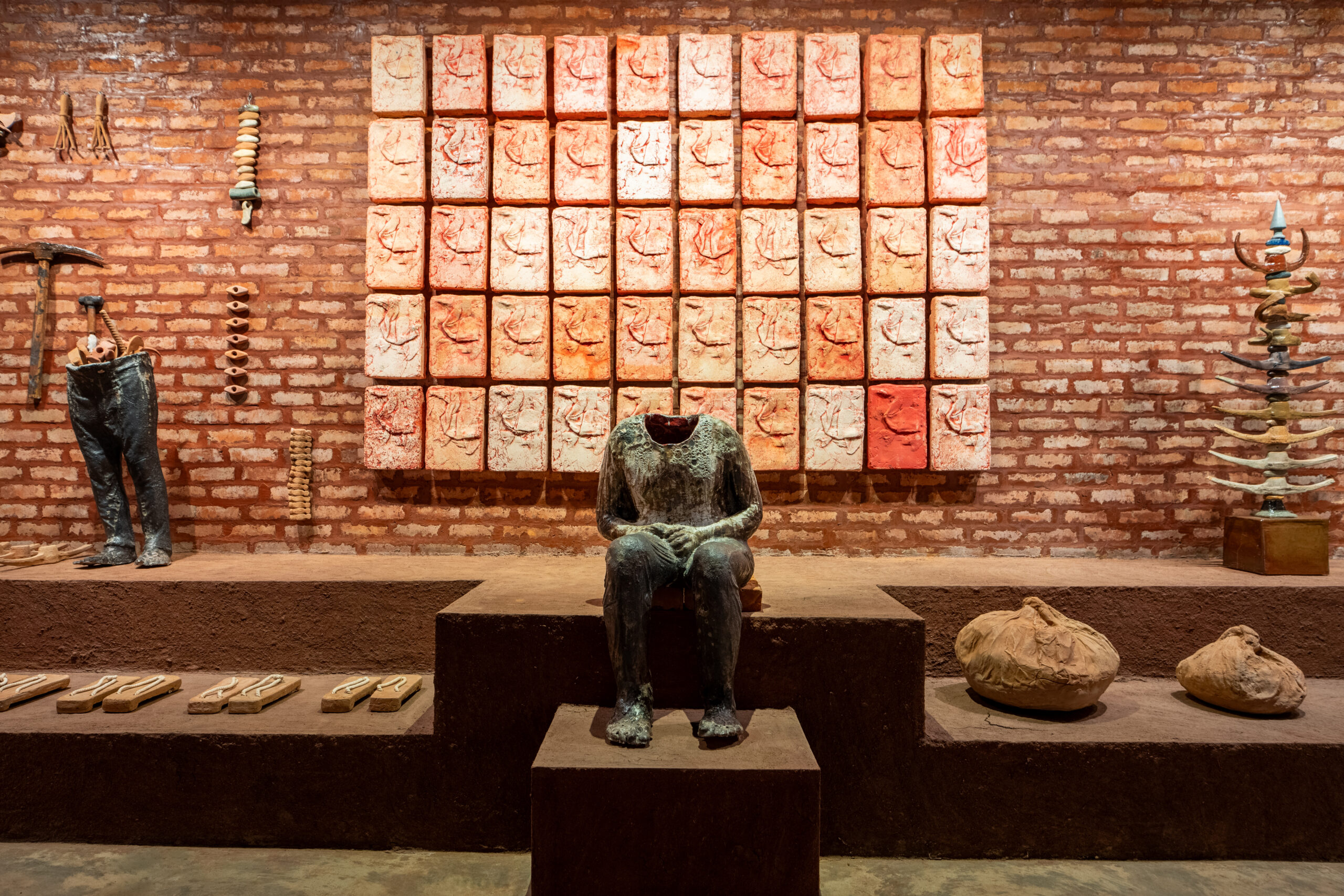
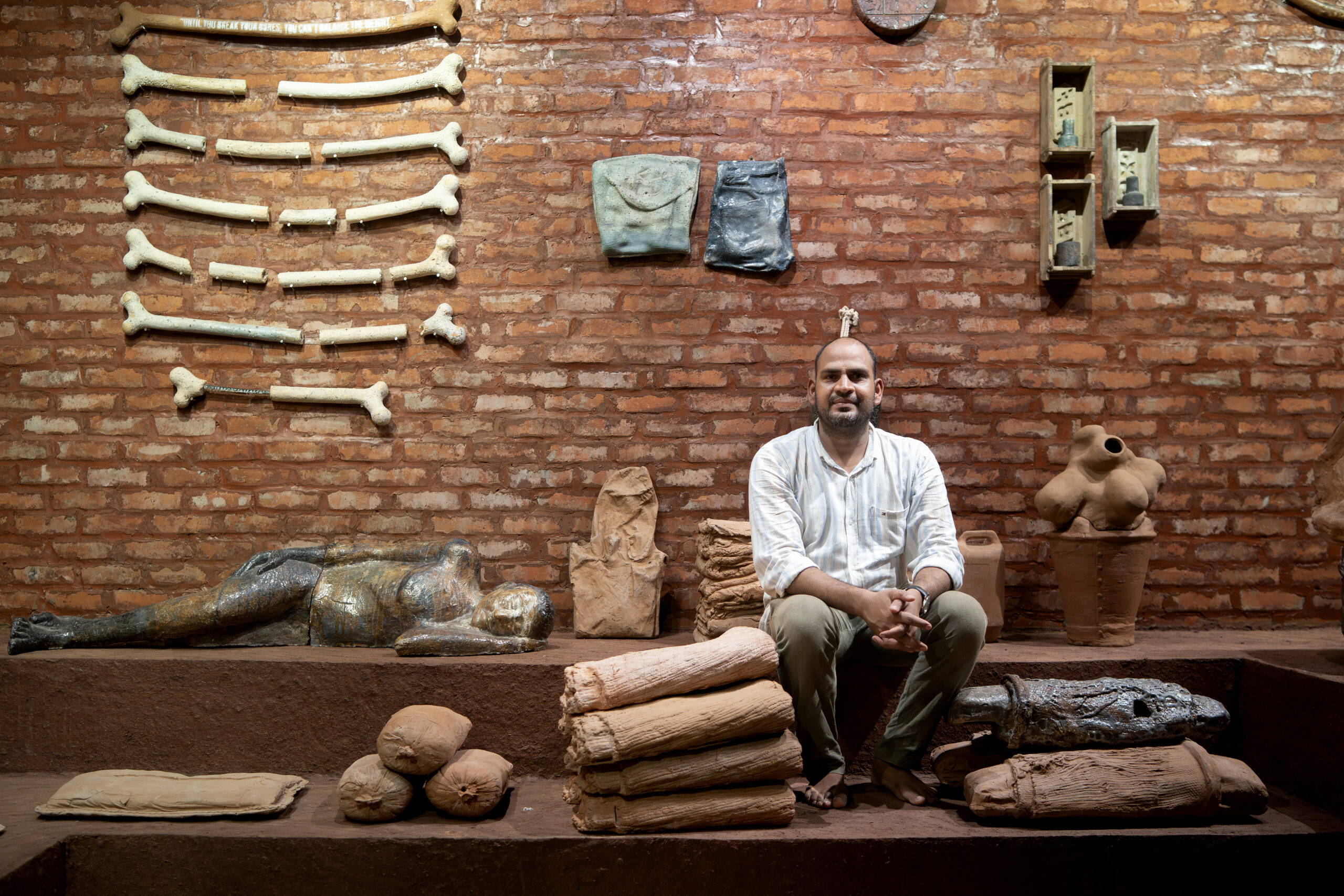
At the ongoing Kochi-Muziris Biennale, the installation Only the Earth Knows Their Labour invites viewers into a space that feels like entering a brick kiln. The first thing one encounters is a cart filled with brick moulds. Scattered around are clay casts of everyday tools and personal belongings. Together, they form a quiet reminder of lives lived in temporary kiln settlements.
The workers themselves are absent, yet their presence lingers everywhere.“Moulds without a name are discarded as waste — then what of the labourers whose name was never inscribed?” reads an inscription on the cart at the entrance.
The question has stayed with 34-year-old artist Birender Kumar Yadav since his first visit to brick kilns in Mirzapur while pursuing his Bachelor of Fine Arts at Banaras Hindu University, Varanasi — an experience that would go on to shape his artistic practice and his engagement with migration and labour.
Birender himself is not unfamiliar with migration. At a very young age, his family moved to Dhanbad, Jharkhand. “I was studying in Class 1 then,” Yadav recalled. The first to migrate were his uncles, followed later by his father, Hare Ram Yadav, who began working in the coal mines of Tata Steel as a blacksmith.
Back in their village Pahiya in Uttar Pradesh’s Ballia district, the family depended on small-scale farming for a living. “My family migrated mainly in search of better employment opportunities and financial stability, which were difficult to sustain through farming alone,” Yadav said.
His family was not alone. According to his father, many people from neighbouring villages, as well as areas such as Chapra and Arrah in neighbouring Bihar, migrated to Dhanbad to work in the coal mines.
Years later, when Yadav began repeatedly visiting brick kilns, migration became one of the connections he shared with the workers. Yet, as he admitted, “their conditions are often much more difficult and precarious.”
Over the years, Yadav’s work has remained centred on brick kilns and the lives shaped within them — from Erased Faces (2014), which responded to workers’ lack of formal identity by using thumbprints as portraits; and Walking on the Roof of Hell (2016), reflecting on the physical toll of kiln labour through worn wooden sandals; to Re-Presented from the Traces (2021–22), where everyday objects left behind at kiln sites became witnesses to migration and displacement. Each project examines a different dimension of labour often left unseen.
In this conversation with The Migration Story, Yadav, who is now based in Delhi, reflects on migration as repetition rather than departure, on labour remembered through material rather than image, and on why the earth retains the imprint of those who shape it.
Excerpts from the interview.
Your installation Only the Earth Knows Their Labour grows out of years spent observing brick kiln workers in Mirzapur. What moments or encounters there stayed with you most and eventually shaped this work?
When I first began visiting the brick kilns in Mirzapur, I did not go with a fixed idea of making a work. I spent time there simply observing and speaking with the workers. What stayed with me most were the repeated gestures of labour — hands pressing wet clay into moulds, bodies bending and lifting, the slow stacking of bricks in long lines. One thing that struck me deeply was the imprint of palms on the bricks. Each brick carries the mark of a worker’s hand, but once it becomes part of a wall or a building that trace disappears.
Over time I began to think about how these marks of labour remain in the earth itself, even when the worker is forgotten. That thought gradually shaped the idea of Only the Earth Knows Their Labour.
What drew you back to the kilns over the years? As you returned to the kilns over time, what layers of reality were you discovering about the workers’ lives and conditions? Did these experiences change how you began to think about migration — beyond movement, toward something more cyclical or inescapable?
I kept returning because the kiln is not just a workplace; it is also a temporary settlement where entire families live for months. When I visited repeatedly, I began to understand the seasonal rhythm of their lives. Workers arrive from different regions, work through the production cycle, and then return home, only to come back again the next year.
This made me see migration differently. It is not always a one-time movement from one place to another. For many workers it becomes a cycle — something they are pulled back into every season because there are very few alternatives. The kiln became a recurring point in their lives, and that sense of repetition stayed with me.
You yourself migrated as a child when your father moved to work in the coal mines of Dhanbad. How did those early experiences of movement and labour shape the way you later connected with kiln workers? In what ways did your own experience feel similar or different?
My own childhood involved migration because my father moved to Dhanbad to work in the coal mines. Growing up in that environment, I saw how labour shapes the lives of families, where they live, how they move, and what kind of stability they have. Because of that experience, when I later encountered kiln workers I felt a certain connection with their situation. The temporary settlements, the uncertainty, and the dependence on seasonal work were things I could relate to in some way. At the same time, their conditions are often much more difficult and precarious. That difference made me more conscious of the many layers of labour and migration that exist in our society.
In the installation, people encounter palm impressions, tools and personal objects, but not the workers themselves. What made you choose to speak about labour through these traces?
I did not want to represent the workers directly because that can sometimes turn their lives into images that people quickly consume and move past. Instead, I wanted to evoke their presence through traces — palm impressions, tools, and objects connected to their daily work.
In reality, the labour of these workers is present everywhere in our built environment, but the workers themselves remain unseen. By showing these traces, I wanted viewers to sense that absence and think about the labour that is usually invisible.
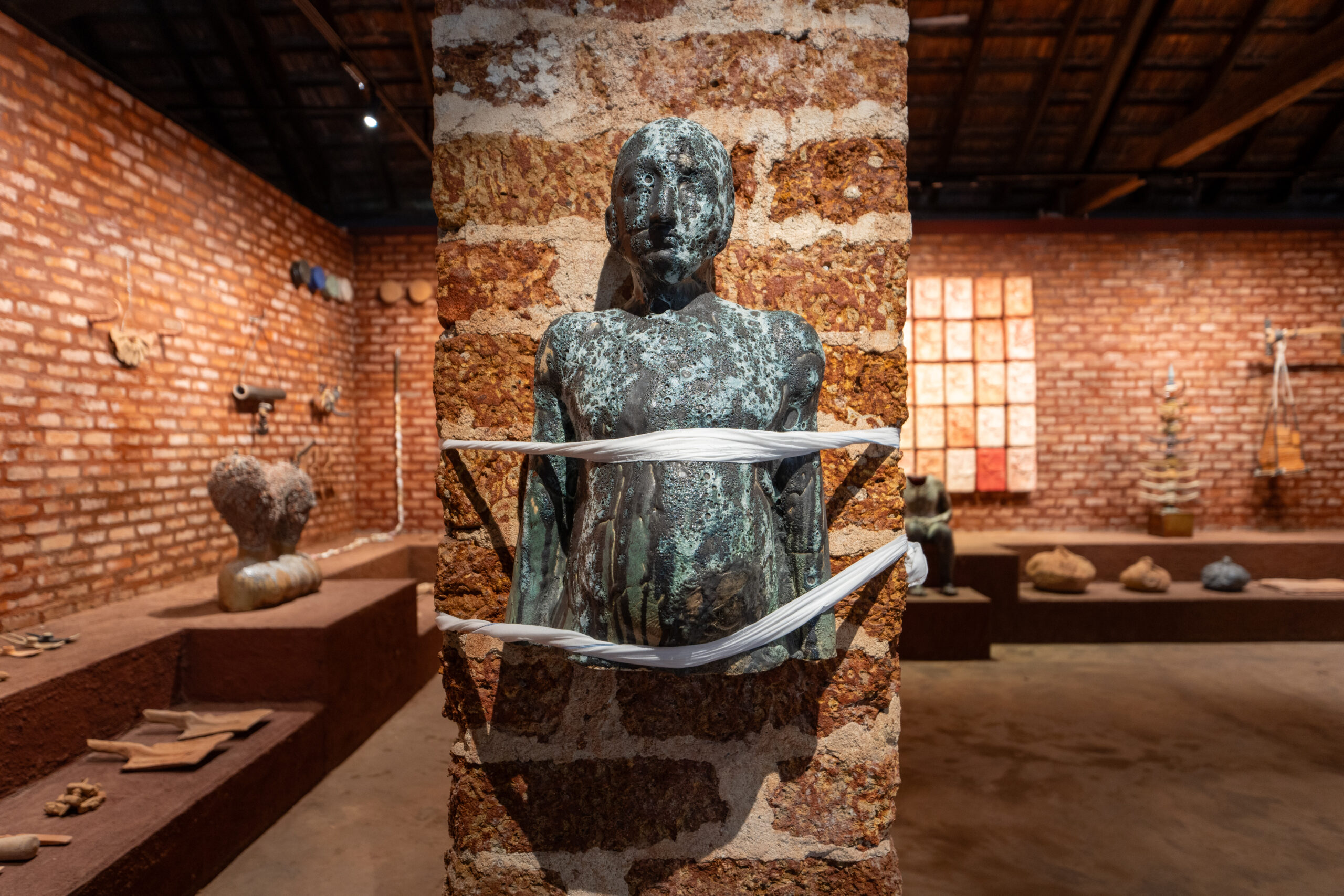
In some of your installations, the worker’s body appears altered — headless, tied to wall or merged with tools. What were you trying to understand about how labour reshapes the worker’s body and identity?
When someone performs intense physical labour for long periods, the body begins to adapt to that work. Movements become repetitive and the body almost merges with the tools it uses. I was thinking about how labour can slowly reshape a person’s relationship with their own body.
The altered figures in my installations are symbolic rather than literal. By showing incomplete or merged bodies, I am trying to reflect how workers are often recognized only through the labour they produce, while their individuality disappears.
Speaking about one such work, in which a half-figure is tied to a wall, Yadav explained that it reflected “the idea of what remains after burning.” In brick kilns, workers spend long hours in extreme heat, and in a way, he said, their bodies too feel “burned or melted” by the process.
Clay and soil recur throughout your work. What does working with earth allow you to express about labour that other materials cannot?
Clay and soil are very important materials for me because they are directly connected to the labour I am speaking about. Brick kiln workers spend their entire day handling wet clay, shaping it and transforming it through fire.
When I work with earth, I feel that I am working with the same material that holds the memory of their labour. Soil absorbs the pressure of hands and the marks of work. Using it allows the work to remain physically and conceptually connected to that reality.
Most people never know who makes the bricks their homes are built from, whether in villages, towns or cities. Was confronting this everyday invisibility part of what you wanted the installation to do?
Yes, that invisibility is something I was thinking about a lot. Bricks are one of the most common materials around us, but we rarely think about the people who make them. Their labour becomes part of our everyday environment, yet their presence is not acknowledged.
Through the installation I wanted to create a moment where viewers become aware of this hidden labour and begin to see ordinary materials differently.
After moving through the installation, almost like entering a kiln environment, what do you hope viewers carry with them when they leave?
I hope viewers leave with a deeper awareness of the labour that exists behind ordinary materials and structures. If they begin to think about the human effort embedded in something as common as a brick, then the work has opened a small space for reflection.
Anything else you would like to add?
For me, the process of making this work has been about spending time, observing and listening. The lives of workers cannot be fully represented in a single artwork. What I try to do is create a space where their labour can be felt indirectly. In many ways, the earth itself becomes a witness to that labour, holding marks and memories that often remain unseen.
Sanskriti Talwar is an independent journalist based in New Delhi. Her work centres on in-depth storytelling about rural India and migration, with a focus on gender, labour, agriculture and social justice.