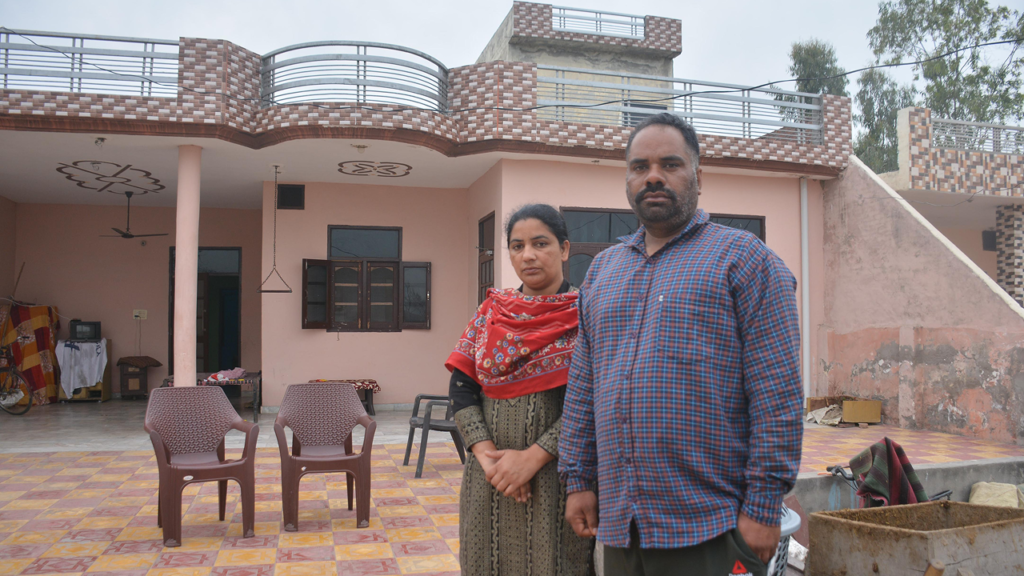
SELAMPUR, Punjab: More than a year after he was chained and bundled onto a plane, Daler Singh fights a battle in court to get his hard-earned money back from an agent who duped him into taking the so-called “donkey” route to the United States.
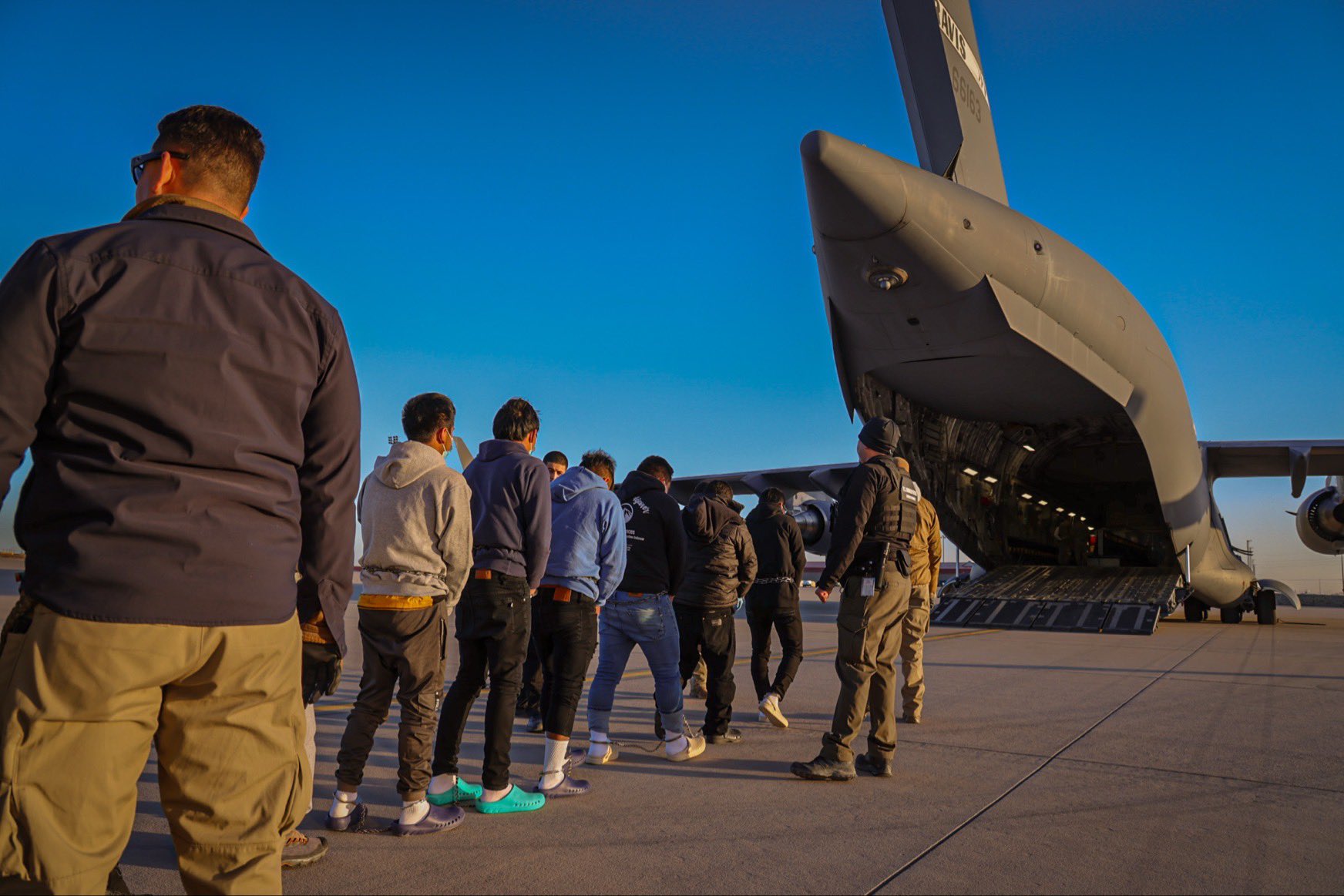
Daler, 42, was one of the 104 Indians deported on a U.S. military plane in February 2025, barely a month after he crossed the southern American border via Mexico in search of better jobs and a chance to send money back to his family.
It took him 50 lakh rupees and almost half a year to complete the “donkey” route, a long, zigzagging journey designed to dodge border controls.
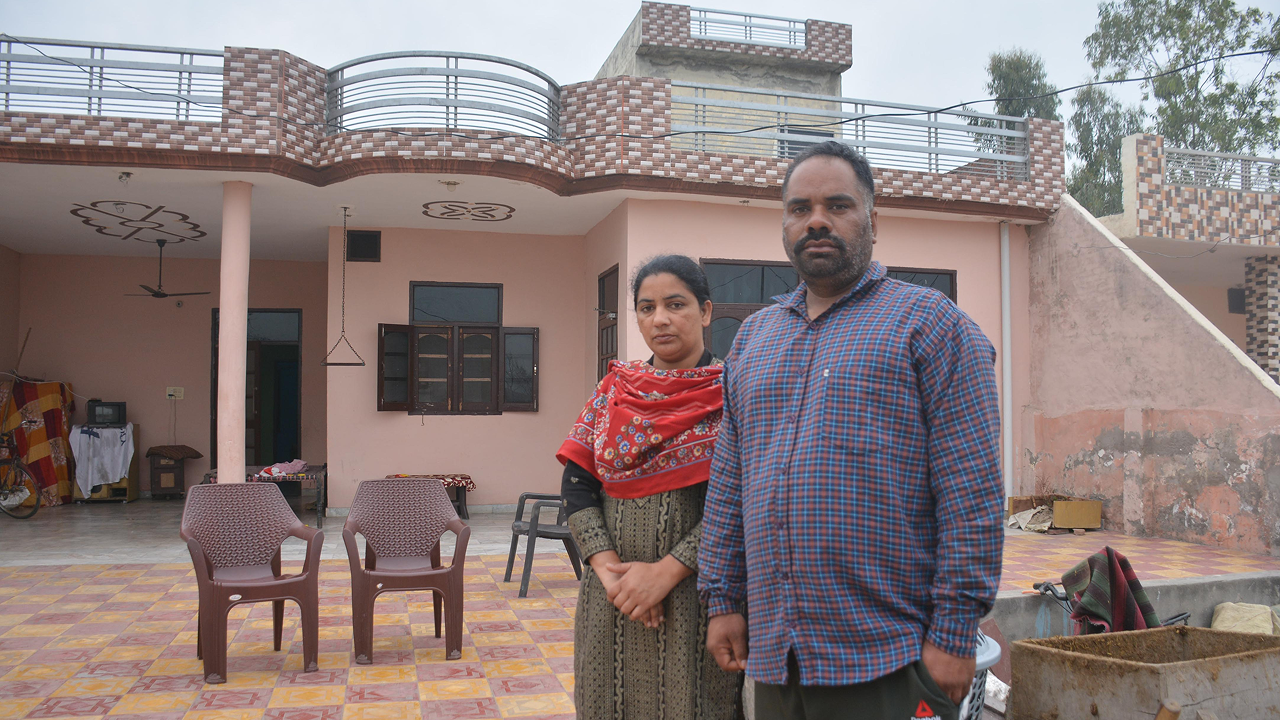
“We talked to (the agent) but when we did not get the money back, we registered a case,” Daler said in his village of Selampura in Punjab state.
“I was promised to be sent to the U.S. legally but was told halfway that I had to take the donkey route. I had no choice,” he said.
While his agent comes to the court hearings, he said it barely provided any assurance. But he remains hopeful of getting back his money, which he had gathered by mortgaging his home, and borrowing from relatives and friends.
The money, he says, would be his ticket out of poverty. He works as a private bus conductor seven days a week, earning a monthly 15,000 rupees. He spends whatever little is left after home and school expenses on the court case, and clearing debts.
“I am under a lot of stress. It is difficult to survive on 15,000 rupees a month with two school-going children,” said Daler, adding that he wanted to go back to the Gulf to work like he did decades ago in Dubai where he was a construction labourer.
Since Donald Trump returned to the White House in 2025, border controls have been tightened as part of sweeping crackdowns on illegal migration, directly affecting thousands of Indians who entered irregularly or overstayed visas.
From January 2025 until March 2026, more than 32,000 Indians were caught or expelled, compared to 96,917 and 90,415 in the fiscal years of 2023 and 2024 respectively, U.S. Customs and Border Protection data shows.
“Most of the agents themselves are advising people not to try for the U.S. because it is a risk for them too. People are mostly being sent to Europe,” said Jagmeet, who had been smuggling people into the U.S. for a decade.
“They are also aware of the strictness of the Trump government,” said Jagmeet, who, along with other agents interviewed by The Migration Story, asked to be identified by a pseudonym.
Another agent, Mandeep, who has been sending migrants through illegal routes for more than a decade, said that most of his peers had been absconding since the much-publicised 2025 deportation.
“People have now shifted their focus to Europe. They prefer to go to countries like Serbia and Greece, countries which they feel are financially sound and where they can get a work visa,” said Mandeep, who earned at least 30 lakh rupees per U.S.-bound client.
Nitin Rawat, who runs immigration services company Golden Visa in Kurukshetra in Haryana state, said his clients now mostly opted for study visas to South Korea and Europe.
“Canada has also been very strict for over two years and similar is the case with Australia,” he said.
Rawat, however, said some agents were still duping aspiring migrants by selling false hopes of a future in the U.S. and taking their money in return. This was confirmed by agent Jagmeet.
“There are some agents who are misguiding people in the name of the U.S., suggesting they can send them (there) but that it would take some time,” said Jagmeet.
An official with the Department of NRI Affairs in Punjab said that the number of complaints against such agents had gone up since last year, but did not share the exact number.
At least 69 FIRs were registered against illegal travel agents in Punjab in 2025, compared to none in 2023 and 38 in 2024, government data shows.
The Ministry of External Affairs (MEA) did not respond to requests for comments.
The ministry said it had identified 3,505 unregistered agents until January.
Mandeep Sachdev, a Jalandhar-based criminal lawyer, cited unemployment and illiteracy as the main drivers of the “donkey” operation, and said that more job opportunities would curb the trend.
India’s unemployment rate has been steadily improving since 2018, including in rural parts. But low-paying, seasonal, and unstable jobs mean many families face income stress and debt, prompting them to migrate to other states or even countries.
Sachdev said it was important to clamp down on illegal immigration operations, which he described as organised crime.
“It is a network. Everyone gets commission, from the local agent to the ones in Delhi and in foreign countries. The ones in Delhi are mostly fake and they close their offices once they have done the fraud, and then they are nowhere to be found,” he said.
Harvinder Bhatti, a retired sociology professor at Punjabi University, echoed Sachdev, calling the migration racket a “mafia”.
He also said that people who were still willing to risk everything to go abroad did so only because there is no promising, liveable land left in the state.
“The mechanisation of agriculture through the green revolution in the 1960s displaced people. They went on for higher education and were absorbed in teaching jobs. During militancy, many of the people were absorbed in the police,” he told The Migration Story.
“But since then, there have hardly been any jobs, or better jobs than the previous generations. People are, therefore, going abroad because of this push factor.”
He added that the high levels of crime and drug abuse in Punjab forced parents to mortgage their land and send their children abroad for safety.
Bhatti urged the government to launch rehabilitation plans for victims of illegal migration operations.
Punjab’s minister for NRI affairs in early 2025, Kuldeep Singh Dhaliwal, had vowed to waive off loans for the deportees, jobs and rehabilitation policy, but Sachdev, the lawyer, said that there had been no headway on those assurances.
India does not run any special welfare or reintegration schemes for those deported from the U.S., but general livelihood programmes and some consular support are available to them.
“It is in India’s collective interest to encourage legal mobility and discourage illegal migration. Government of India’s initiatives to enhance and support livelihood opportunities are available to all Indian citizens including those deported from the US,” the MEA told parliament in March 2025.
In December 2025, the MEA said law enforcement had registered 27 human trafficking and illegal migration cases, leading to 169 arrests. They also arrested four high-profile traffickers in Haryana, Punjab and Himachal Pradesh, in which they found agents accused of charging migrants lakhs of rupees, exposing them to dangerous journeys, forged documents, and exploitation.
While authorities have been cracking down on illegal agents, the efforts have yet to bring relief to people like Daler and Gurpreet Singh.
Gurpreet sold his land and borrowed money to pay his agent 45 lakh rupees to go to the U.S. in August 2024, after a series of failed enterprises, including a truck business.
But the 40-year-old was deported along with Daler. He also filed a complaint against his agent to get his money back, only to finally drop the case.
“I was called by the police every now and then. There are no other earning members in the family and it was difficult for me to leave work and pursue the case,” said Gurpreet, who has started a retail clothing shop near his home in Punjab’s Sultanpur Lodhi with a loan from friends.
“I do not know where the agent is and I have given up hope,” said Gurpreet, who unlike Daler, has no plans to try to go abroad again.
“You can only go if you have money, and I have no money … The future seems uncertain.”
Arshdeep Arshi is a Chandigarh based independent journalist, reporting on gender, human rights, climate issues and crafts of the Punjab region.