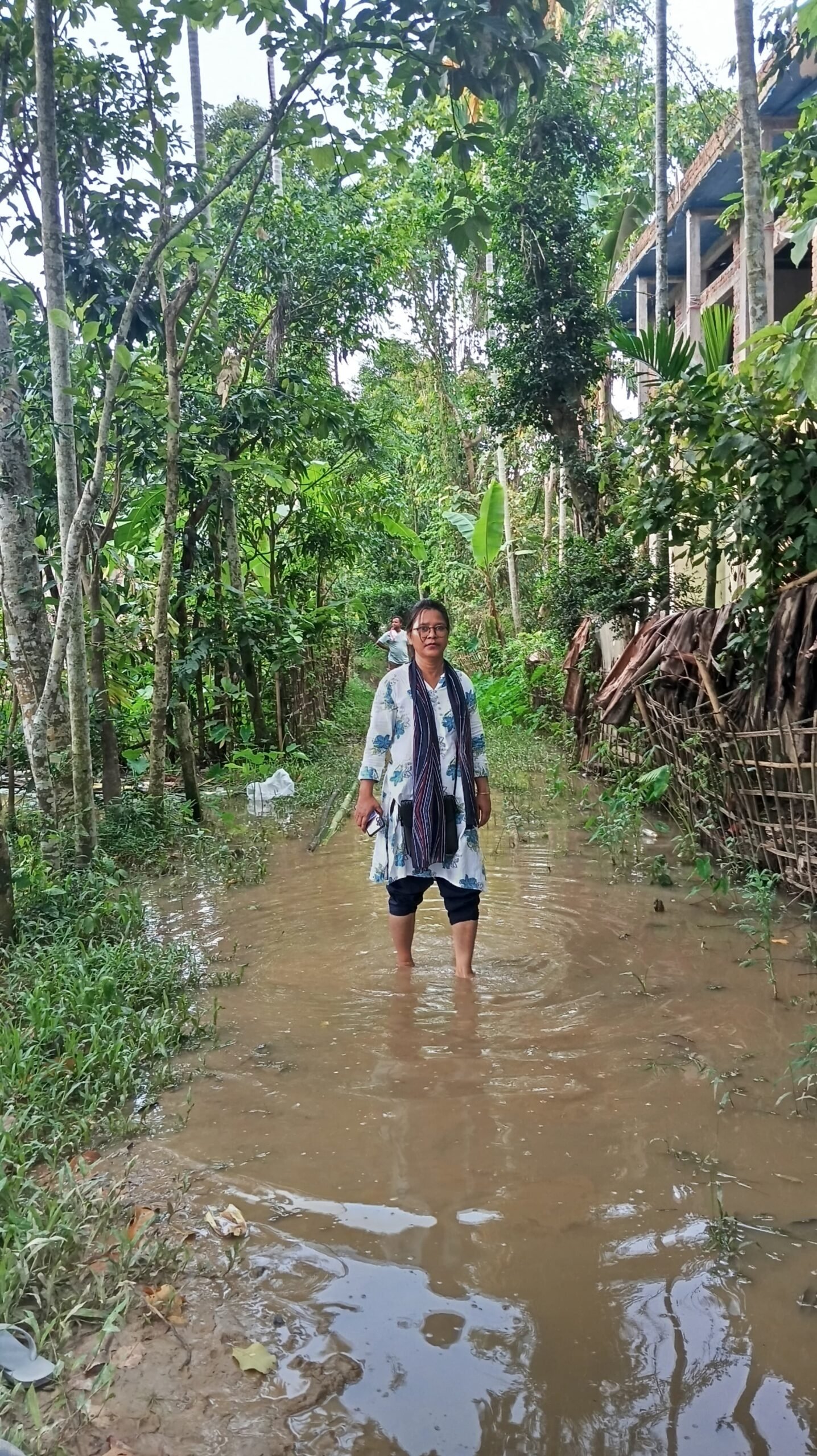
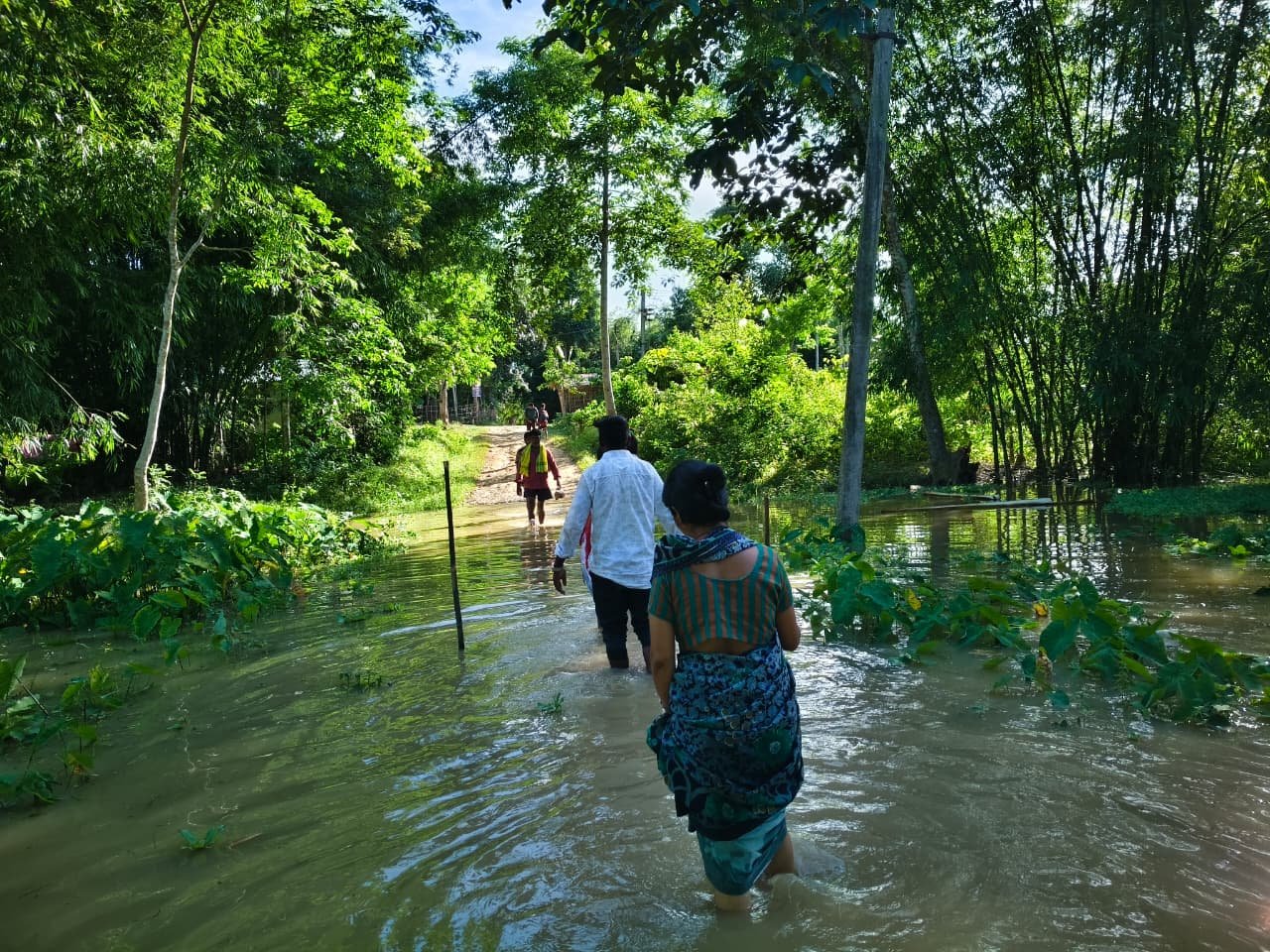
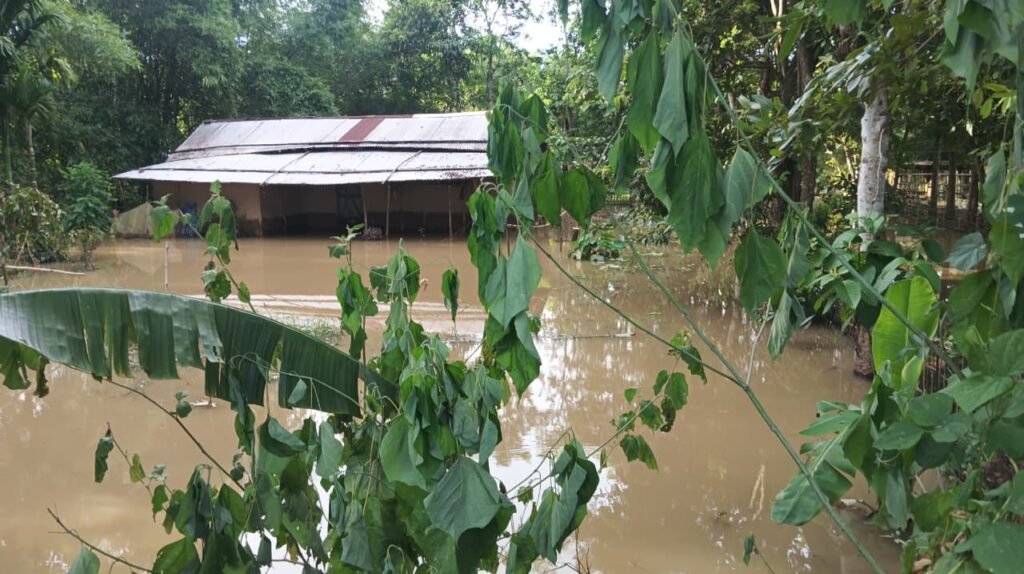
GUWAHATI, Assam: It was a regular morning on July 21. After finishing her household chores and eating breakfast, Gitali Phukon, a resident of Gaurisagar in Assam’s Sivasagar district, left her home to buy groceries. The sun was up after two days of rainfall. The 53-year-old carried an umbrella with her. It is a habit. The unpaved roads had already turned muddy and slippery because of the previous days’ rainfall. But there was no sign of water. She returned home a little past noon, within half an hour, to an unfamiliar sight. “The water came with great force. I could not believe my eyes. I thought it was a nightmare. It was a bhoyongkor (dreadful) sight. The water level quickly rose to waist level,” she said.
As the floodwater rapidly increased and swallowed everything on its way, so did Phukon’s dread. She said that she had never witnessed a flood in her life and had at most seen the water level rise in the paddy fields of villages. Most people in the three severely affected districts of Assam—Sivasagar, Charaideo, and Jorhat—on the southern bank of the Brahmaputra River had similar experiences.
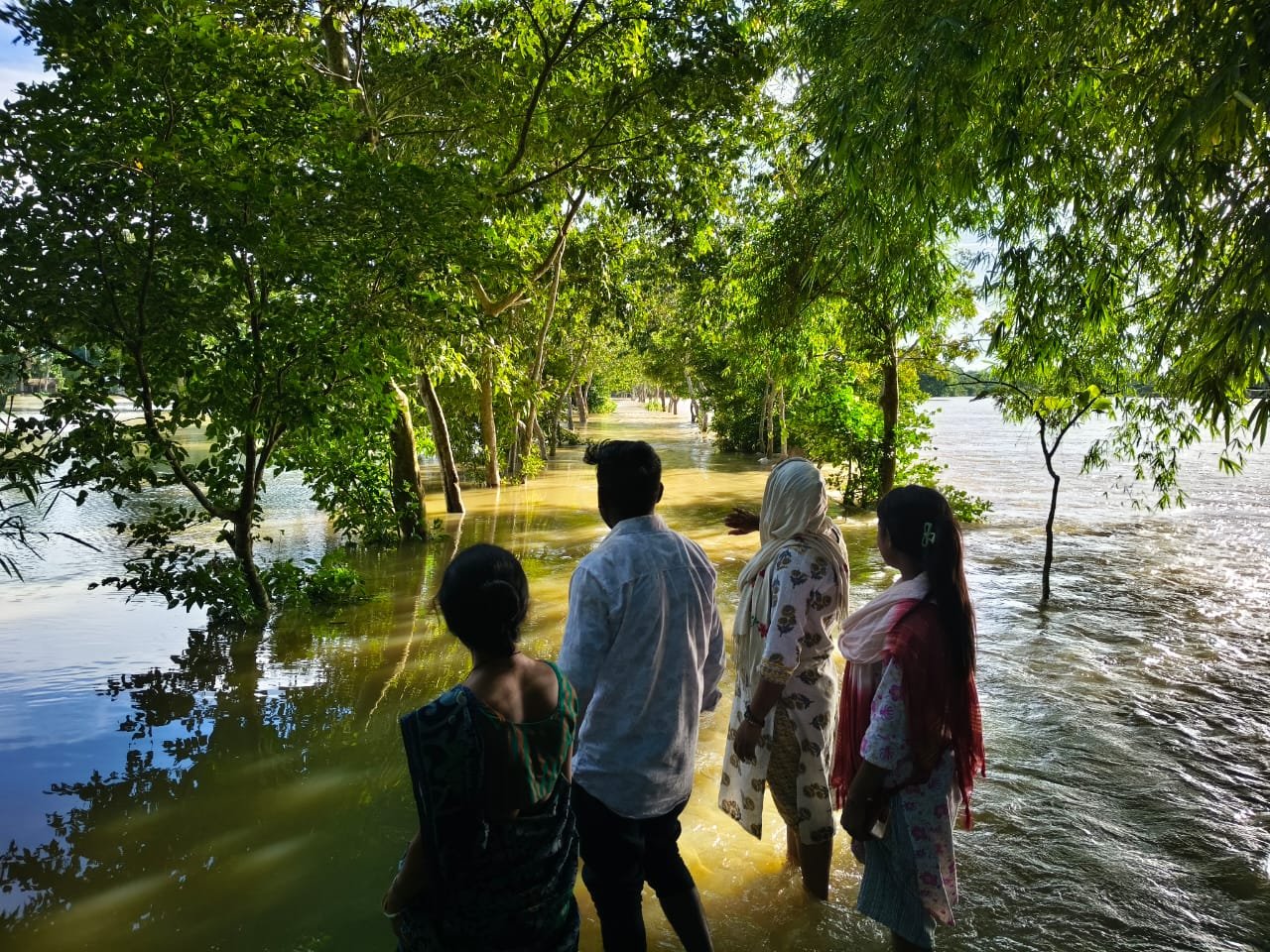
The floods in Assam were triggered by heavy rainfall from 18 July to 20 July. Reports show that within four hours of rainfall from 3 pm to 7 pm on 18 July, various villages in the three severely hit districts were inundated. The severely affected districts of Assam recorded noticeably above-normal rainfall—46% in Jorhat, 47% in Sivasagar, and 147% in Golaghat (adjoining Jorhat) from 16 July to 22.
According to the official figures, floods affected 25 out of 35 districts this year. Around 2,298 villages have been flooded, affecting 11 lakh 45 thousand people. A total of 89 people have lost their lives as of 4 August. The death toll is likely to rise, fear officials.
Dr Rahul Mahanta, director of Guwahati-based Centre for Clouds and Climate Change Research at Cotton University, said that it was prolonged rainfall rather than instantaneous. He said that a combination of intense rainfall in Nagaland, which sent large volumes of water into Eastern Assam, and heavy rains in Assam, which caused the Brahmaputra River to be in high flow, led to prolonged inundation, as it became difficult for tributaries in Sivasagar and Charaideo to drain floodwaters naturally.
The wrath of floods has spared none. The famous Jokaichuk paddy field, a vast stretch of agricultural land shaped like a jokai—a bamboo fishing tool—near Gaurisagar, looked like a mini river. It is the largest paddy field in Sivasagar district, which has around 1,17,000 hectares of agricultural land.
“The floods have ruined 95% of the farmlands across Sivasagar,” said Himadrijyoti Dutta, who works with farmers through his non-profit organisation, Krishak Nyas, in the district. As of 2 August, the floodwaters had not receded from the Jokaichuk paddy field. “The floodwaters have washed away all the hard work and financial investments of the farmers. They have all been left poorer and desperate,” Himadrijyoti told The Migration Story.
Locals estimate that around 50,000 people live in and around Gaurisagar, which is famous for its ancient temples and the Gaurisagar Pukhuri (lake), a 150-acre water body. The Mitong River flows through Gaurisagar and is in spate even several days after the flood hit. Rajib Dutta, a local journalist from Gaurisagar, told The Migration Story that the floods had destroyed all the paddy saplings sown for winter harvest in November. Farming is the main source of livelihood for people in the region.
“People have lost their homes and belongings too. A great sense of despondency has descended across these villages,” Rajib said and added that the floods will force people, especially farmers and farm labourers, to migrate out of Gaurisagar and the adjoining villages in search of work. “Otherwise, how will they survive?” he asked.
FLOODS TO TRIGGER MIGRATION?
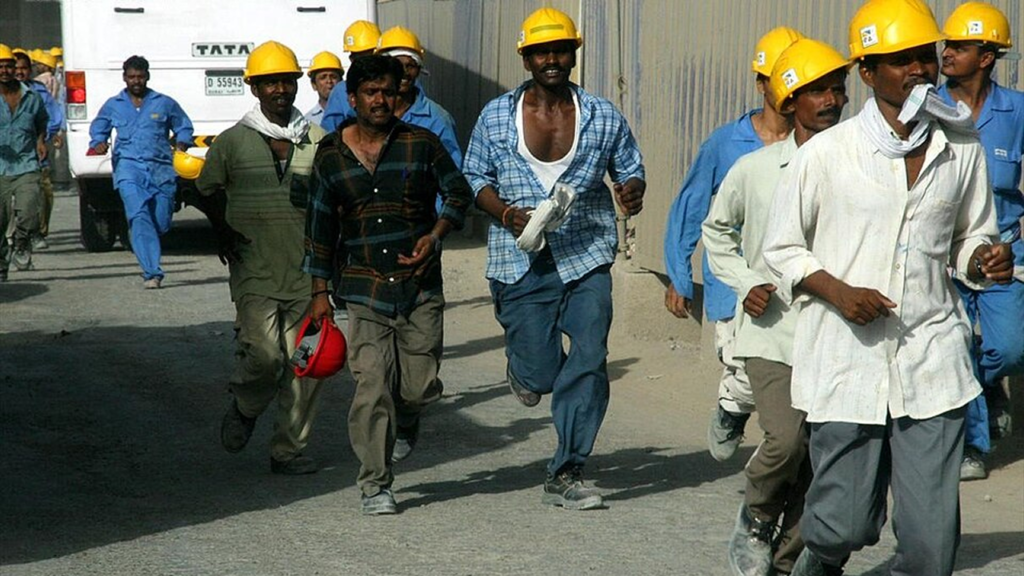
Sivasagar is not alien to out-migration. Himadrijyoti Dutta said that the pace of out-migration from the region had been increasing since 2000. He added that men between 18 and 40 years, who were usually children of farmers, made up the bulk of the out-migration. “At least 80% of them are unskilled and school dropouts,” he said, adding that they work as security guards, construction labourers, staff in hotels and restaurants, carpenters, plumbers, and painters. Many also migrate seasonally, working in cities like Chennai, Kochi, Mumbai, and Bengaluru for around six months, then returning home with around 50,000 rupees or more in savings. “Once they are back home, they either work in their agricultural fields or work as farm labourers. Some again migrate when their financial conditions become dire,” Himadrijyoti said. Not everyone migrates, though, he added, and most families have three or more children, some of whom—typically women and children—stay behind.
Now, amid floods, he is visiting different villages to provide relief materials, and villagers told Himadrijyoti that they miss their children who were working outside. He said that some parents want their sons to return to offer them help and emotional support. Others are consoled by the fact that their child is safe at his destination. “They can send remittances (even if small amounts) back home as they have a job,” he said. The 64-year-old is a retired school teacher who taught economics. His organisation, Krishak Nyas, trains farmers to adopt the scientific method of farming during the sali paddy cultivation (winter rice farming) and seed selection. It also helps farmers access various government schemes. “A lot of silt and mud have come along with the floodwaters. It will be difficult to salvage the farmlands. The farmers are left with nothing. They have to migrate and will work as daily wage earners in nearby towns or faraway places like Kerala, Tamil Nadu and Karnataka,” Himadrijyoti said.
Professor Kalyan Das, from the Department of Geography at Cotton University, Guwahati, said that the latest disaster will trigger out-migration of affected people in the coming days. “Assam is already witnessing a serious crisis of out-migration of people from every block. There are many factors, primarily land degradation because of which farming is no longer sustainable,” he said. The employment-driven out-migration from Assam rose from 16.3% in 1991 to 24.4% by 2011, according to a 2022 study. In rural areas, floods and soil erosion were primarily causes of out-migration, the study said. “The latest floods have destroyed homes and agricultural fields. The villagers will be forced to migrate in search of livelihood opportunities,” Das said. He added that the affected districts had never witnessed such havoc and had been unprepared.
Eight years ago, Mintu Hazarika, 30, came to Bengaluru, Karnataka, from Kosumari village in Sivasagar district. He earns 25,000 rupees a month after working double shifts as a security guard in Bengaluru’s Marathahalli and sends half his earnings home. “My father is a farmer. So is my elder brother. They grow paddy. But it is not financially viable. So they also work as daily wage earners in nearby urban areas to supplement the household income,” he said. On 22 July, Hazarika received a call from his father. He was told that the floods had destroyed their family’s paddy cultivation on five acres. “I don’t know how my family is going to survive. My elder brother is planning to come to Bengaluru to find work. There are already so many men from Sivasagar and other parts of Assam working in Bengaluru,” he said.
Madhurjya Das, 36, runs a two-wheeler showroom in Gaurisagar, close to Phukon’s house. For years, he looked for a government job after his graduation. It was a long wait. Finally, he decided to start his own business. “It was a difficult choice. I could have failed and lost my investment. Thankfully, my business is running fine. I have paid off all my loans,” Madhurjya said. He added that there were hardly any avenues to earn a livelihood in a place like Gaurisagar, with too few government jobs and no private jobs or industries. “Many youths have already started migrating to different corners of the country. More will leave now,” he said.
ANOTHER YEAR, ANOTHER FLOOD
Assam is one of the most flood-prone regions in India. It witnesses at least two to three major flooding events annually. Around 40% of its land is vulnerable to inundation. The northeastern state faces an acute flood problem in the plains of the Brahmaputra and Barak rivers, and other smaller river sub-basins. The extremely dynamic monsoon regime vis-à-vis the unique hydrological and physiographic characteristics of the Brahmaputra River system makes Assam highly susceptible to flooding.
In 2025, Assam experienced three waves of floods that affected 28 of 35 districts and approximately 11.19 lakh people across 3,255 villages. The death toll due to floods and landslides was 36. The year before, all 35 districts of the state were affected by floods, which had killed at least 110 people.
According to Dr Partha Jyoti Das, an environmental scientist specialising in the water-climate-hazard nexus, the current disaster was inevitable. He told The Migration Story that the rainfall was extremely heavy due to climate change, but human activity also played a role. “It’s a much-abused landscape turning into a burial ground,” he said. Dr Das explained that had it been just floodwaters, the damage would have been less, but the rain brought with it debris, mud, silt, and soil from the hills of Nagaland, the foothills of which lie in Assam. “These areas have seen mining and quarrying, both legal and illegal, for several years. From coal, sand or boulder mining, everything happens in these places. The whole landscape has been changed, as one can see large-scale deforestation, encroachment, and excavation,” he said.
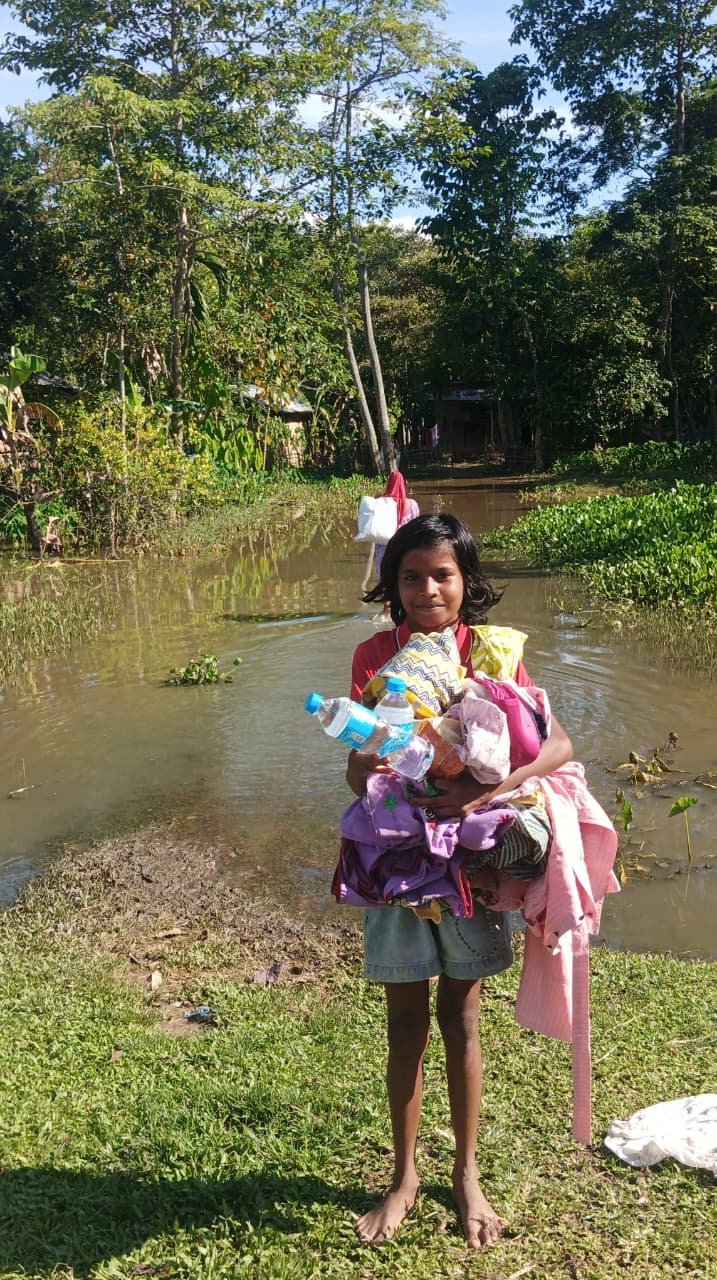
Dibrugarh-based Chow Sureng Rajkonwar has been providing relief materials to flood-affected people in the villages of Sivasagar and Charaideo districts since 22 July. Around 40 people from One Northeast Motorcycle Club, a bikers’ club founded by Rajkonwar, are travelling to affected areas to distribute food, clothing, sanitary items, candles, matchboxes, and other essentials. “It’s a heartbreaking sight,” Rajkonwar said. “Many people have died. The farmers have lost their agricultural fields. Those who reared cows and goats have lost their animals. Most of the rural people have lost their livelihood,” he added.
It is because of good samaritans like Rajkonwar and several others from across Assam that the scale of the natural disaster was brought to light. As they helped people in need, they took videos and photographs of human and economic losses and posted them on social media.
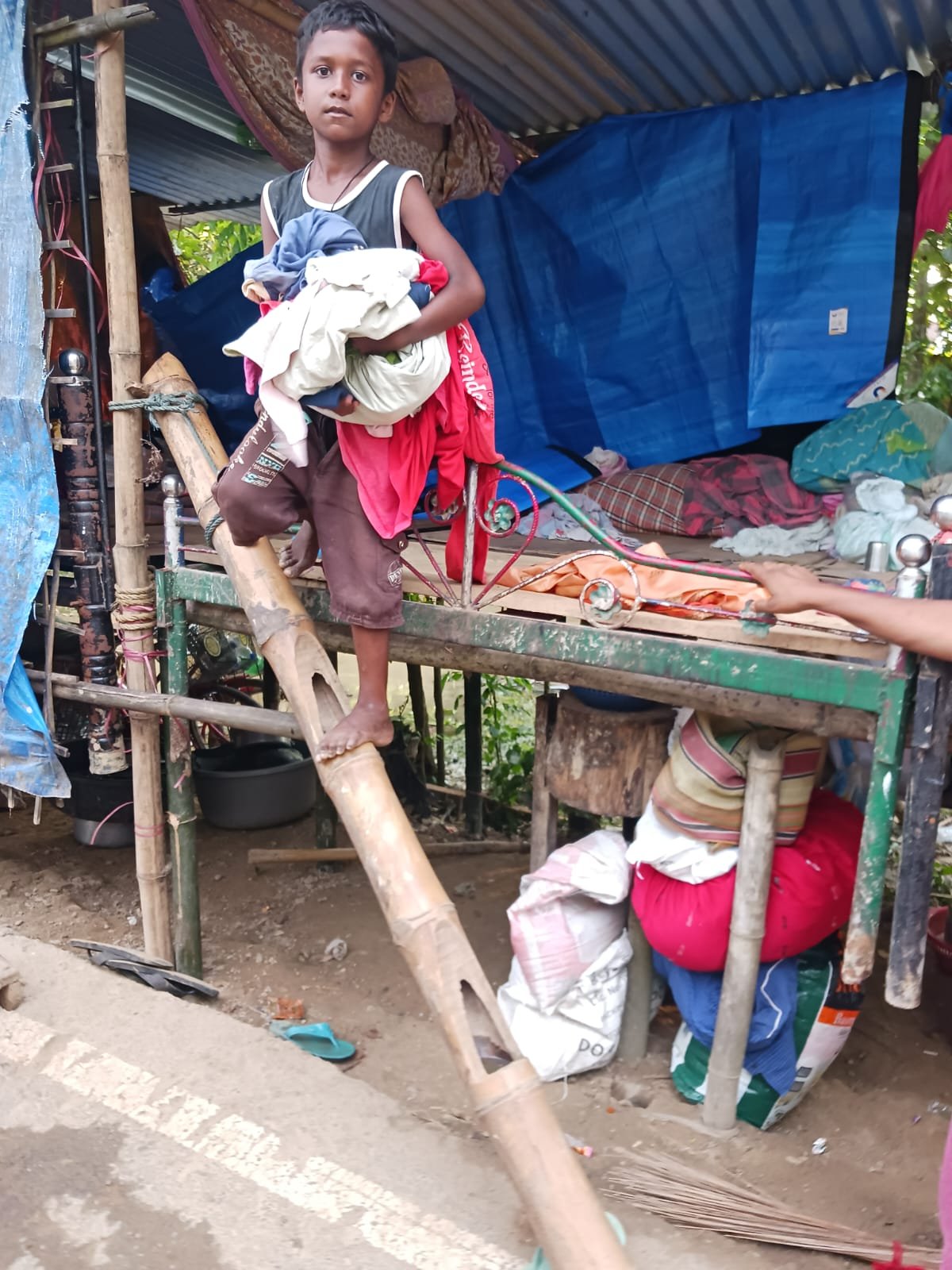
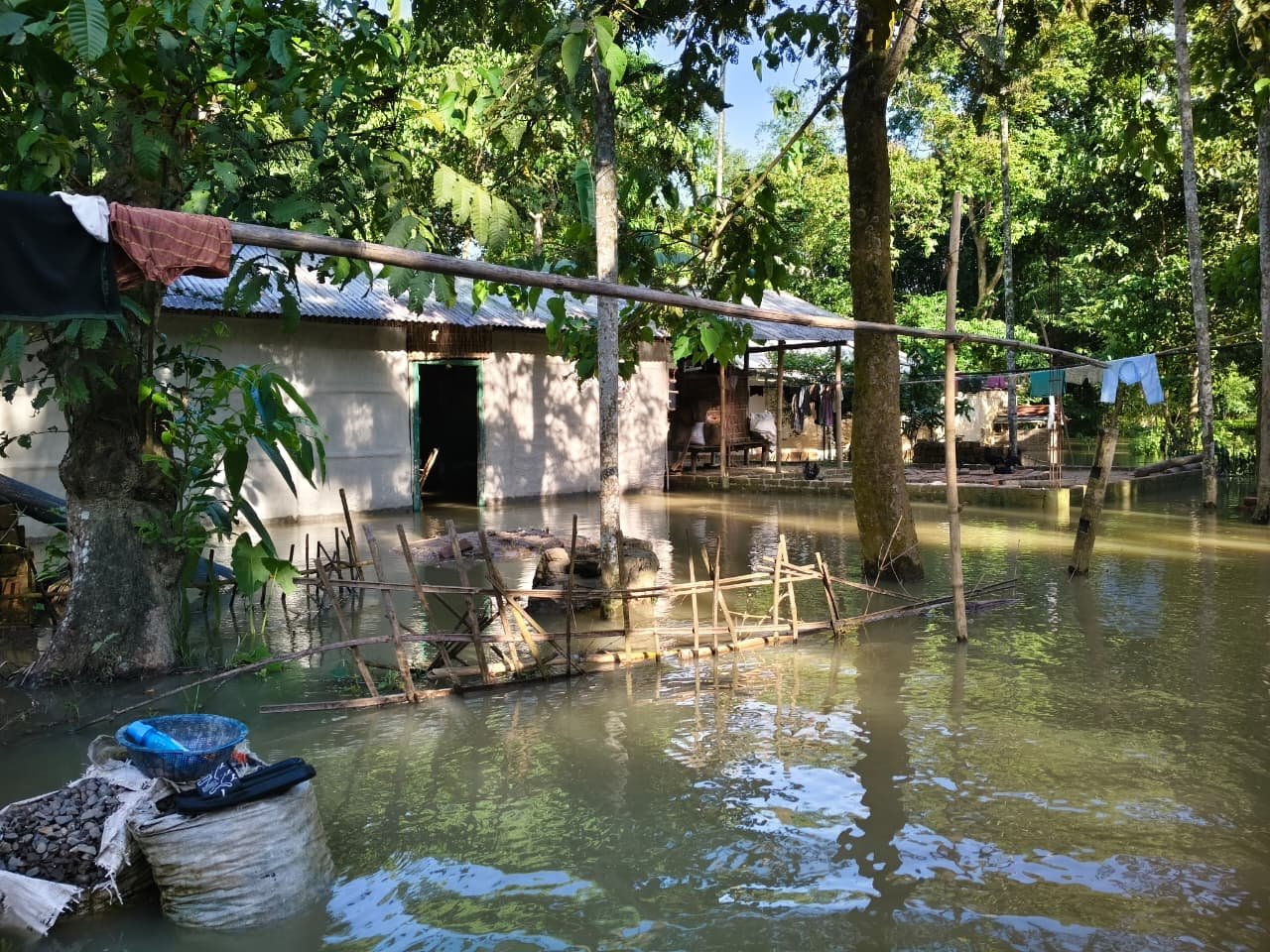
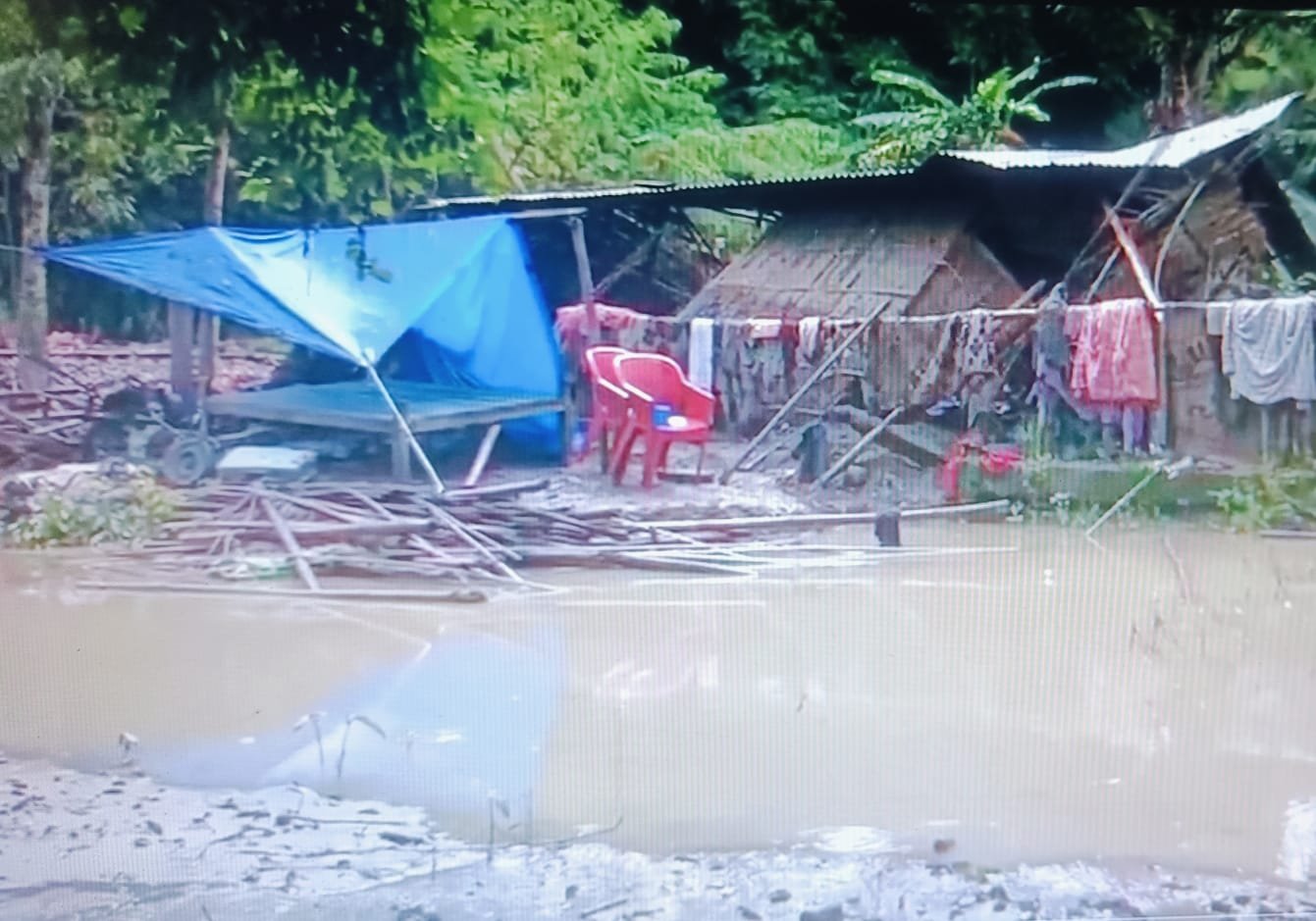
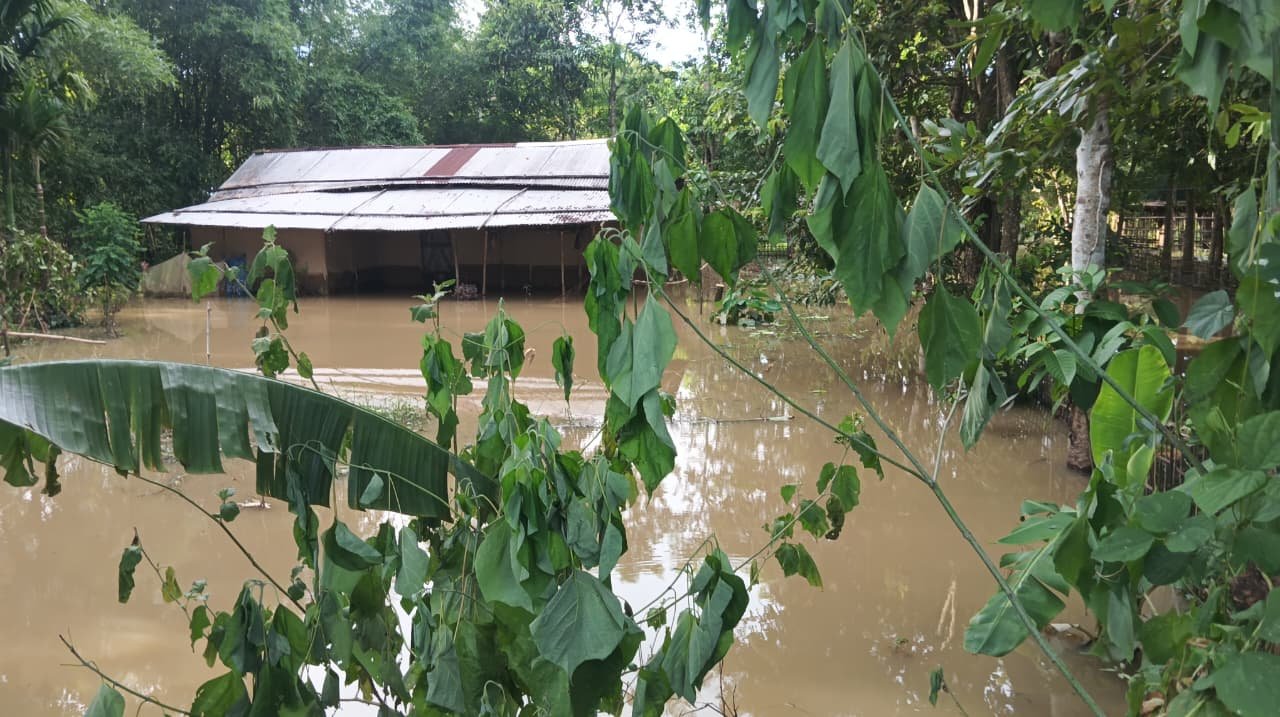
Rajkonwar said he witnessed homelessness and hopelessness all around him as he travelled to rural areas such as Lihiri Pukhuri, Nepalikhuti, Gohain Gaon, Betbari, and Nimaijan in Sivasagar district, and Lakwa and Sumoni Gaon in Charaideo district. “Hundreds of people across villages have become homeless. Their homes were destroyed and flattened to the ground. Those that remain are filled with polokh—alluvial silt or sediment left behind by floodwaters. All their belongings were destroyed or washed away with the water. It will take months to rebuild those houses,” Rajkonwar said, adding that the affected people were staying inside makeshift tents made of plastic sheets and tarpaulin on roads or elevated ground near their villages.
For almost a week now, Phukon has been providing relief materials to flood victims. She said that she had been getting distress calls from family, friends and acquaintances.“I decided to leave my home and reach out to people who need food, clothing, and other essentials. Everyone I know has been affected by floods,” she said as she stood outside her home, which was still under floodwaters.
Phukon’s house is built on elevated land near the National Highway 37. Although the water level was more than five feet high in her courtyard, it did not enter her house, a concrete building. A widow with two daughters, Phukon stays alone. Her elder daughter has shifted to Moran, a town in the neighbouring Dibrugarh district, after her wedding. Her younger daughter is studying in Dibrugarh city, 95 kilometres from her home.
As the evening approached, floodwaters entered most of her neighbours’ homes. The rain resumed, and darkness descended. Standing on her verandah with a burning candlestick in her hand as the electricity supply stopped, Phukon saw a large number of people taking shelter on the highway. Most of her neighbours took shelter on their rooftops to save themselves from the continuous flow of water into their homes.
Phukon waved at children, elderly, and women huddled together on rooftops. They too waved back, signalling they were alive. Phukon said that she spent the whole night at her verandah. She did not sleep a wink, nor did anybody in her neighbourhood. “We feared we would all be drowned in water and die,” she told The Migration Story. Along with mosquito bites, Phukon had to endure a foul smell emanating from the floodwaters, which was heavily mixed with mud and silt.
The following morning (22 July) the situation worsened. “People were thirsty. They were crying for water. But there was no water to drink as the groundwater was contaminated,” she said. Most villages in Assam depend on wells and tubewells for water. She said there was water everywhere around me, but not a drop to drink. “Thankfully, I had some stored water, and I shared that with my neighbours,” said Phukon. For food, people ate biscuits and puffed rice for at least three days until water receded a bit.
When Phukon went to her paternal home in Charing village in Sivasagar, 10 kilometres from Gaurisagar, she found that the whole house had been destroyed. “All the memories I had always associated with my home are gone now,” she lamented.
Despite the agonies and losses incurred, including destruction of houses and agricultural land, Phukon said she and her neighbours were lucky to be alive. “It is worse in other places. Many people have died,” she added.
NEPALIKHUTI: THE FACE OF ASSAM DISASTER
Till 19 July, people of Nepalikhuti, a village in Sivasagar district, lived quite a contented life. The Dikhou River flowed gently through the village. One had to open the window to see the hills surrounding the village. Those were hills of Nagaland, bordering the village.
Nepalikhuti was one of the first villages hit by the recent floods. “Everything changed after floodwaters entered our village on 19 July. It was in the morning hours. The Dikhou river was already overflowing because of rainfall the previous day. But we never thought the water would come with such vengeance. Everything was destroyed on its way,” Rukmini Sharma told The Migration Story. The 32-year-old homemaker broke down as she recounted the harrowing experience she and others in her village have endured. “Many people took shelter on rooftops and trees as the water level kept rising. When water receded, most people ran towards the roads. People are still living on roads and elevated ground. We can’t live in our damaged houses.”
The village with around 3,000 residents lies in ruins today. As far as the eye could see, it’s all thick layers of mud and silt. A drowned car, or a dead cow, or a broken wall of a house bear witness to the calamity today. Today, there is no sign of cows, goats or any other livestock, the primary source of income for the village residents, as many depended on dairy farming.
At least 10 people from the village have died, and many remain missing. Villagers say they have seen several unidentified dead bodies floating on the Dikhou river, which is slowly regaining its former calmer version.
Bitupan Raidongia, the District President of Sivasagar of the Bharatiya Janata Party, told The Migration Story that floods had spared no one. The BJP is the ruling party in Assam. “Our government is doing its best to rescue marooned people. We are also reaching out to affected families by providing them with food items, clothes and other essentials,” he said. Sivasagar Deputy Commissioner Mridul Yadav said that the district administration was making a coordinated effort to address the ongoing flood situation. “Various departments are working together on rescue, relief distribution, and damage assessment. Health camps, essential medicines, drinking water, livestock fodder, and Chief Minister’s Relief Kits are being provided. Several relief camps remain operational to support affected families and restore essential services,” he added.
Maitreyee Boruah is a Guwahati-based independent journalist