BAGALKOT, Karnataka: There was a time when Guledgudda sent handwoven khana to markets in Maharashtra by the truckloads. Today, this fabric, made specifically for saree blouses, is struggling to find takers, said the town’s weavers.
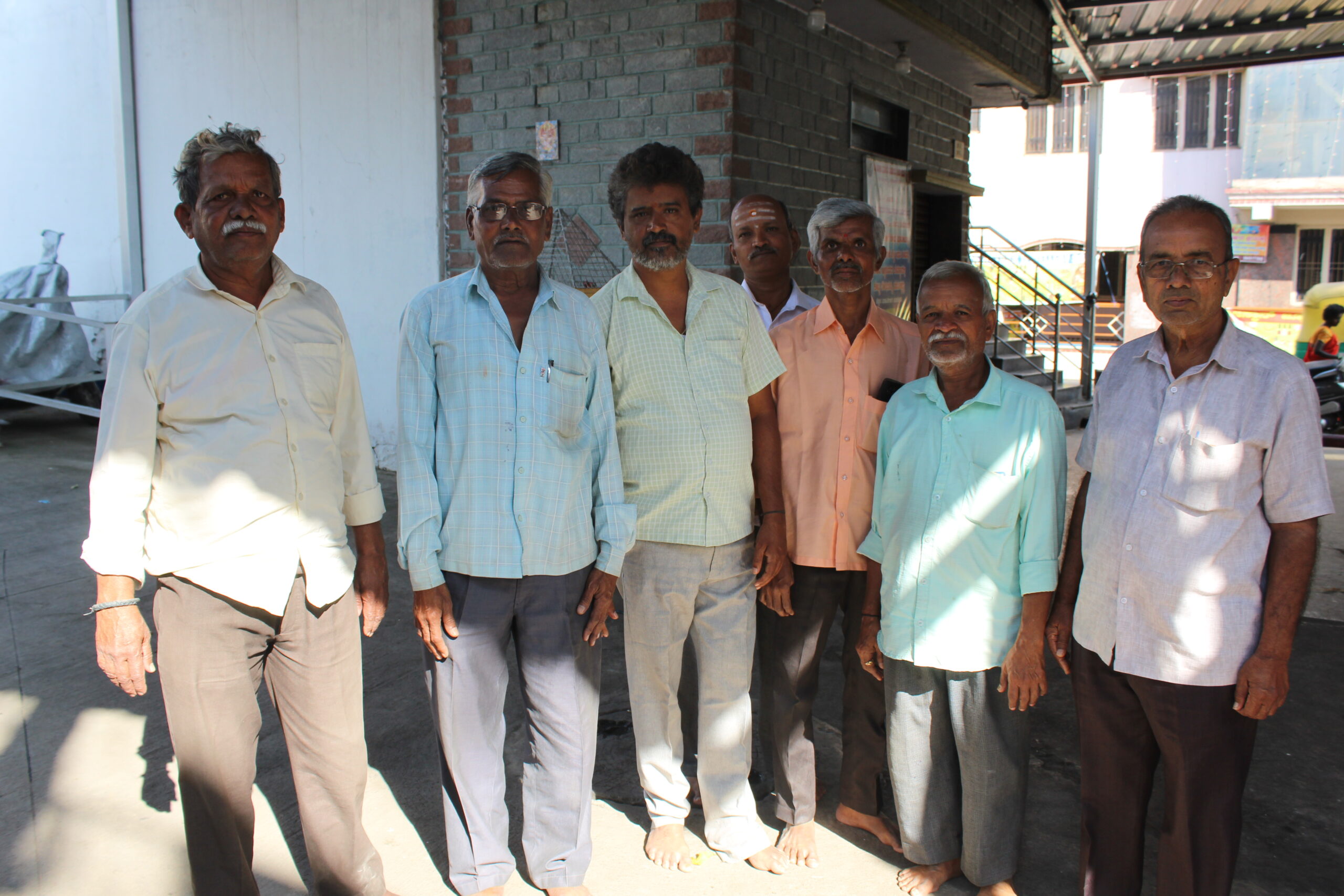
“Thirty years ago, there were more than 15,000 handlooms here,” recalled Eranna Jawali, a 59-year-old khana weaver sitting with fellow weavers in the courtyard of one of the town’s old houses. “The weaving tradition was so strong that even houses were designed around the looms. People would refer to homes as ‘four-loom houses’ or ‘six-loom houses’.” And this tradition dates back over 400 years in this Bagalkot district town.
Others recounted tales of how indigo cakes used to dye threads were brought here from far-away Dindigul in Tamil Nadu and sold on pushcarts.
But from 15,000 handlooms 30 years ago, the number has fallen to 40 or 50 today, according to Ramesh Ayodi, who started Khana Weaves, an initiative to help revive the art form. He told The Migration Story that khana has been edged out of the market by synthetic, power loom alternatives – an oft-told story about India’s handlooms sector.
Power looms came up in the town in the early 2000s and over time, khana’s production and sales fell. It just couldn’t compete with the low prices of the power loom fabric. So, fewer customers wanted to buy the more expensive traditional khana, which, of course, impacted weavers’ incomes. Soon, Guledgudda’s youth lost interest in their ancestral occupation, and many ended up migrating to the big cities for work.
DECLINING INCOMES BRING STIGMA
Older weavers told The Migration Story that migration to the big cities in search of better-paying work has been taking place for several decades.
Jawali said that, in the 1960s and ’70s, the wealthy sahukars (loom owners), who employed weavers, had a monopoly over raw materials and retained a larger share of the profits. This affected how much weavers could take home as income – and proved to be the first major setback for working-class weavers. “The 1972 drought also triggered large-scale migration from the town to bigger cities,” he added.
The situation only got worse in the early 2000s with power looms coming up in the town. “On a power loom, close to 30-40 metres of khana made with polyester threads can be woven in a day, compared to just three or four metres on a traditional loom,” said 65-year-old Honappa Khadivalad, another weaver in the group. “As a result, the market for the handwoven variety declined sharply.”
This economic setback had other consequences too. Jawali said that families of khana weavers started being stigmatised because of their declining incomes. “Our sons found it difficult to get married, and many hesitated to marry their daughters into our families. We were grouped with other struggling artisan communities, like potters, goldsmiths and basket weavers,” he added, as the weavers around him nodded in agreement.
MANY HANDS, MANY SKILLS, MANY PROCESSES
But even today, one can hear the distant clacking of traditional pit looms in the streets of this quaint town. Khana blouses, traditionally paired with ilkal sarees, are popular across North Karnataka and in the regions of Marathwada and Vidarbha in neighbouring Maharashtra. In fact, older weavers said that khana’s biggest markets are across the state border.
This intricate weaving tradition has sustained many families for decades – some say ever since the 8th century CE – and over time, it became central to the town’s identity.
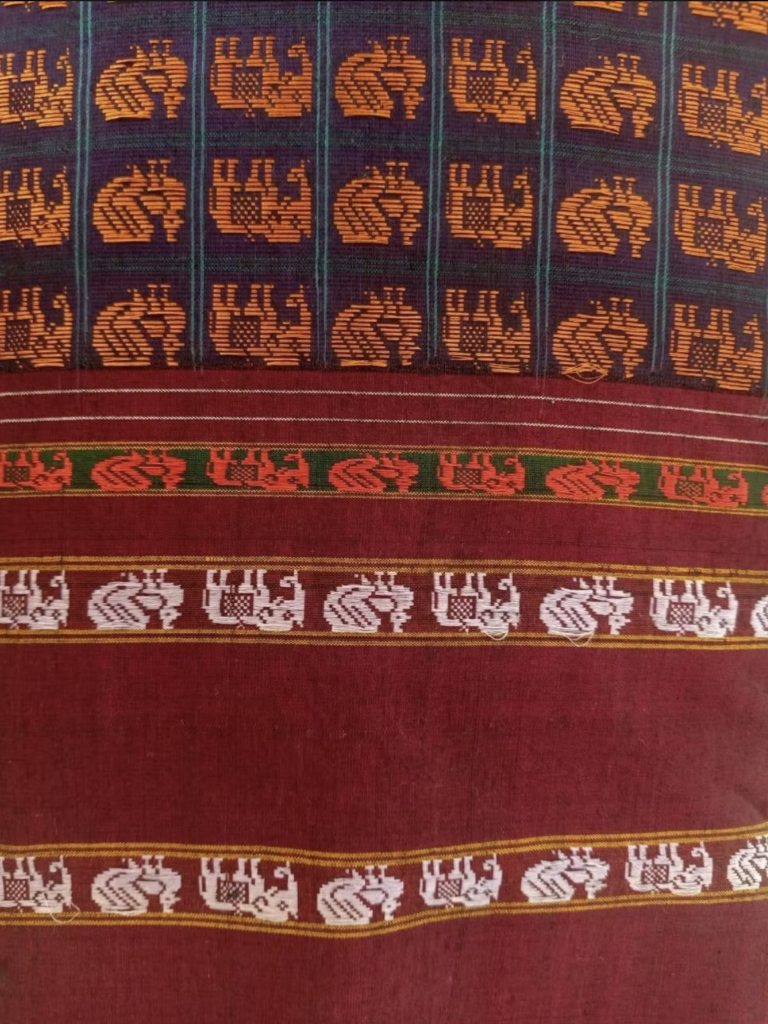
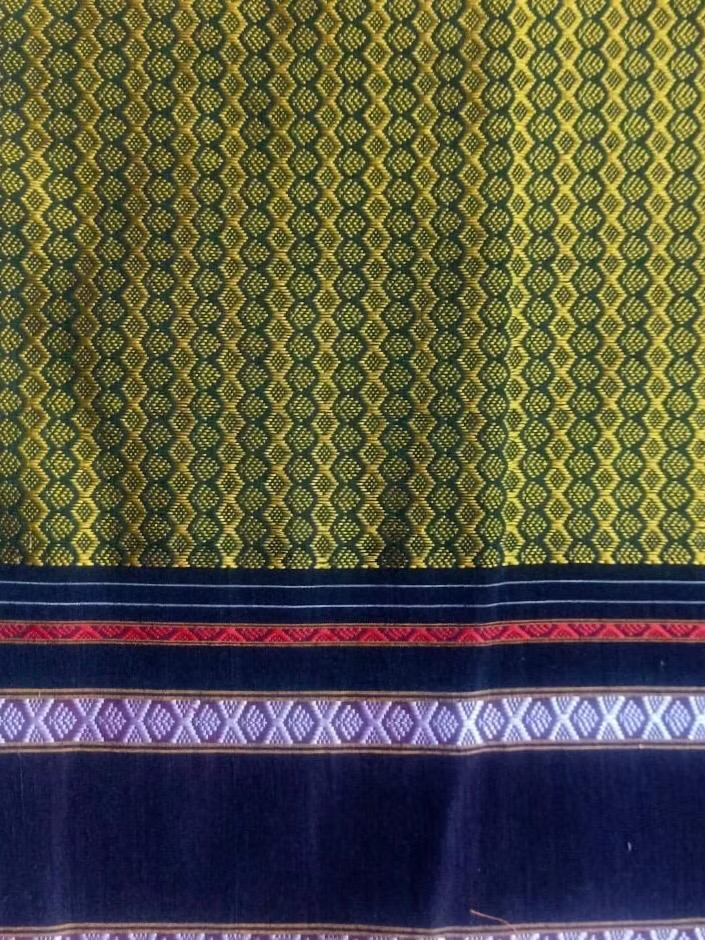
Khana comes in many patterns, including geometric ones (right), and features natural motifs too (left).
Picture courtesy: Khana Weaves
Guledgudda is believed to be the country’s only traditional weaving cluster making just blouse fabric. Its name consists of two Kannada words: gulle meaning migration and gudda meaning hillock. Situated near a hill, it grew into a town when migrants, mostly weavers, from other parts settled here. As time went on, the tradition of khana weaving was born.
“You do not realise how elaborate this craft is until you see it,” said 77-year-old Aadapa Alluli, who has been weaving since he was 12.
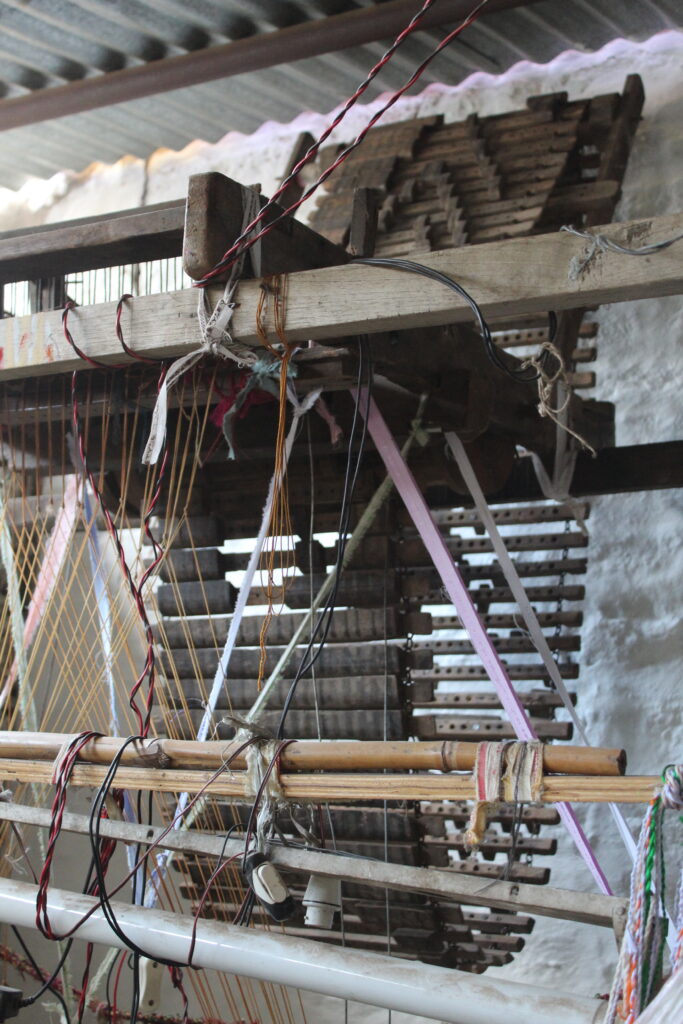
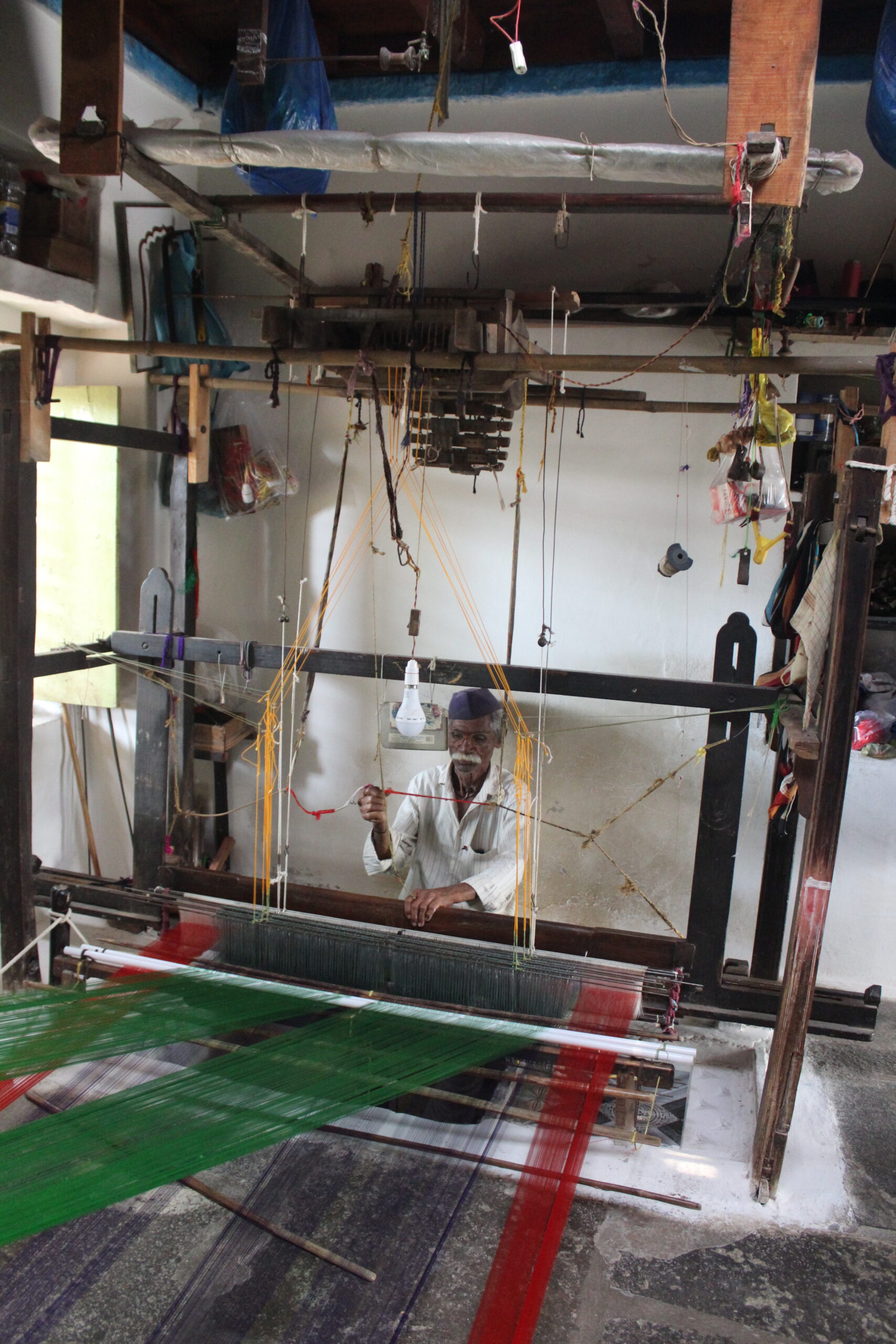
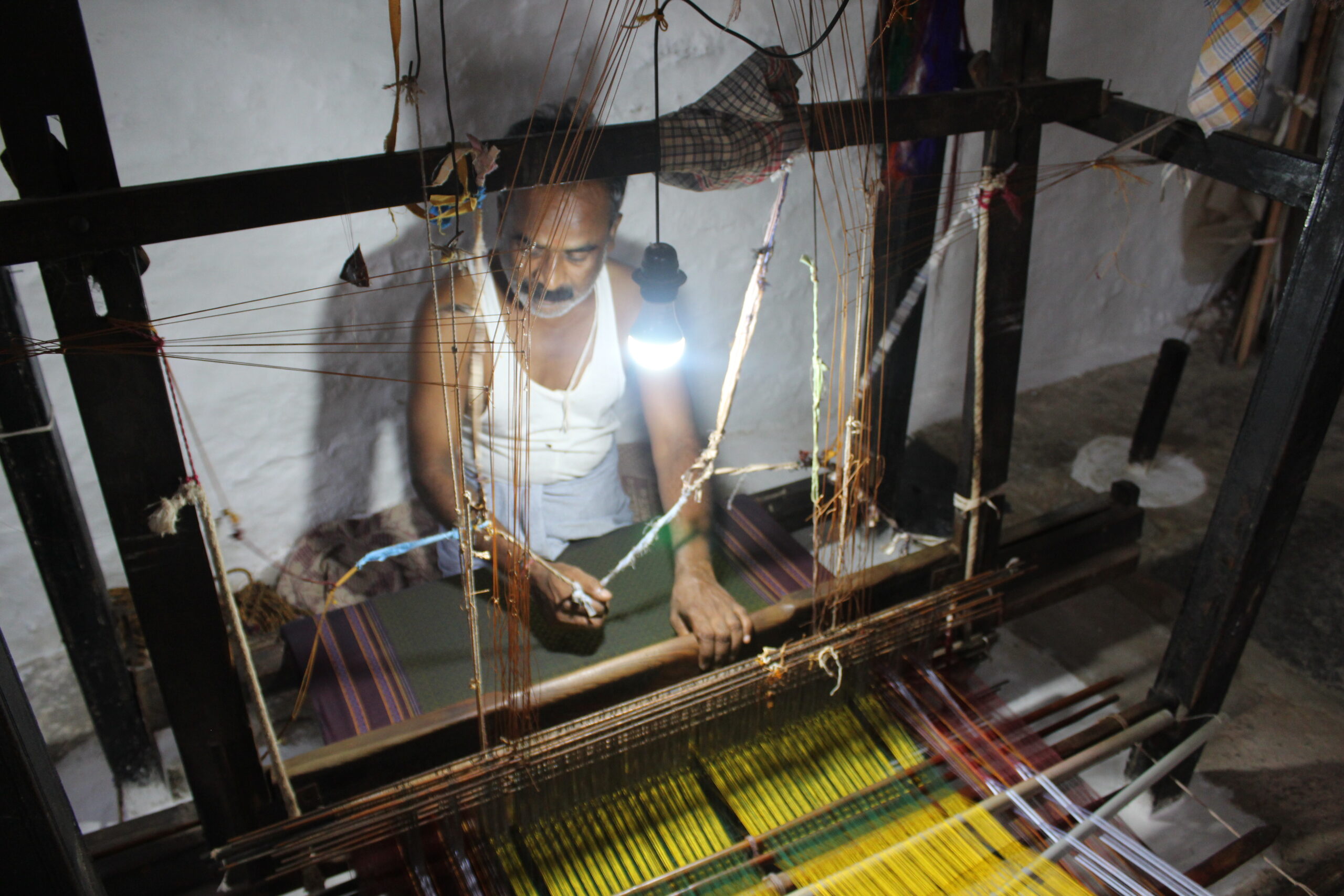
It involves close to nine steps, including dyeing silk threads for the borders, washing them, gathering threads of different colours, winding them on spools, weaving the fabric, and cutting it into blouse pieces. There is also denting and drafting of the warp yarn on the dobby, a mechanism attached to the loom that helps weavers make small, geometric designs.
Weavers often use degummed soft silk yarn for the warp and pure cotton yarn for the weft, usually in contrasting colours so that the silk motifs can stand out against the background. The brocade patterns often resemble a honeycomb and feature distinct motifs inspired by nature, mythology and everyday life, such as sooji malige (jasmine), anne mathu navilu (elephants and peacocks), mukuta mattu kalavara (masks and clover leaves), sanna kedige balli (a small pandanas creeper and so on.
Geeta S. Patil, 44, a textile designer from Kalaburagi in North Karnataka, grew up seeing women in her family wear khana blouses with colourful ilkal sarees. In 2019, she founded Kubsa, a clothing enterprise that fuses the khana weaving traditions with modern design to “infuse new life” into the textile and tap into its “untapped potential”, as she put it.
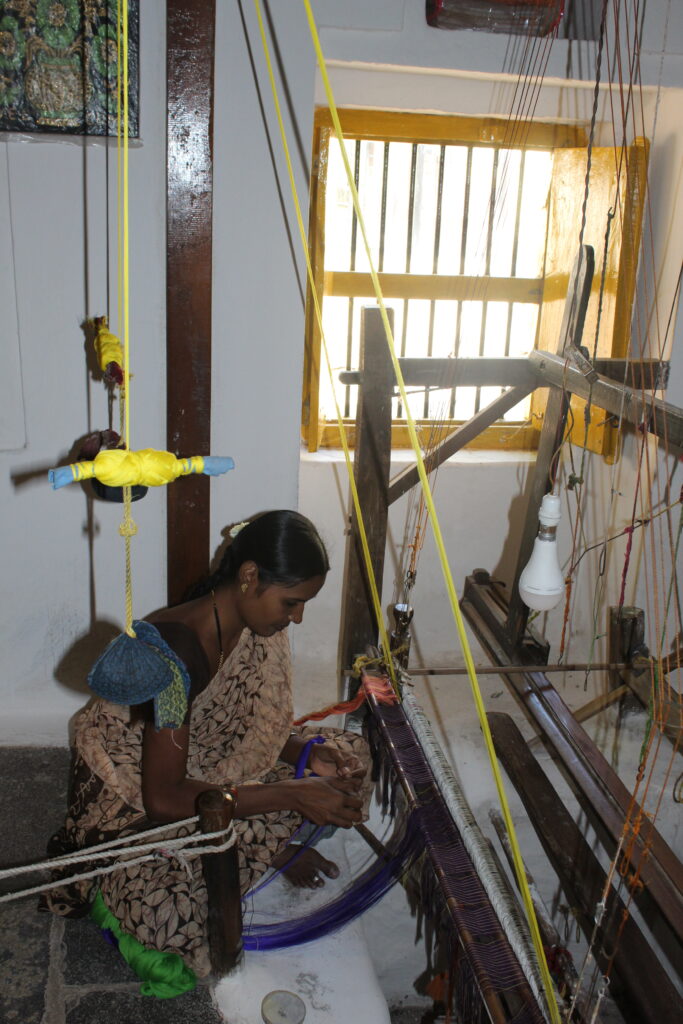
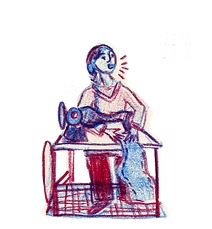
“Khana weaving requires many hands, many skills and many processes. It literally takes a village and more,” said Patil, adding that the actual weaving is done by men and the ancillary, pre-loom activities by women. “The process is slow and meticulous – from [readying] the yarn to dyeing, winding to warping, sizing and setting up of the loom and the design, and of course the weaving itself.”
Despite the labour-intensive process and the skill it demands, Khanna has struggled to retain its foothold in the market.
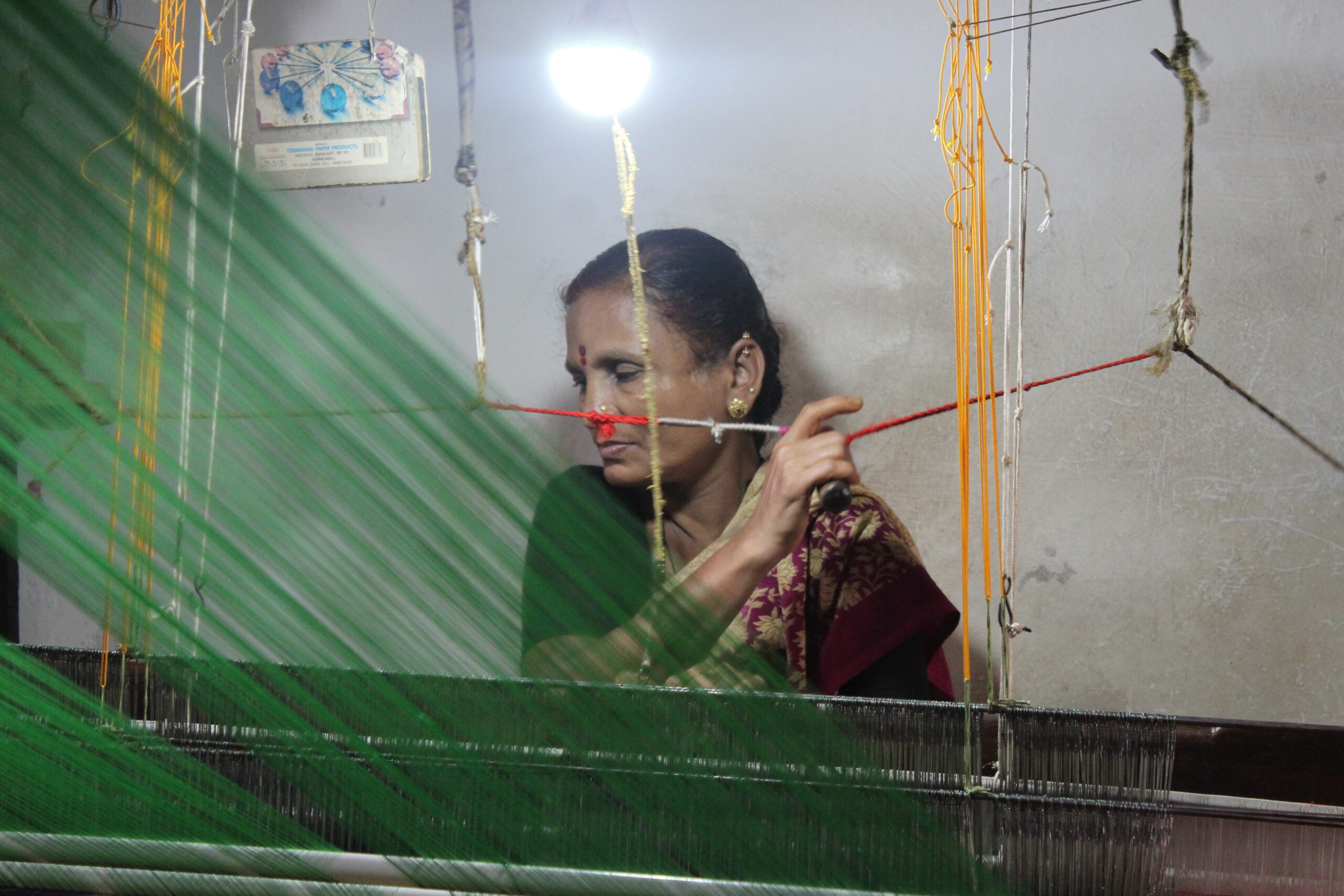
Weaving khana is labour-intensive and complicated – a woman gathers differently coloured threads (left) and a dobby mechanism (right) is used to make patterns. Amoolya Rajappa/The Migration Story
In a conversation with retired weavers from Guledgudda in Bengaluru, at the Amba Maheshwari temple in Kamakshipalya, this reporter heard stories of why migration felt like the only option. All of the weavers now do different jobs in the city’s textile industry.
Among them was Thotappa Kalur, 53, who lives with his wife, Gowramma, and sons, Sharavan and Natraj, both in their twenties, in a small, three-room space nearby. The couple followed their sons to the city a year ago, after the former found work here.
“They were never really interested in learning how to weave khanna, and I was not eager to teach them. I know it does not pay well even after putting in all the hard work,” said Kalur, who was a weaver for over 40 years.
Gowramma, a skilled khana weaver whom The Migration Story spoke at her home, said, “Initially, I was hesitant, but I have little choice as the wages are higher for my sons here.” The parents, however, haven’t been able to find work in the city.
Other weavers, like 59-year-old Ganesha R. Putta, recalled their own stories of migrating to Bengaluru. Putta spoke of running away at the age of 13, with only the seven rupees he had stolen. “I knew nothing, but I had confidence because many people had migrated to Bengaluru before me,” he said. His first job in the textile industry in Sudhama Nagar paid him an hourly wage of one and a half rupees.
“After five years, my father came to find me and dragged me back home out of fear, but eventually, I returned, and after a few years, my brother also moved to the city for a garment factory job in Yelahanka.”
Putta spoke of the harsh conditions that workers had to endure in the city’s then mushrooming garment industry, where regulations were strict and employers unforgiving. “Our bosses would beat us, douse us with water if we fell asleep at work, and withhold wages for days because of the smallest mistakes,” he said. “But despite the challenges, there were wages and hence sustenance. There was nothing to do back home,” he added.
Many weavers who left Guledgudda now work in silk extraction, factories producing shirts, trousers and sarees, or in garment shops as helpers. They earn a salary of around 12-15 thousand rupees a month.
Seventy-one-year-old Basavaraj Yeraga said that migration to Bengaluru rose by at least 50% in the noughties. “Today the use of traditional khana is only 10% as compared to 100% in the old days. It is less profitable and there is no matching the cheap prices of the polyester khana, which is more durable,” he told The Migration Story.
In fact, a weaver earns around 100 rupees per metre of khana made with cotton and silk threads on a traditional pit loom, while the same metre of khana made with synthetic threads on a power loom costs only seven rupees.
In the market, however, handwoven khana sells for nearly 500 rupees a metre, while the power loom version is priced at around 60 rupees. The weavers also said that the costs of natural yarn were high but the returns from the sale of khana low and that customers these days preferred the cheaper, power loom khana. All of this, they added, had made surviving on handmade khana extremely difficult and migration for work, a natural choice.
Additionally, the COVID-19 pandemic began right before the 2020 wedding season, dealing a harsh blow to Guledgudda’s weavers. “They had almost decided to burn their looms in the Holi fire that year,” said Ayodi, who first came to the town as part of a cooperative movement to revive handlooms. Originally from Vijayanagara district, Ayodi, who also has a diploma in textile design, set up Khana Weaves in 2021 and leveraged social media to market unsold khana fabric and mobilise financial help for weavers.
Even though the Guledgudda’s khana received a Geographical Indication (GI) tag from the government in 2016, that did little for weavers’ livelihoods. Under Indian law, a GI tag is a kind of intellectual property right for goods originating from a particular place.
Ayodi also said that most weavers are not aware of GI’s advantages. Even if they were to pursue legal action against fake, power loom khana (which they can with the help of a GI tag), they cannot meet the market demand for it themselves.
He added that there have been no systematic efforts or policies by the state to support weavers. “The government provides loan benefits and subsidised electricity to people who want to start power looms,” he explained, adding that they have led to the overproduction of khana, which in turn has sunk market prices and hindered innovation.
Patil argued that government policies for the handloom and craft sectors have failed to recognise them as complete ecosystems involving multiple actors. This narrow-tunnel approach, she said, limited meaningful change on the ground.
“It is not just the looms and not just the weaver. Every artisan involved needs support, and each in a different way. For example, a dyer might need training in proper dyeing techniques and better infrastructure to support his craft, while a weaver might need easier access to the right kind of cotton or silk,” she explained.
But this handlooms ecosystem support is yet to come. Instead, almost two generations of weavers have had to step away from their ancestral occupation.
WEAVING A NEW LIFE FOR KHANA
Take the case of 63-year-old Virupakshappa Mantheda, who was a weaver in Guledgudda for over four decades before moving to Bengaluru seven years ago. He now works at a saree shop in Kamakshipalya. “The situation is bad back home because the only ones who are still weaving khana are those who own a handful of looms. Roughly 40 thousand people from Guledgudda are in Bengaluru. The rest migrate for construction jobs and other employment to cities like Bagalkot, Udupi, Mangalore and so on,” he said.
Mantheda’s predictions for the khana’s future are not encouraging. “The town already looks like a ghost town, with few women there to light lamps in the evening. In ten years, we might have no weavers with traditional knowledge of khanna left at all.”
Even though people from Guledgudda returned home during the pandemic, many migrated again after the second and third lockdowns in the state, Ayodi said. Incomes from weaving in the village just couldn’t match those earned in the city.
Still, Ayodi has been trying to introduce innovations in traditional khana weaving and use it to make modern clothes and accessories, including shawls, dupattas, notebooks, pen pouches and so on. “The effort is to bring back people who have given up on khana and get youngsters in the town interested and involved,” he said, hopeful that this centuries-old craft will not fade away and be forgotten.
However, some challenges remain unsolved, including the transfer of knowledge related to certain steps in the weaving process. “For instance, it is almost impossible for anyone to learn how to make or even repair the wooden dobby used to create khana’s intricate patterns,” he said.
“Unlike saree fabrics of which Karnataka has many varieties, khana stands alone. We have to restore it to its former glory – the textile’s originality is now at stake,” he added.
Like Ayodi, Patil has tried to revitalise the khana ecosystem. Under her Kubsa label, she worked with weavers to expand their loom’s weaving width, from the traditional 32 inches for blouse fabric to 48 inches for sarees. “This is important because the traditional market for khana has dwindled and affected many livelihoods. A modern take opens up a whole new market and hopefully ensures the continuity of this weaving tradition,” she told The Migration Story.
But Patil knows that her work is far from complete. “We have [tried to] revive the textile, but it is not enough if there is nobody to practise the weaving,” she noted. What is needed, she argued, is the revival of “the entire ecosystem that nourishes the looms, the weavers and every hand involved.”
There are too few hands in Guledgudda to make khana now, but some still work at their looms, often alone. Savitri Bai’s well educated sons used to help her weave khana, but they moved to Bengaluru a decade ago and took up tech jobs in the IT sector. City life didn’t suit her, she said, so she stayed on in the village with her husband, Narandappa Dhadi. They work on a single loom in their home now; earlier, they used to operate ten.
“When I was younger, there were only traditional looms here; today there are barely any. Given the effort it takes, the per day wages [approximately 300 rupees] are discouraging. So, we cannot blame anyone who migrates in search of better livelihoods,” she said, sitting at her pit loom, looking down at the bright silk threads.
Amoolya Rajappa is an Assistant Professor at the Department of Media Studies at Christ University, Bengaluru. She is also an independent journalist who reports on labour, internal migration, climate change, and displacement in India.
This is the second story in a two-part series on the decline of weaving and its impact on communities engaged in the practice. You can read the first story here