NEW DELHI: On a Thursday morning in May, as the sun slowly rises over the mountains of garbage at New Delhi’s Ghazipur landfill, trade begins in one of the largest fish markets in North India. Nestled beneath the shadow of the landfill, the Ghazipur fish market attracts customers and workers from all over the national capital and neighbouring states.
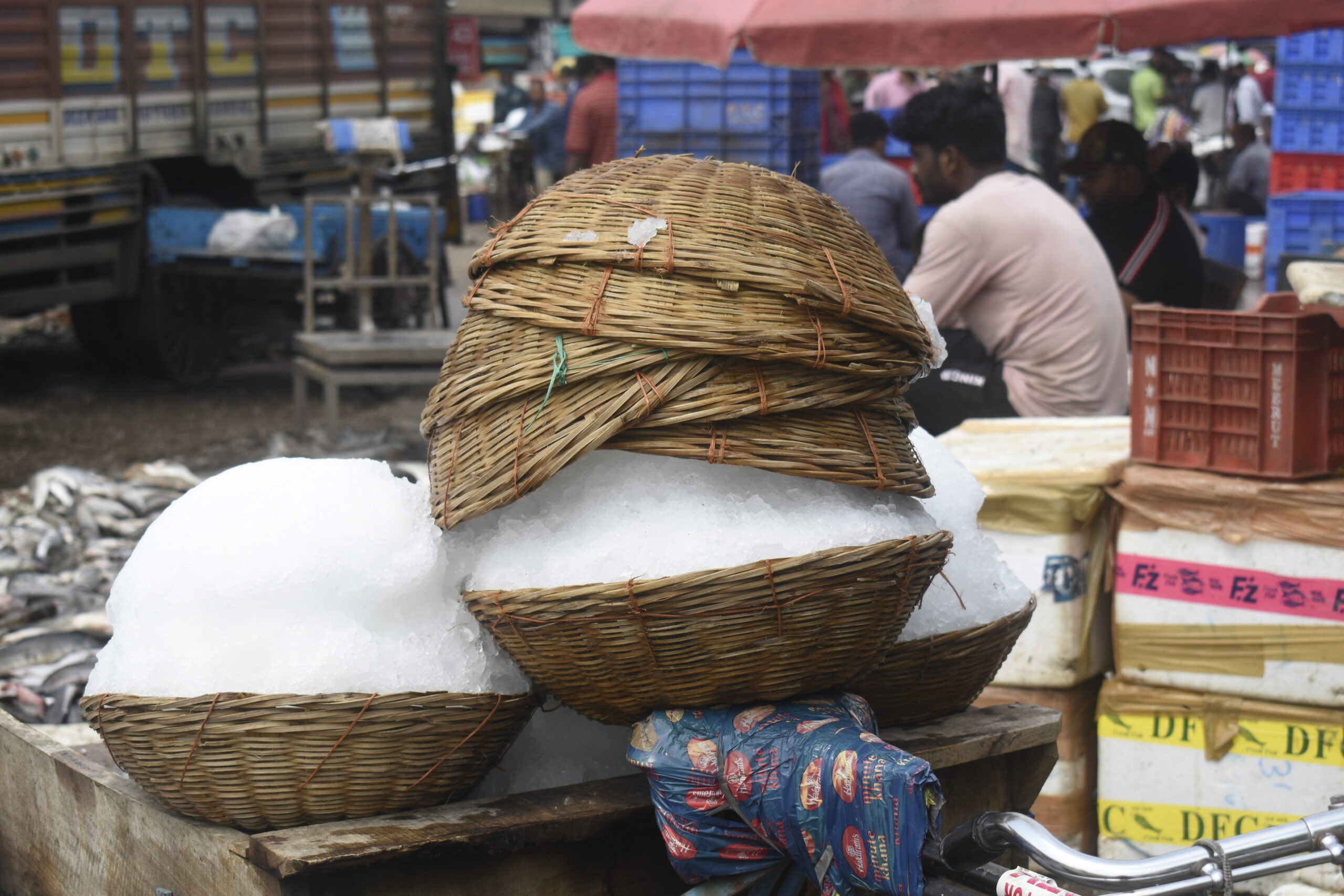
Rows of glassy-eyed fish of diverse sizes and types are laid out here in neat rows on beds of ice. Customers haggle loudly with the fishmongers amid the clanging of deafening machines known as ‘mills’ which are used to crush blocks of ice. Fish spoils easily and thus the market’s hunger for fresh ice is perpetual.
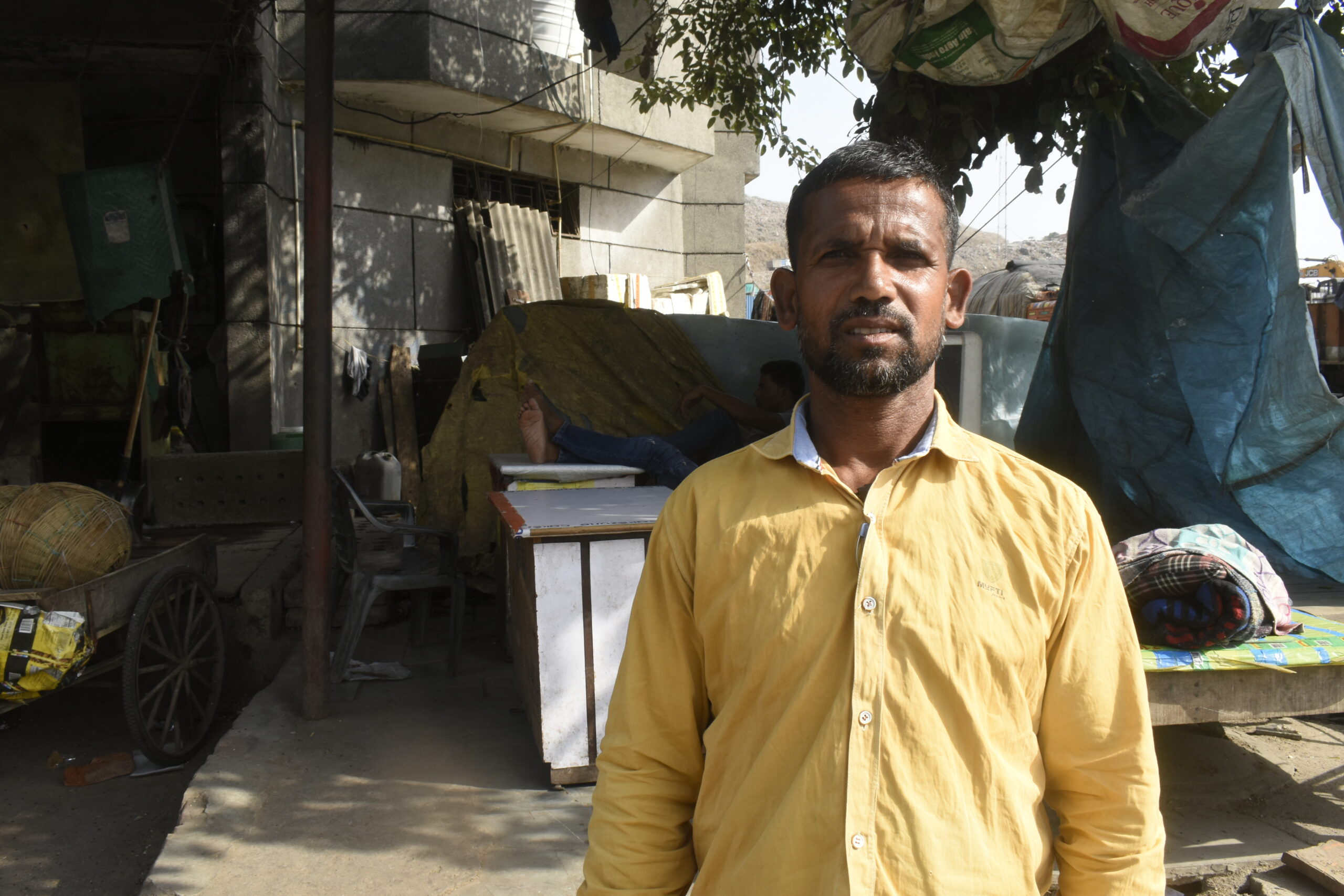
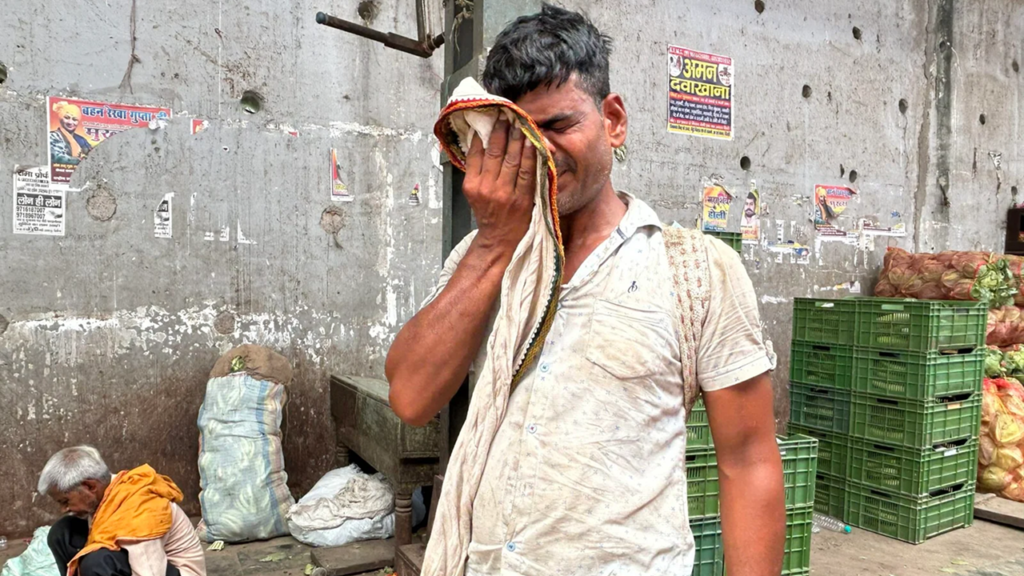
Rafiq Alam, one of the hundreds of delivery workers who ply their trade here, stands attentively near a mill as an ice slab is crushed into small granules. Hailing from Bihar’s Kishanganj district, the 46-year-old moved to Delhi in search of work in 2005. He is employed at one of the shops that crush and deliver ice to customers.
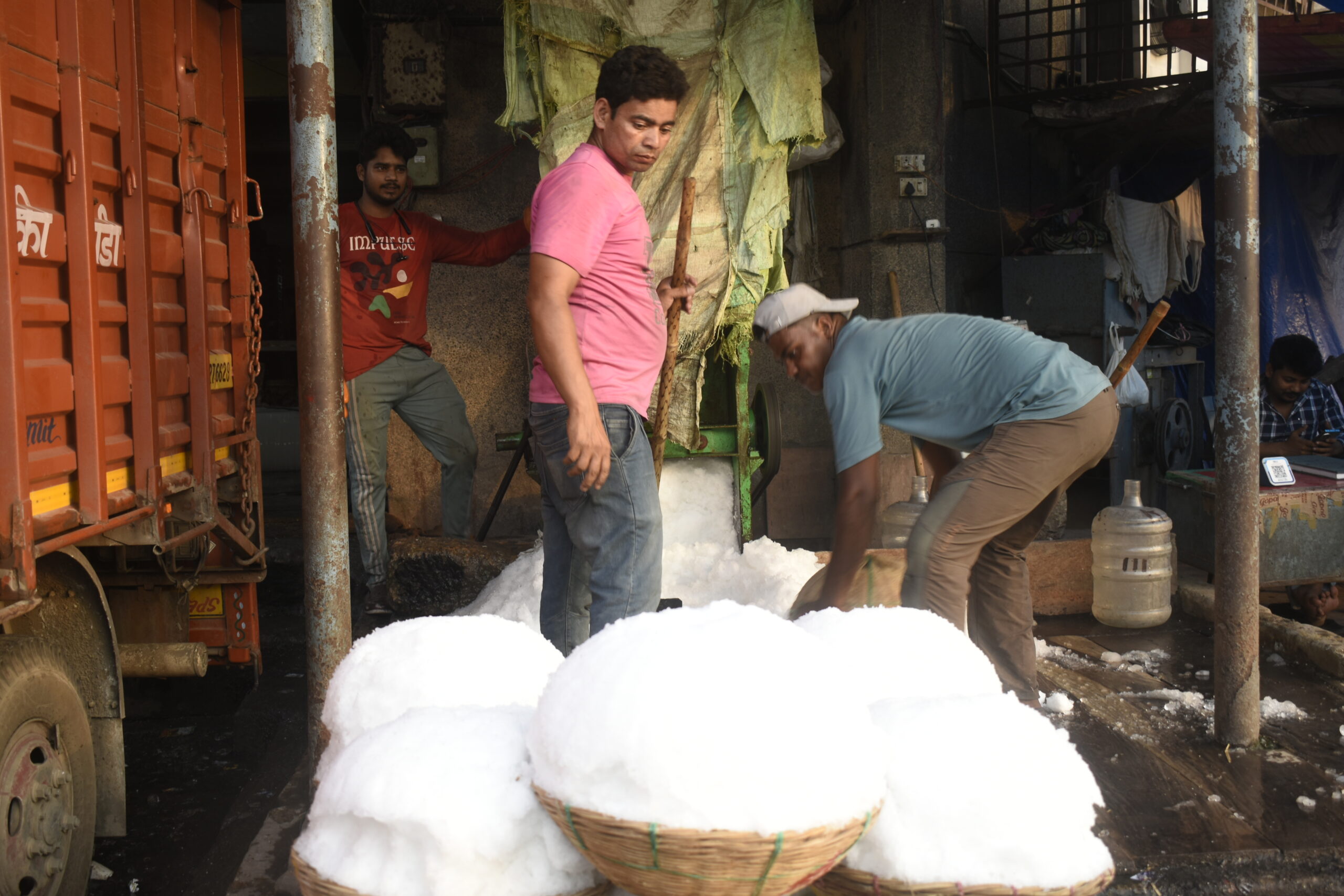
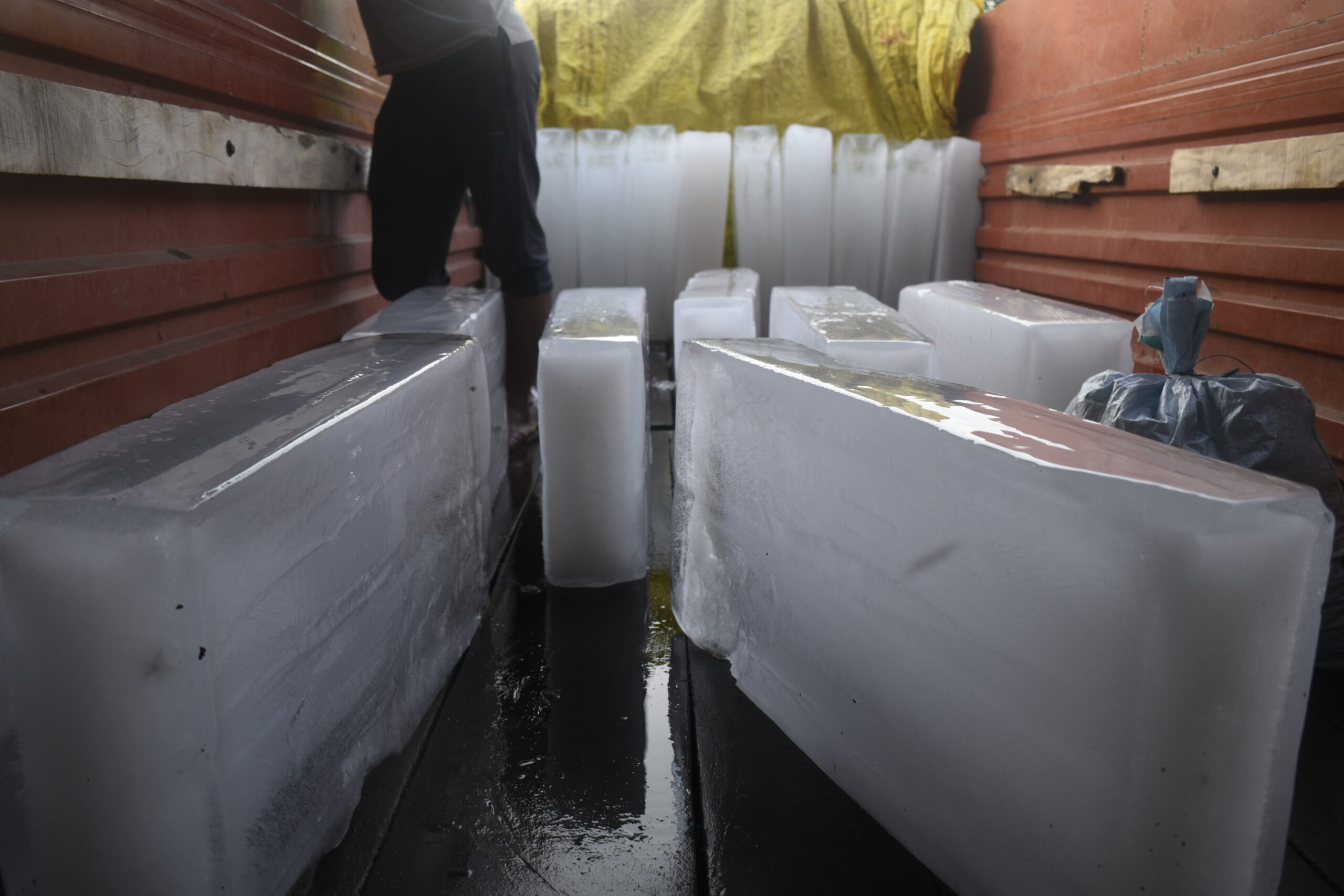
The mills work 24/7 to turn blocks of ice, which weigh between 40 and 60 kg, into more manageable ice granules, which are then packed into thermocol cartons and transported to customers in Delhi and neighbouring states. Multitudes of small fish sellers who occupy the market’s maze-like pathways during the morning hours also buy this ice.
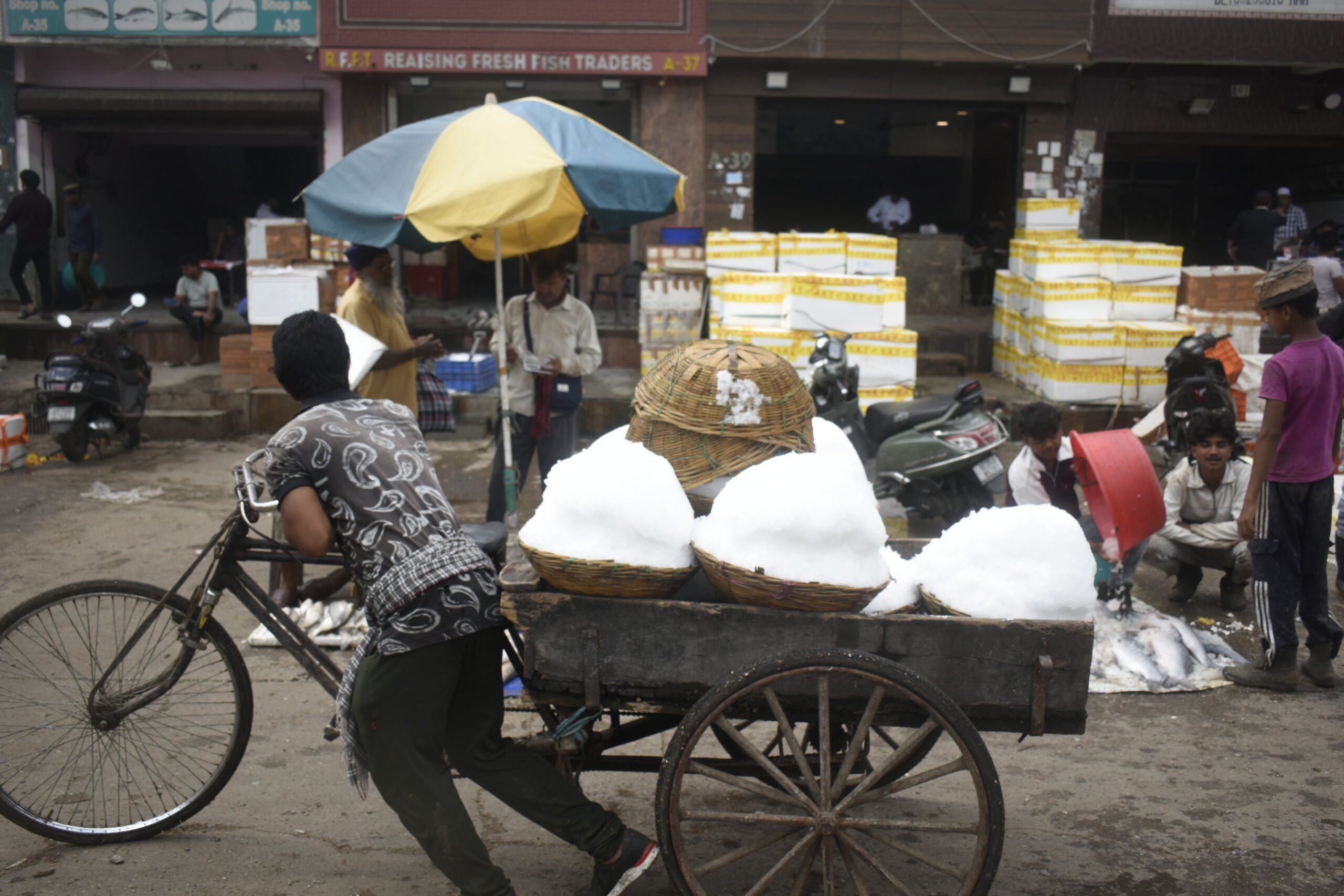
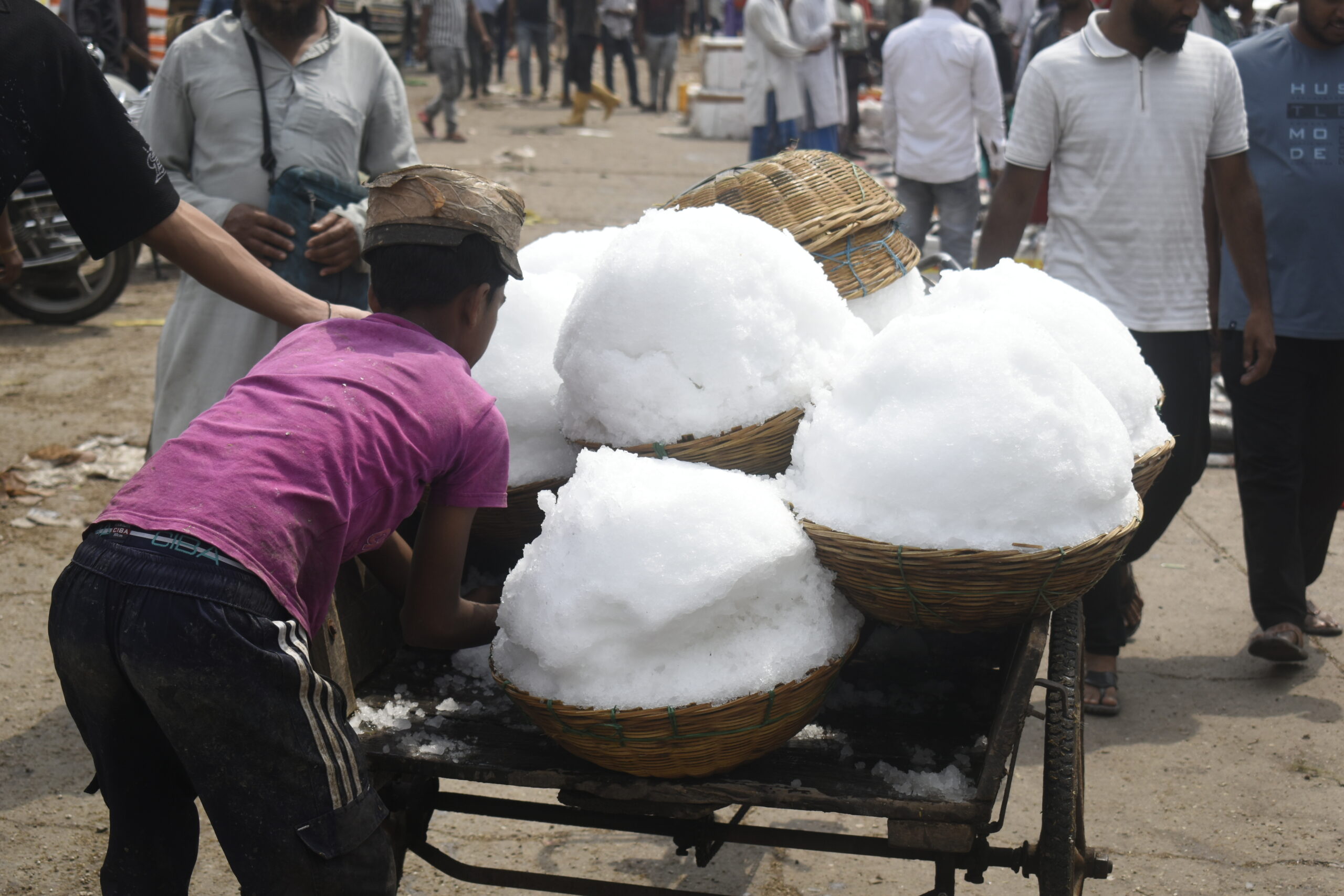
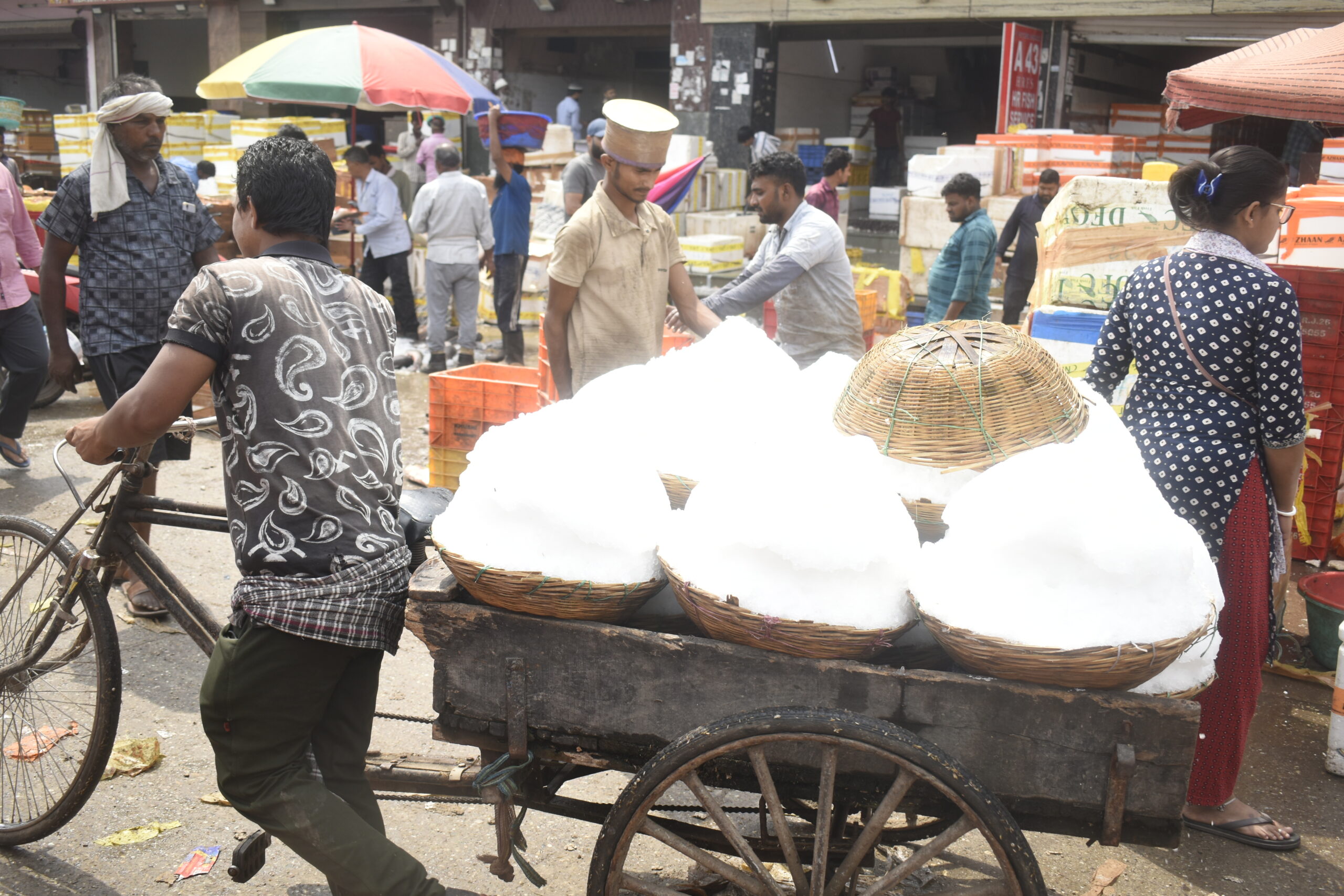
As workers feed the noisy green-coloured machines with huge ice blocks, an assembly line of other workers stands attentively at the other end. Equipped with baskets and a pushcart, they collect their share of crushed ice, which is then delivered to the wholesale dealers dotting the market. Crores of rupees worth of fresh produce depends on a simple commodity which is common and unbrandable, yet helps keep the market economy alive, in turn sustaining many migrants.
Alam’s day starts at 7 am as trucks from the ice factories nestled in neighbouring Uttar Pradesh’s Ghaziabad start making their rounds. With his pushcart, he makes around 20 trips daily to various shops within the market. However, carrying and pushing 10 to12 baskets, each holding 17 to18 kg of crushed ice is backbreaking work. “On some days, my body aches so much that just getting up in the morning to go to work is difficult,” he said.
Catching a brief afternoon siesta in the scorching sun as work slows down in the market, the father of five told The Migration Story that he had a patch of land back home but could not really make a living out of it. He uses his plot of four bighas to grow crops such as rice, wheat and vegetables but the produce is barely enough for his household’s needs. “I have no option but to come here every few months and work,” he said with a sigh.
In peak season, a working day at the market stretches to 10 to 12 hours with a fixed wage of 550 rupees. Alam said the amount just about kept him afloat. “I stay at the shop, as do most of the other workers so I am able to save some money,” he said. By the end of the month, he is able to send 7,000 to 8,000 rupees back home. With a 13-year-old daughter and sons aged 15, 10, eight and six years, the exhausted worker sadly said that his desire to educate his children in private schools was fated to remain a pipe dream.
“It is tough to even buy books for them with my meagre earnings here,” he said, as a truck from another ice factory makes its way to the shop, and workers begin unloading the cold slabs.
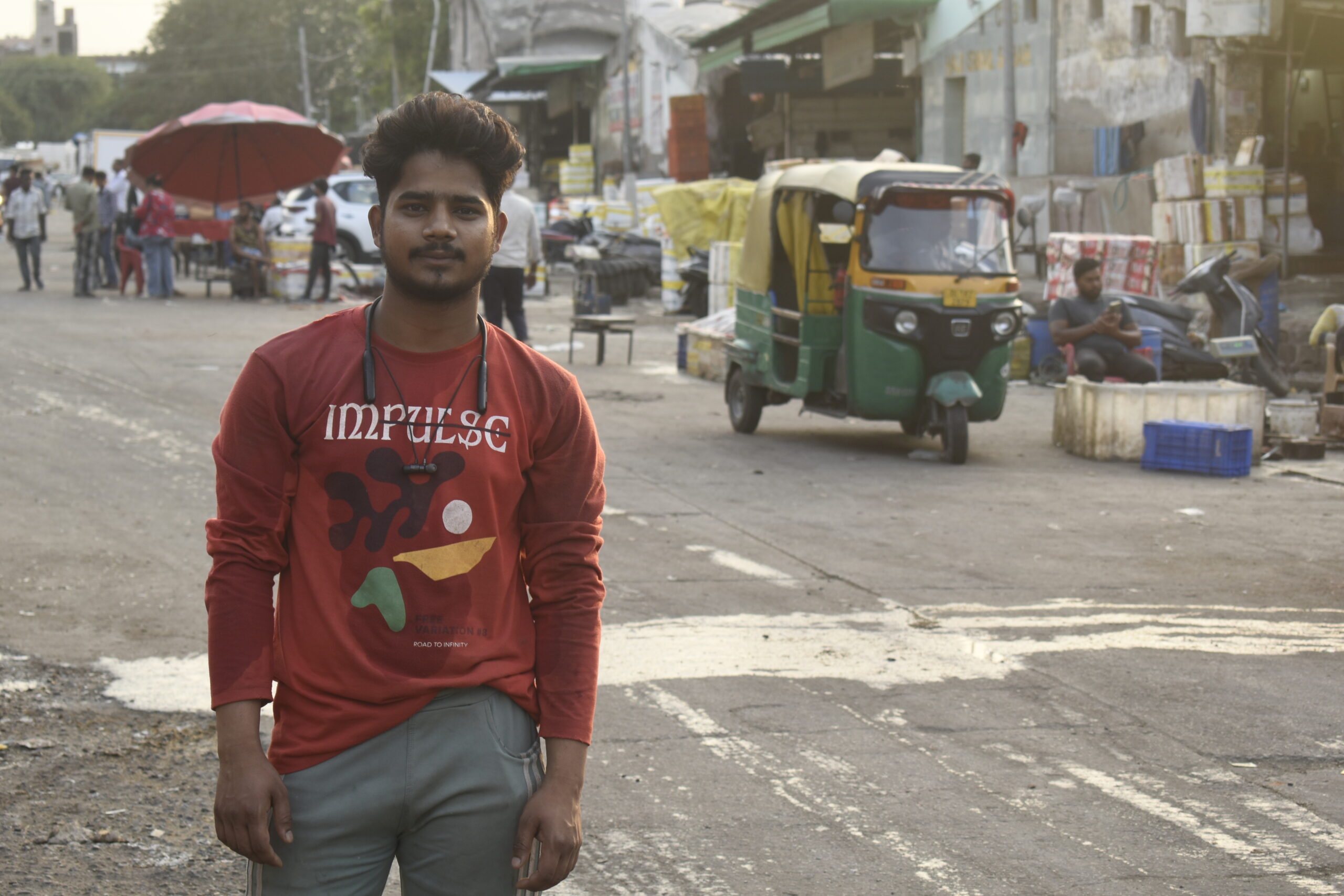
Slippery to the touch and weighing between 40 and 60 kg, the work calls for practised expertise. Imran, wearing a bright red t-shirt and pyjamas, helps guide the truck to what can be compared to a docking station. A wooden ramp is placed between the truck’s loading section and a dingy room. Slabs of ice slide down the ramp as Imran attentively guides them into the room.
“This work may look easy but ask any worker who is new to the business and they will tell you how even a little mistake can lead to problems,” said Imran, who, like a couple of other interviewees, refused to give his full name. Ice, brittle by its very nature, is predisposed to breaking if a worker does not pay attention. Injuries are also a reality, said another worker, showing a deep scar on his shoulder. Workers with such scars and calloused hands are a common feature in the ice trade.
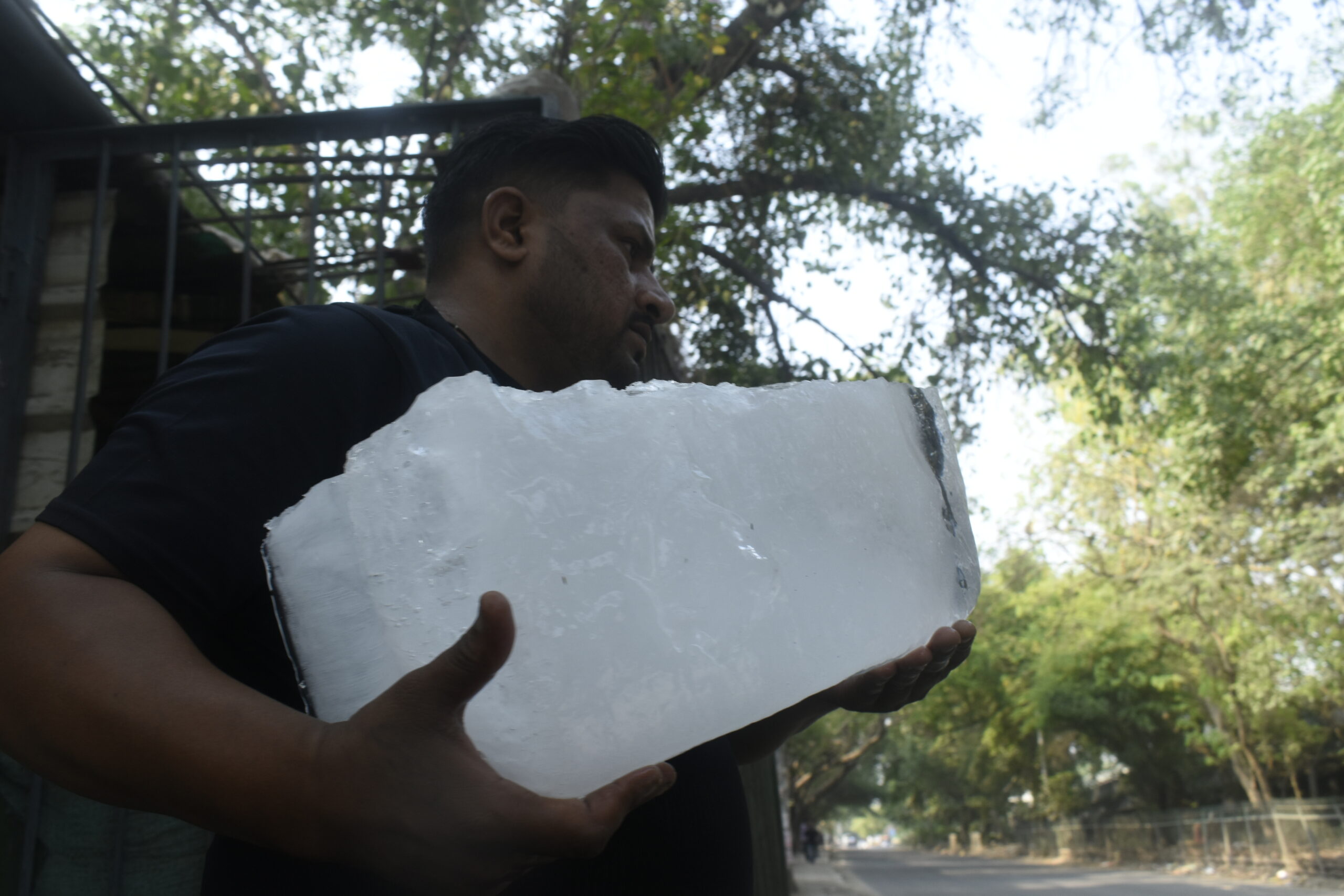
“Ice, if held for long, can burn your skin, and it is never easy to handle a 50-kg block,” said Imran as one of the blocks veered off its intended destination. As he fetched the block, the 19-year-old, who also hails from Kishanganj, said he had never heard about the ice trade. “I had just arrived in Delhi and was loitering around the market when I happened to meet the owner here,” he said. Imran was hired that very day and is now one of the key workers at the establishment, guiding new inexperienced hands at the shop.
The ice trade sustains many workers like Imran and Alam, who migrate from India’s eastern regions to find employment. At the Ghazipur fish market, most of the workers The Migration Story spoke to came from West Bengal and Bihar. Many youngsters in the region, who are unable to find a better living in their home states, often tap into community networks far away from them for work. “I get calls from young people and their parents every day. I don’t understand what the fuss is about working here,” said Alam.
Rajat Kanti Sur, an academic associated with the Mahanirban Calcutta Research Group, an independent research institution, may have the answer. According to him, the pattern of small landholdings in eastern India has bolstered the phenomenon of migration towards cities. “Earlier, there was not that much migration from India’s eastern regions,” he said. “However, in the case of West Bengal, once the land redistribution policy was adopted in 1978, things started changing.”
The policy provided tilling sharecroppers with small grants of land and was expected to gradually improve their economic condition. “But over the decades, the land got further fragmented among family members, leaving future generations unable to rely on agriculture alone,” explained Sur. Other factors which push people towards intra-state migration are failing economic conditions and a lack of employment opportunities. “Initially, nobody wants to move out of their home to live in unknown conditions amid strangers. However, urban spaces do provide respite for workers who otherwise feel bound to the traditional hierarchies in rural areas,” he emphasised.
AMD Shahrukh sits quietly under the shade as business slows down a bit in the afternoon hours at the Ghazipur fish market. He calls home and talks to his wife and children for a while. Father to a boy and a girl, the young man moved from West Bengal’s North Dinajpur district to Delhi in 2008. Like other workers in the market, Shahrukh’s land of five bighas proved insufficient to feed a growing family. “Initially, I used to sell puri-sabzi near Jama Masjid for around one and a half years,” he said. “Subsequently, I ran a tea shop in Seelampur for three years. The money was not enough, so gradually, through contacts at home, I secured a job here.”
Shahrukh has been working at the shop for around 12 years. However, unlike older workers like Alam, he loves the city. “What’s not to like here? I earn well. I do not have to pay rent as I stay at the shop. Whenever I feel like meeting my family, I simply rent them a room nearby,” he said cheerfully. His family often stays for weeks in Delhi, as Shahrukh candidly admits to feeling lonely in the big city.
According to the Delhi Economic Survey 2022-23, migration alone added 2,83,000 people to the capital in 2021. However, Sur said that the government needed to do a better job of maintaining data on migrants. “How do you expect policies that can actually change the lives of migrant labour without adequate statistics?” he asked. Sur suggested the creation of a migrant register that could keep track of migrants and help them with adequate protection and welfare.
Apart from the other problems they face, the scorching heat is another downer for workers. “Just imagine making deliveries in this heat. Sometimes I feel I will faint working in a summer like this,” said Alam, adding that their long work shifts were often interrupted by a search for water. “There is not a single water tap in this market,” he said.
Shahrukh added that while temperatures could be high in his native village, they were nothing compared to the burning sun in Delhi. “The only thing I hate about this place is the heat. I cannot stand it,” he said exasperatedly.
Every year, large parts of the country’s northwestern, eastern and central regions are gripped by regular heatwaves. Earlier this year, the India Meteorological Department (IMD) stated that 2026 could witness above-normal heatwave days across the country. At the time of reporting, the national capital too was reeling under a heatwave and recorded its warmest May night in 14 years, with night-time temperatures staying above 32°C. Eleven afternoons that month, meanwhile, crossed the 44°C threshold, peaking at 45.9°C on May 19.
Later, as it inched towards the delayed monsoon, Delhi remained hot despite temperatures descending. The sweltering humidity kept the heat index or “feels like” factor very high—on June 28, the heat index was recorded as 51°C.
The Migration Story spoke to Suruchi Bhadwal, Director of Earth Science and Climate Change at TERI (The Energy and Resources Institute) to better understand the impact of heat on the bodies of migrant labourers. “Most of the time, those employed in the ice trade, including loaders, cart pullers and drivers, work outdoors,” said Bhadwal. “Working in such high temperatures can lead to dire health consequences, including chronic dehydration, heat exhaustion, heatstroke and in extreme cases, even organ failure.”
Bhadwal added that daily-wage workers rarely had the choice of taking sick leave since this impacted not only their earnings but also caused productivity losses for the ice industry. Explaining the effect of heat on such businesses, she said that the loss of ice through melting was a big concern during transport and storage. “Rapid melting of ice impacts capital, as the supply chain dependency on it can cause inventory losses and further squeeze profitability,” she said.
Drivers like Pappu Mishra everyday face the harsh reality of losing income due to the nature of the goods that they transport. The 50-something native of Bihar’s Chapra has to race against time, as ice slabs melt even quicker in harsh summers. “Once the slabs are loaded on the truck, we are on the clock to reach our delivery destination at the earliest,” he said. “But despite all our efforts, slabs can shed four to five kg in transit alone.”
Mishra, who said he had been driving trucks and delivering ice to markets and wholesale dealers for the last 40 years, said that the business had not changed much. “After all, what can you change about ice except maybe increase the price a bit to get some profit in seasons of high demand?” he said. As he completed his last delivery for the day, he reminded a new driver, “Remember that you can never ever take leave without letting us know; we need to make sure the customer gets his delivery.”
In the cut-throat world of the ice trade, a missed delivery can mean losing a customer of years. “Ice seems very basic, but without it, crores worth of material will simply rot within a day,” Mishra asserted. With his gaze fixed on the sky and sipping some cold water, he shared the pressure his work put on him. “When my brother-in-law died, I went home only after completing my delivery,” he said. “I could be sick but I still need to make sure everything goes smoothly with customers. In our line of work, the customer is God.”
Govind Sharma, owner of Radhey Ice Factory in Ghaziabad, agreed that the only way to survive in the ice business was to never miss a delivery. Over a phone call, he explained how his ice factory operated even in the winter months despite incurring huge losses. “I have to make sure that year-round customers are not left in the lurch,” he said.
Sharma described the nature of work in the ice trade as “very physical”. According to him, every factory requires experienced labour that knows how to remove the frozen slabs from the massive cooling tanks and dispatch them to the transportation trucks. “If it is a huge establishment, it can house multiple cooling tanks. These tanks usually have a capacity of 400 to 500 ice slabs,” he pointed out.
The first batch of ice usually takes around 24 hours to freeze in these tanks, with production time decreasing for each subsequent batch. Despite Sharma’s factory working day and night, it is still hard to meet customers’ expectations as shortages continue to be a reality. “But excuses do not work with customers,” he said. “Be it accidents, machine failures, labour shortages, electrical breakdowns or even regular transportation problems, delivery schedules can never be delayed. There are simply too many players in the market now so our negotiating space has also decreased.”
“The ice business is unforgiving,” emphasised 42-year-old Mahesh whose links to the trade are familial. Around 50 years ago, his grandfather, Kanhaiya, moved from Uttar Pradesh’s Bulandshahr city to a still nascent capital and opened a small shop at West Delhi’s Peera Garhi, selling ice to nearby slums and shops.
“He was attracted to the business potential here. Back then, business was booming, and soon he had more work than he could handle so the family started pitching in,” said Mahesh. His own small ice depot called ‘Bansi Barf Wala’, only provides ice to ‘shikanjiwaalas’ or spiced lemonade sellers. “Until the early 2010s, the business was still profitable but now every home has a fridge or some kind of refrigeration,” he said, lamenting the loss of a big customer base.
At one point of time, such depots could be found at major intersections or ‘chowks’ in the city but their numbers have dwindled. At Mahesh’s depot, trucks from Ghaziabad’s Loni deliver ice slabs in the early morning hours, which are then kept on wooden platforms. “We use plastic tarpaulin sheets or jute and other heavy fabric to minimise the melting of the slabs,” he said. The method, though basic, helps sellers like him maintain sales all through the day.
Mahesh buys 50-kg ice slabs for 200 rupees each from manufacturers and breaks them into manageable blocks. “At the end of the day, I make a profit of 50 rupees or so on one slab,” he said. Peak seasons such as the month of May yield more, and Mahesh often goes home with 500 to 600 rupees in his pocket.
Every day, work starts early in the morning with both Mahesh and his brother Ajju breaking the slabs with ice picks. “This is a job for experienced hands; one hit at the wrong place and the whole slab can shatter,” Mahesh warned. Father to a 12-year-old boy and a five-year-old girl, he has already made up his mind regarding the future of his decades-old business. “People can remain stuck to these wooden platforms, breaking ice for an eternity,” he said. “My children will definitely not do this.”
Edited by Radha Rajadhyaksha
Monish Upadhyay is a New Delhi-based independent journalist. Interested in issues pertaining to human rights, migration, environment, art and culture, he extensively covers marginalized communities.