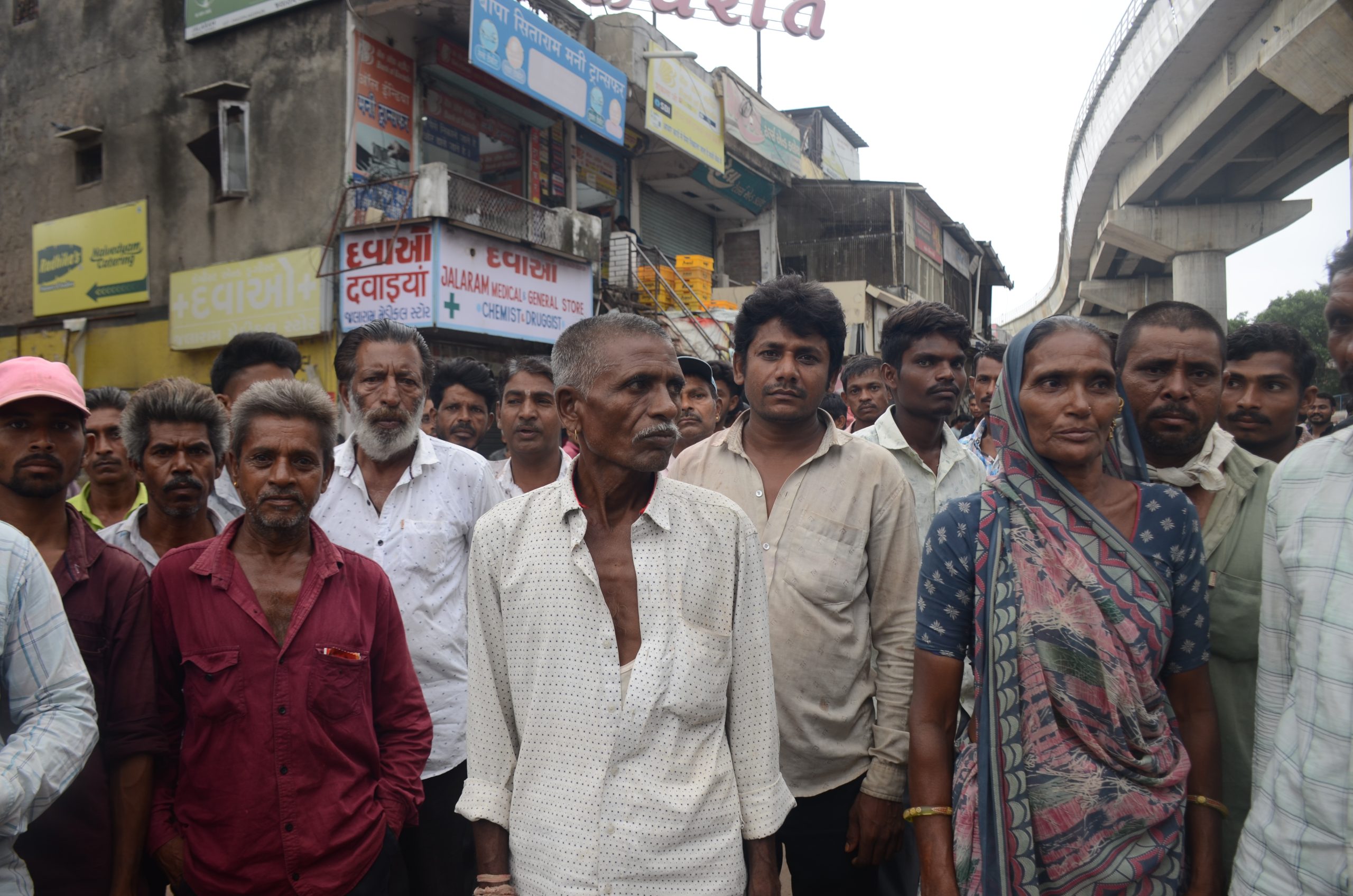
AHMEDABAD, Gujarat: Every morning at 7 o’clock, Jitubhai Somdhi walks to the Gurukul labour centre or kadia naka, one of Ahmedabad’s roughly 100 informal labour markets, to seek work for the day. This year, his average has been a mere seven to 10 days per month. In June, as the monsoon set in across Gujarat, he worked for only three days and earned 3,000 rupees, less than a third of his pre-Covid-19 income.
The pandemic was one of the factors that broke the back of the informal labour sector, and its effects continue even after the lockdown. “We used to get work for at least 20 days every month before Covid,[1] [O2] ” said Somdhi, a 50-year-old construction worker from Gujarat’s eastern city of Dahod who has worked in the sector since 2009. “Now no one is interested in hiring us.”
Every single day, Somdhi waits at the Gurukul naka till 11 am but often returns home empty-handed. At other nakas in the city, some labourers wait till noon while others stand there all day, hoping to be hired. “More than half go back dejected,” said Somdhi.
According to Aajivika Bureau, a non‑profit that works with migrant workers in Gujarat and Rajasthan, Ahmedabad’s nakas attract between 150 and 1,500 labourers each. Most are employed for between five and 25 days a month, depending on skill, gender, access to technology and demand.
“Most of the workers are temporary or seasonal migrants from Gujarat’s tribal belt and nearby states like Rajasthan,” said Saloni Mundra, an executive with Aajivika. “They get wages for short- or medium-term work. Contractors hire them for specific projects, often paying them slightly more than what onsite long-term labourers earn.”
After the pandemic, Ahmedabad rapidly transformed into an infrastructure hub, driven by metro expansions, industrial growth, and its aspirations to host the 2036 Olympics. However, the recent slowdown in the city’s real estate sector has adversely hit employment for informal construction labourers.
According to a local media story, the latest Gujarat Real Estate Regulatory Authority (GujRERA) report indicates a prolonged downturn in the state’s housing market. The number of newly constructed residential units has fallen from 0.323 million in 2017-18 to 0.199 million in 2024-25, and investment slid from 83,963 crore rupees to 78,944 crore rupees over the same time frame.
The recession has been compounded by delays in civil projects and poor planning which have left many workers who rely on seasonal employment idle. For example, many government-funded flood mitigation projects under the Ahmedabad municipal corporation, which were expected to generate pre-monsoon employment in 2025, were reported to be only 1% to 30% complete by May.
Rameshbhai, a construction contractor at the naka in Naroda, pointed out that contractors themselves had been hit by the recession in the construction sector for the last two years. “How do I hire people when I am not getting work myself?” he asked.
Another reason for the bleak job scenario is that automation is gradually replacing manual labour. The growing use of heavy construction equipment such as cranes, excavators, concrete mixers and loaders has hurt the demand for some manual labour roles, especially unskilled tasks like digging or carrying materials, according to the workers.
Kantibhai, a 60-year old construction labourer who has been working in the sector for three decades, told The Migration Story that the going was tough because of this. “I used to climb five floors with bricks on my back but machines have replaced many of us,” he said. “We are barely getting by. I don’t make even 10,000 rupees a month now.”