SURENDRANAGAR, Gujarat: Every year, Santabhai Bamaniya returns to the shimmering salt flats of Gujarat’s Little Rann of Kutch, pitching his seasonal hut and betting on clear skies for a strong harvest to feed his family.
But increasingly erratic weather is upending the trade in India’s salt heartland, leaving makers like him fearful for its future
“The best quality salt is so white that you cannot look at it straight for a long time, your eyes will hurt. It shines, it almost radiates light,” said Bamaniya, an Agariya, a term that refers to small-scale traditional salt makers of Gujarat state.
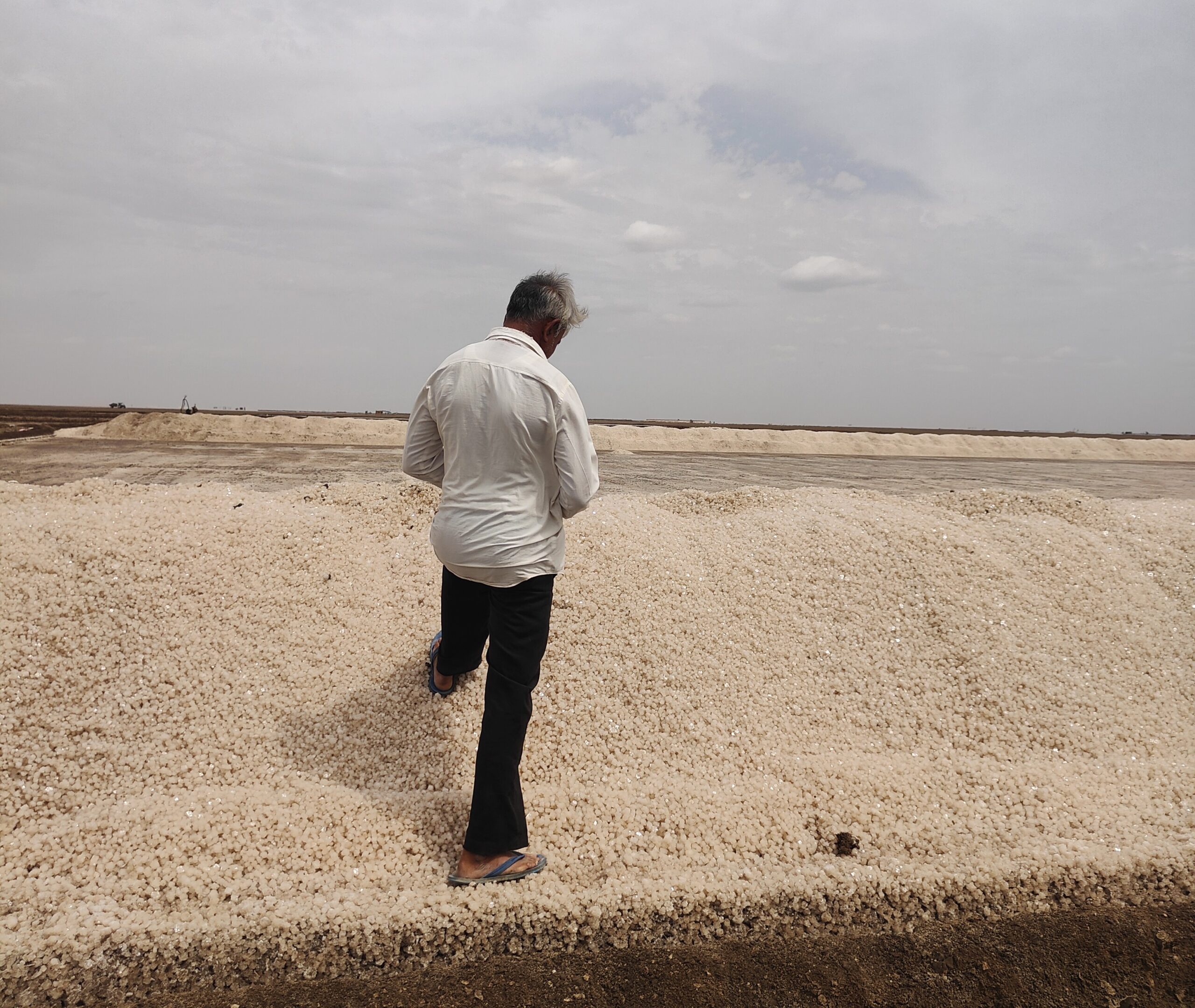
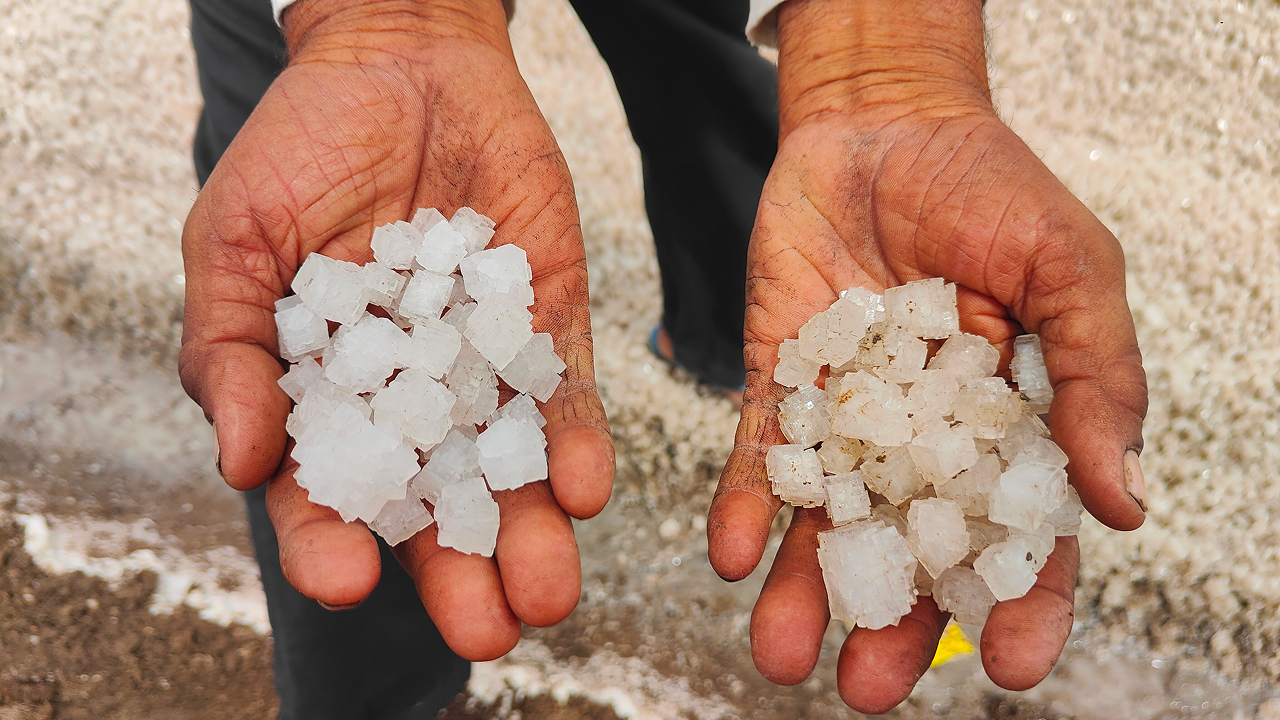
“But look at the salt now, it’s all brown. You can see the difference clearly,” said the 66-year-old as he bent down to gather a fistful of coarse crystals from his field and showed the brownish tinge in his salt, suggesting traces of sand and clay.
This is what most salt farms in Little Rann of Kutch look like this season due to unseasonal rain and strong winds that hit just ahead of harvest in March. The storms churned up the fragile surface of the pans, mixing sand into the crystallising salt.
But Agariyas say this is not the first time unpredictable monsoons have disrupted their harvest, and they fear it will not be the last.
They say that despite severe losses from increasing strong winds, unseasonal rains and flooding in the area, there are no compensation mechanisms in place for them.
India faces some of the fastest-rising threats from climate change, environmentalists say, with increases in blistering heat, powerful cyclones, drought and flooding.
More unpredictable weather can threaten harvests and food security, especially in developing nations such as India, they say.
“(Gujarat) is more familiar with excruciating spells of heat and little known for any dust storm or thunderstorm, especially in March–April,” AVM GP Sharma, president of private weather forecasting agency Skymet said in a note in late March, rightly predicting that the state would see “another round of freak weather” in early April.
Last May, the Central Salt and Marine Chemical Research Institute (CSMCRI), a government research body on the production and utilisation of salt, recommended the government to study and compensate for the Agariyas’ losses. Yet nearly a year later, there has been no relief.
India is the world’s third largest salt producing country after China and the United States, with Gujarat contributing nearly 90% to the total salt production in the country, government data shows.
The Little Rann of Kutch, spread over an area of more than 5,000 sq km – about three times the size of Delhi – is a triangular desert in Gujarat where more than 40,000 Agariya families contribute to 31% of the total salt produced in the state, according to government data.
The produced salt is processed for human consumption, and also as raw material for other products, like caustic soda, fertilisers, and paints.
The Agariyas sell their salt directly to industrial traders and local salt factories who visit the desert. From these traders, the salt is then distributed to manufacturers for table salt, soap, detergent, and various chemical industries across India.
Each farm roughly 10 acres and up to a kilometre apart, is carved out of the desert – flattened, channelled, and prepared for crystallisation.
Eight out of 12 months, Bamaniya lives in Rann with his son, daughter-in-law and three grandchildren in their makeshift home built with bamboo and tarpaulin – one room, a hall and a small kitchen, all for it to be dismantled by the end of April.
“Every year there is a cyclonic storm. Sometimes there are just strong winds. In either case the salt gets damaged,” Bamaniya said.
The Arabian sea has historically witnessed fewer storms than India’s eastern Bay of Bengal coast, but that pattern has changed in the last three decades, and more so recently.
A 2018 study by the National Disaster Management Authority also suggested an increase in both intensity and frequency of cyclones along the western coast, citing global warming. The Little Rann of Kutch lies 200 kms east of the Arabian sea coast.
“I do not remember such changing weather conditions when I started working at the salt pan with my father. Facilities were limited, but we were still sure about what the weather would be like, which made us confident of the product,” said Bamaniya, who has spent nearly five decades working at the salt pan.
“Now there are alerts on our phones about cyclones and rain, but there is little we can do about it. We cannot store the salt anywhere to protect it. Either we start again if it’s in the early days of production, or we sell it at a minimum price as the quality goes down.”
The region witnesses inundation during monsoon, converting into a wetland.
Each September, the sea retreats and the seasonal rivers dry up, marking the start of the salt manufacturing period that lasts until March or April the following year.
The whitest salt fetches the highest price of up to 500 rupees per tonne. Once discoloured, that value can drop to 300 rupees, or even less, depending on the trader, salt makers say.
Bamaniya keeps a small bottle of the pure good quality salt to mark the difference.
“This is like our benchmark for the best quality. Any variation from this is bad quality,” his son Maheshbhai Bamaniya said, showing off the starkly white salt crystals they have saved.
The best quality is called grade 1 salt, sold at the highest price, then there are grades 2 and 3, which are decided based on how much the trader who buys the salt will have to work on processing it.
“We do not get to decide the price. There is no standard benchmark to decide the quality of salt. The traders who buy the salt from us decide the price. We are yet to sell it, but those who have started selling it are selling it for not more than 400 rupees a tonne,” the son added.
The Agariyas say a 10-acre salt farm can produce roughly between 700 and 1,000 tonnes of salt, or enough to fill about 40 standard shipping containers. But flooding, cyclones and unseasonal rains can drop the production to 500-600 tonnes.
“This year we were hoping that nearly 70% of our produce would go as grade 1 salt, fetching us the best price, but now there is no grade 1 salt left. All the produce will be sold at the minimum price,” Maheshbhai said.
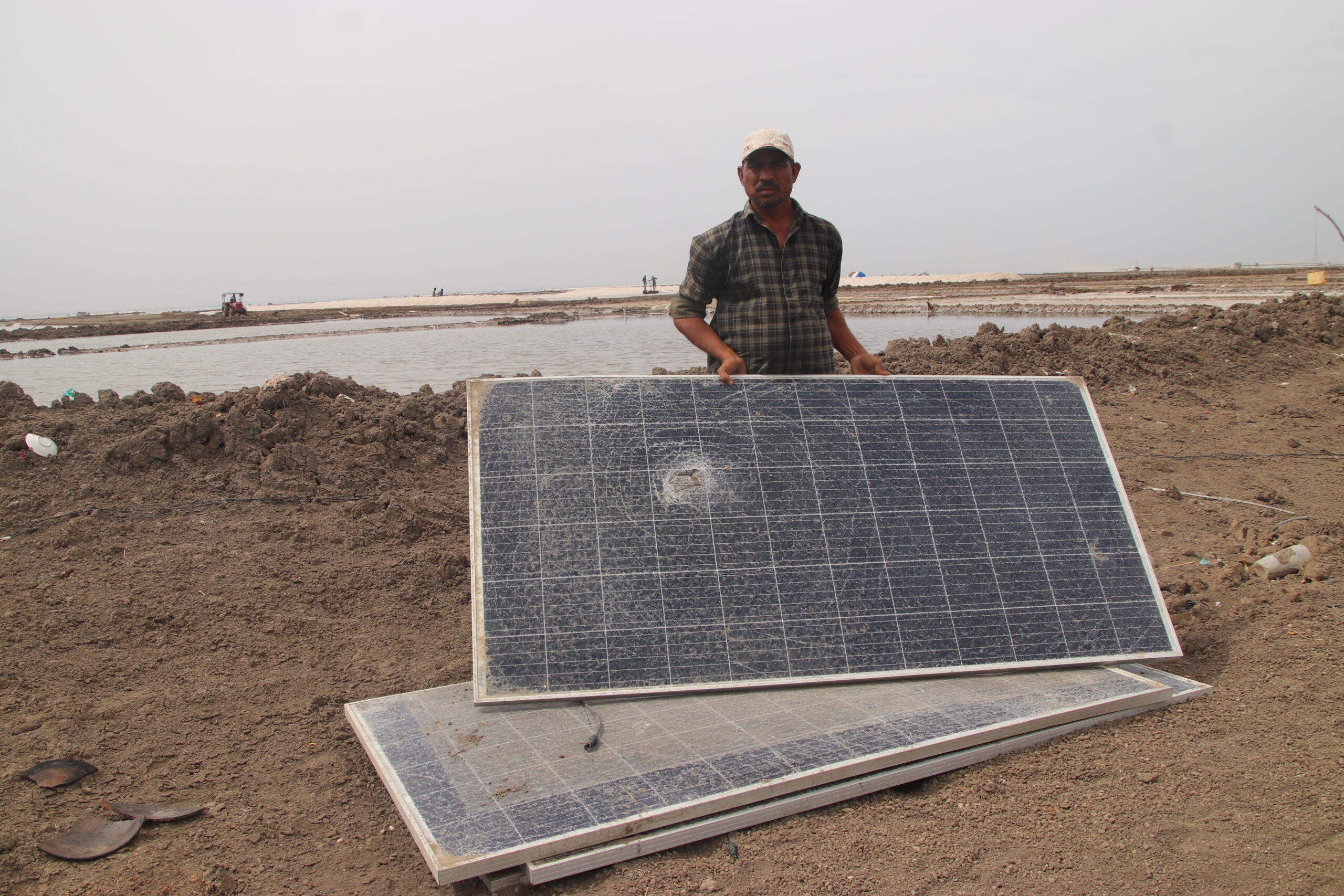
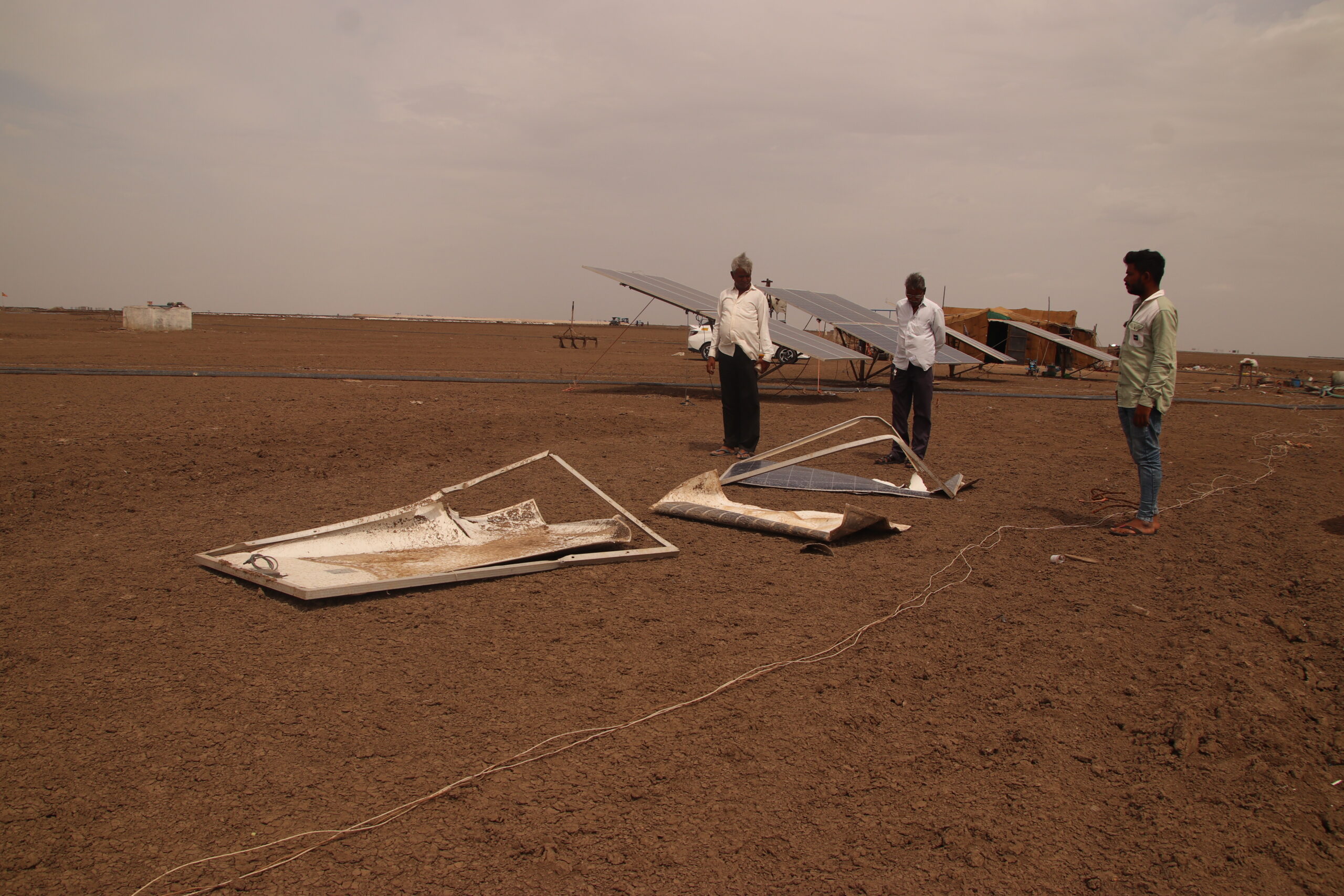
A kilometer from the Bamaniya hut, 39-year-old Vashiram Dedwaniya passes a new casualty: shattered solar panels strewn across his 10-acre farm.
He had saved up for three years to buy them last November for 1.2 lakh rupees. But fierce desert winds in March this year, wrecked his salt harvest and panels beyond repair.
Like Dedwaniya, most Rann farmers rely on government-subsidised solar panels to pump water. He had secured two at a discount and added more to slash diesel costs.
“I manage to make 4 to 4.5 lakh rupees a year by selling salt. After all expenditures including transportation, housing, and others, I manage to save around 2 lakh rupees. Using solar panels has helped us reduce costs more and make better profits. I have to start saving again to replace these panels now,” he said.
When The Migration Story visited the Little Rann of Kutch in early April, the salt makers said a survey was underway to assess the damages by the strong winds.
But later, a committee member said it lasted two days before stalling ahead of Gujarat’s local elections this month.
The poor quality of salt and impending price drop worries Dedwaniya, who tries to make ends meet as a daily wage labourer in nearby towns and cities during the four months he is not in the Rann.
Cyclones are not the only threat. Excess rains overwhelm regional dams like Narmada and Machhu, prompting authorities to release water through canals near salt pans – a recurring blow, makers say.
“Rain, excess water from dams, all of it is fresh water. If it mixes with the saline water in our pans, the degree of salinity reduces. We have to start the process again,” Dedwaniya said.
Pankti Jog, state coordinator of Agaria Heet Rakshak Manch, an organisation that works with the Agariya salt makers, notes floods from overflowing dams hit Little Rann salt pans in 2014, 2017, 2020, 2021, and 2025. Yet losses go unassessed and uncompensated.
“It was only in 2024 that we were informed that there is no criteria to map the losses, which was informed by a collector and that is why even if there are funds, there is no mechanism in place to disburse them adequately and properly,” she added.
Despite the scale of losses, salt workers in Gujarat remain outside formal compensation frameworks.
India’s Ministry of Commerce & Industry oversees salt production, under which the Salt Commissioner’s Organization handles regulation, development, and distribution.
Salt production is classified as a mining activity, but in practice it resembles agriculture.
“Like farmers, Agariyas depend on land, weather, and seasonal cycles. They prepare fields, manage inputs, and harvest produce. But unlike farmers, they do not own the land. Nor are they recognised as cultivators,” Jog said.
After any natural calamities, the Gujarat State Disaster Management Authority (GSDMA) rolls out relief measures, but salt workers are not a part of them.
The GSDMA did not respond to requests for comment.
In 2025, the CSMCRI called for an assessment of the loss.
“Agariyas are traditional salt makers, which means these salt making activities are a lifetime activity they undertake for their livelihood. They aren’t businessmen,” Jignesh Shukla, a senior technical officer at CSIR-CSMCRI, told The Migration Story.
“In case of any natural calamities that impacts them directly, they should be compensated,” he added.
CSMCRI proposes a framework to calculate salt losses: average output per acre over the past five to seven years at market rates. Plus, accounting for by-products like bittern, which is used in fertilisers and seasonings, and capital investments like solar panels, pumps, and tractors.
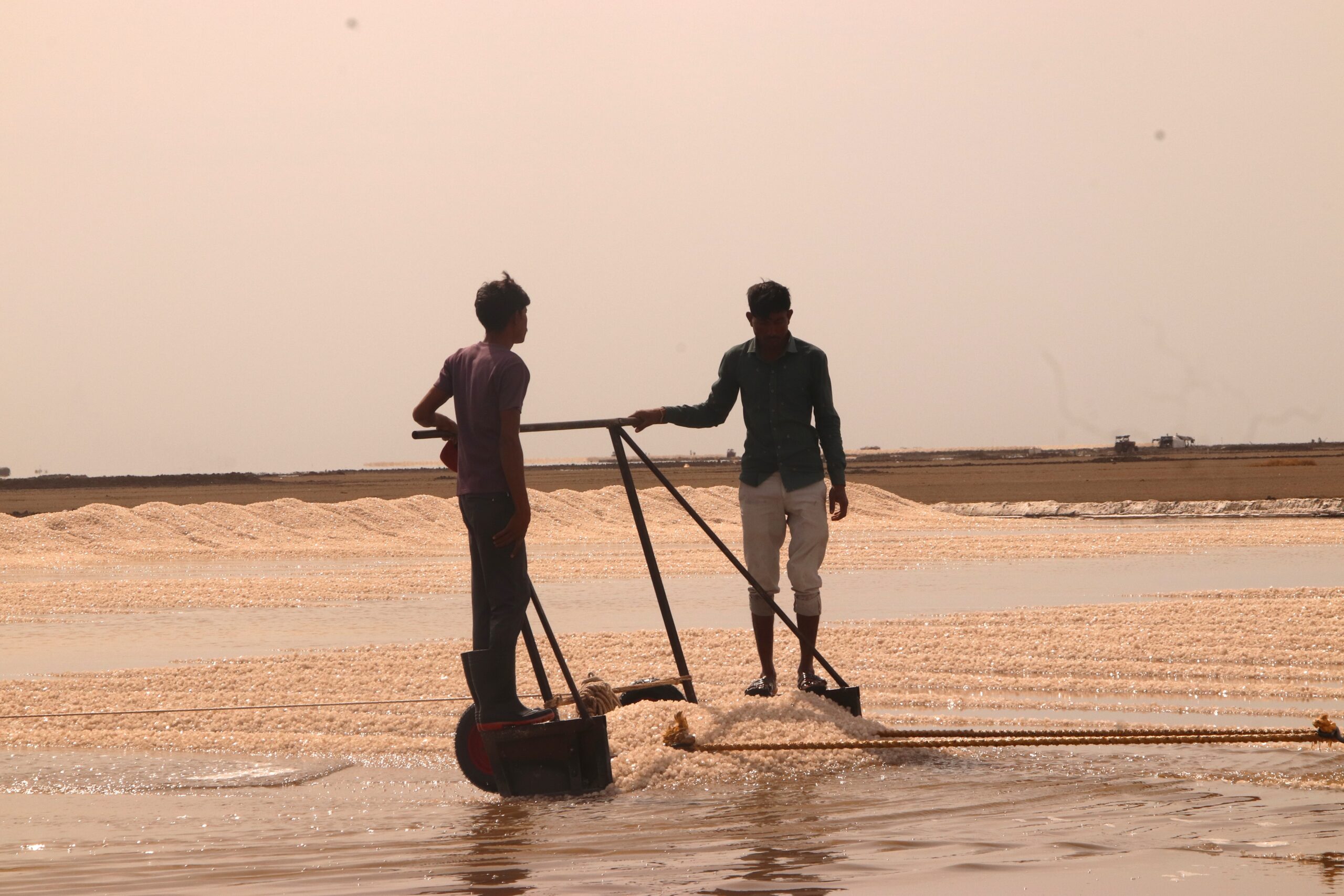
It also recommends including a “man-days” framework, calculating salt makers’ work done over eight months, starting from relocating to the Rann, building shelters, installing pumps, and digging wells to preparing crystallisers, and daily raking operations that can last up to 120 days.
For a typical 10-acre farm, all of this can amount to hundreds of “man-days”.
Shukla said the lack of a standard operating procedure for compensation was a “major roadblock”.
“We made the suggestions since we were asked to and submitted it to the government. But there has not been any update on it yet. The government has to review it and then decide,” he added.
Until then, the salt makers wait in anticipation.
“My land was surveyed too … Nothing happened. There was no compensation,” said Bamaniya.
“Maybe something will happen this time. There’s always a little hope, just not enough to rely on.”
Aishwarya Mohanty is Special Correspondent with The Migration Story.