From new mobility agreements and discussions on skilled migration to reports of worker distress in West Asia, migration featured prominently in policy announcements and news coverage this month.
CASCADING IMPACT OF AN UNENDING CONFLICT
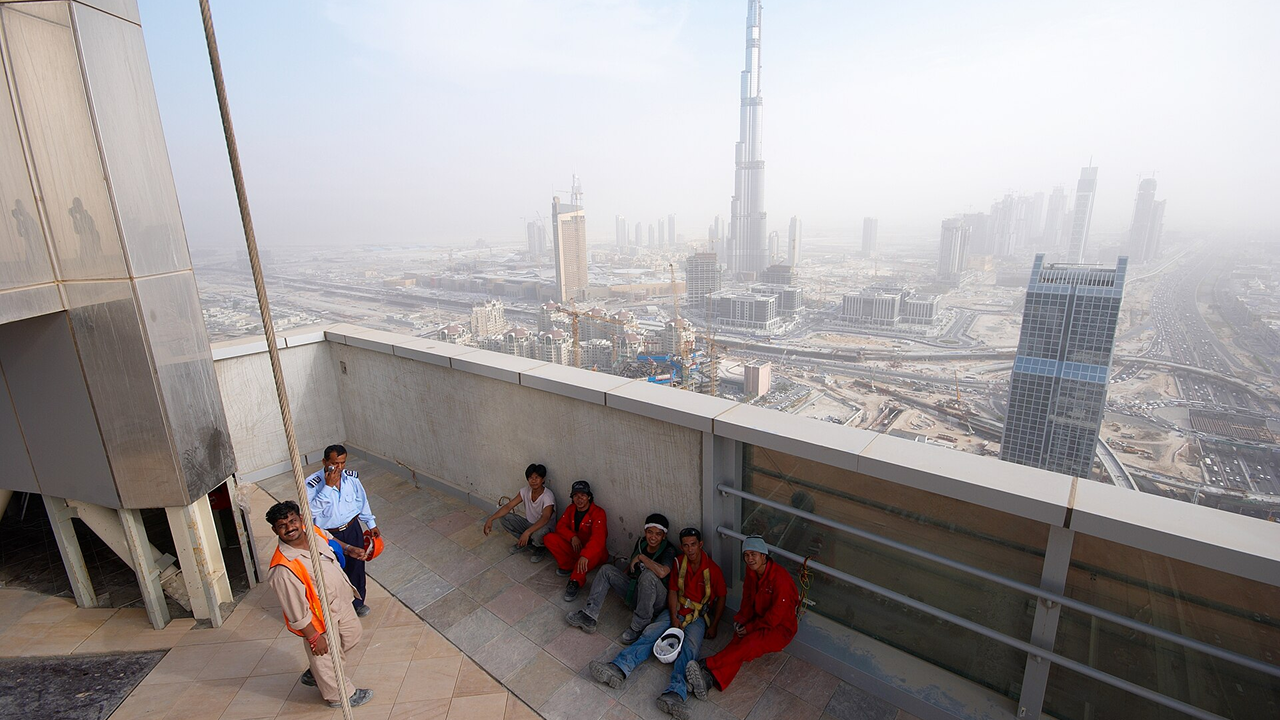
The ripple effects of the Iran conflict are now being felt in the United Arab Emirates, where Indian migrant workers among many others from different South Asian countries, are reportedly facing layoffs, salary cuts and reduced hiring.
The New York Times reported that recent strikes targeting the UAE by Iran have disrupted economic activities and affected key sectors such as aviation and tourism.
The report highlighted how migrant workers from across countries, specifically South Asian countries, were facing the impact. The newspaper quoted an Indian accountant, Mujeeb Rahman, who had lost his job when the catering company he worked at closed down. “The company does not have enough cash flow to pay employees and suppliers,” Rahman said, adding that many companies have stopped hiring, reported NYT.
Another Indian migrant worker, Venkat, an Indian hotel housekeeper, returned home in April after losing his job, the article stated. “I am doing whatever I can to manage. If I cannot come back to Dubai, my children’s future is at stake,” the NYT report quoted him as saying.
At the same time, around 60 Indian nationals were deported by the United Arab Emirates, for allegedly violating local laws and regulations as per a report by The New Indian Express.
The report stated that some had migrated for work through recruitment agents, others had arranged their travel independently.
The report further attributed airport sources as saying that many of the deportees returned without their passports, mobile phones and other personal belongings, which were reportedly retained by the UAE authorities.
DIGITAL SOLUTION TO MAKE MIGRATION SAFE?
The past month saw multiple interventions and conversations around Indian migrants overseas.
On June 30, External Affairs Minister S. Jaishankar, while speaking at the Human Resource Mobility Forum in New Delhi, said that India has signed 28 migration and mobility agreements with countries around the world, so far, including recent pacts with countries like Germany, Italy and Japan.
As per a report by Akashvani News, he also underlined the use of digital systems and tools like eMigrate V.2, a digital platform launched by the Ministry of External Affairs as a one stop common services platform to assist overseas migrant workers from India, launched two years ago.
“India’s commitment to safe and legal mobility is reflected in the eMigrate platform. And since its inception, more than 50 lakh i.e. five million emigration clearances have been issued. This digital ecosystem has become a global example of leveraging technology to protect migrant workers while facilitating mobility,” he said.
The Indian Express also quoted Jaishankar as saying that as countries face ageing populations and declining workforces, the “silver economy” of caregiving and healthcare as well as the “tech economy” will increasingly depend on mobile human resources.
The minister stressed that India’s mobility partnerships are built on “mutual benefit, shared responsibility and long-term sustainability,” enabling countries to address workforce shortages while creating opportunities for Indian talent, as reported by FirstPost.
Earlier in July, the Ministry of External Affairs also emphasised that India is focused on “ensuring greater mobility for its high-skilled professionals rather than broader migration issues”, as reported by Business Standard.
In New Zealand, during PM Narendra Modi’s official visit, Secretary (East) in the Ministry of External Affairs, Rudrendra Tandon, while addressing a media brief said that the Government of India has been working to improve opportunities for high-skilled Indian workers, including CEOs and technical experts, as reported by DD News.
“On the migration question, we are aware that there is a lot of discussion in many countries. But our focus is actually mobility. It is part and parcel of our trade agreements and it’s very important to maintain that distinction,” he was quoted as saying by news agency ANI.
In an interview with The Indian Express, German Ambassador Philipp Ackermann described Indian migration as a success story, noting that Indian professionals have integrated well into Germany’s labour market. Germany continues to expand recruitment in sectors facing workforce shortages, including healthcare, engineering and information technology.
The Migration Story reported last year that Germany’s ageing population is steadily widening the skilled shortage gap. For example, in the energy transition space alone, experts estimated the country will require an additional 350,000 skilled workers by 2030 in order to plan, build and operate renewable power and hydrogen production facilities. The country also faces shortages in its railway sector, as half of the operational workers are expected to retire by 2030.
However, earlier this year Deutsche Welle reported that several Indian students who came to Germany hoping to build a career, were struggling with the country’s high cost of living – mainly unaffordable housing and university fees that was forcing many to take up work as delivery agents. The report noted that the workers were finding themselves trapped in exploitative work conditions and authorities struggling to address the problem.
CONTINUED VULNERABILITY OF INDIANS IN THE GULF
A 26-year-old woman from Hyderabad has alleged that she was trafficked to Oman after being promised a job as a domestic worker, according to a report by NDTV.
In a self-recorded video sent to a Hyderabad politician, Majlis Bachao Tehreek’s Amjed Ullah Khan, the woman, Shabnam Begum from Telangana’s Hyderabad, said she traveled to Oman on March 26 after a local recruitment agent promised her a job as a housemaid.
She alleged that she was made to work up to 15 hours a day without wages, physically assaulted and denied food, rest and basic facilities.
Speaking to The New Indian Express, Amjed Ullah Khan said, “Despite the Centre’s restrictions, recruitment agents continue to send women to Gulf countries on visit or tourist visas and later convert them into employment visas after they arrive.”
He alleged that women are lured with promises of good salaries but are instead forced to work long hours across multiple households, often without proper food or accommodation, and face abuse if they resist, as per the TNIE report.
The Migration Story reported last year that several Indian workers in the Gulf, including those engaged as domestic helps, often do not speak Arabic and unknowingly sign legal documents without understanding the implications. The reported cited estimates from the Ministry of External Affairs that put the number of Non-Resident Indians (NRIs) residing in the six Gulf Cooperation Council (GCC) nations of Bahrain, Kuwait, Oman, Qatar, Saudi Arabia, and the United Arab Emirates (UAE) at approximately 8.88 million. Indians constitute the largest expatriate group among the roughly 35 million migrant workers in the region. However, legal troubles and exploitation are common among migrant workers, particularly those in low-income jobs such as domestic work and construction.
THE LABOUR DEMAND-SUPPLY DICHOTOMY
Even as millions struggle to find quality work, manufacturers across sectors in India are reporting a shortage of skilled workers, as per a report by Mint.
The report quoted Ankit Mathur, Co-founder, Greenway Grameen Infra in Gujarat who said that despite trying their local network to get more people through ads and local contractors, they managed to get half of what they required even after two weeks.
Raj Prajapati, a worker who left a factory job in Maharashtra after eight months, was quoted as saying, “They were paying me 15,000 rupees a month. I was working 12 hours, six days a week… I can make that money by making and selling clay diyas in my village.”
The explainer video on the same said that industry experts say high attrition, inadequate vocational training and poor working conditions are slowing India’s industrial growth and making it harder for factories to expand.
How do you count a scattered workforce?
In an opinion piece published in Down To Earth, researchers and urban planners are urging policymakers to improve how migration is counted in census 2027.
If migrant workers are counted at destination, they increase the city’s population, density and labour profile. If they are counted at origin, the city may remain smaller in data than it is in daily life. If workers are absent, proxy-counted, misreported or missed, the urbanisation rate, census town classification and city-level service demand can all be distorted.
This is not only a statistical issue. It is an urban economics issue.
India’s cities run on migrant labour. Workers from Odisha, Bihar, Uttar Pradesh, Jharkhand, Chhattisgarh, West Bengal, Rajasthan and Madhya Pradesh build and service Bengaluru, Surat, Hyderabad, Delhi NCR, Mumbai, Pune, Chennai, Kochi and many other urban economies.
They work in construction, textiles, logistics, sanitation, domestic work, security, street vending, hotels, factories and platform services. Their labour is urban. But their documents, caste certificates, ration cards, voter identity, family obligations and social recognition often remain tied to the village.
This creates what may be called locally instatistical rurality: people who are economically urban but counted as rural.
MIGRANTS MISS GRAM SABHAS
A study conducted by the National Institute of Rural Development and Panchayati Raj (NIRDPR), Hyderabad on Gram Sabha participation suggested that migrant households and youth were among the least represented groups in Gram Sabha proceedings.
Based on the study, TOI reported that the emerging phenomenon of ‘Gram Sabha Participation fatigue” has led to unresolved grievances and limited follow ups.
A report in Deccan Herald based on the study also stated that migration related livelihood and time related constraints were the single largest barrier to participation.
The study surveyed 7,790 respondents across 400 gram panchayats in 213 districts spanning 26 states and Union Territories.
Daily wage labourers and migrants who moved in search of livelihood accounted for 17.61 per cent of those unable to attend meetings, while youths made up 16.73 per cent.