Disclaimer: Spoilers ahead for readers who haven’t watched the film yet.
Old age is a conundrum. People work all their lives, saving money to live comfortably once their bodies give up to time and senility. In India, children, mostly men, have long been conceived and raised to look after their parents when they can no longer do it themselves. A popular Hindi idiom ‘Budhape ki laathi’ literally translates to ‘a walking stick for old age’ and is often used to address sons. The elderly are also some of the most vulnerable out there – not only dealing with deteriorating health, but also biting loneliness.
A 2020 report on longitudinal ageing brought out by the Indian government showed nearly 14% adults over the age of 60 deal with frequent/severe loneliness.
How far would you travel for a better paycheck?
Follow The Migration Story’s nuanced coverage of India’s massive informal workforce.
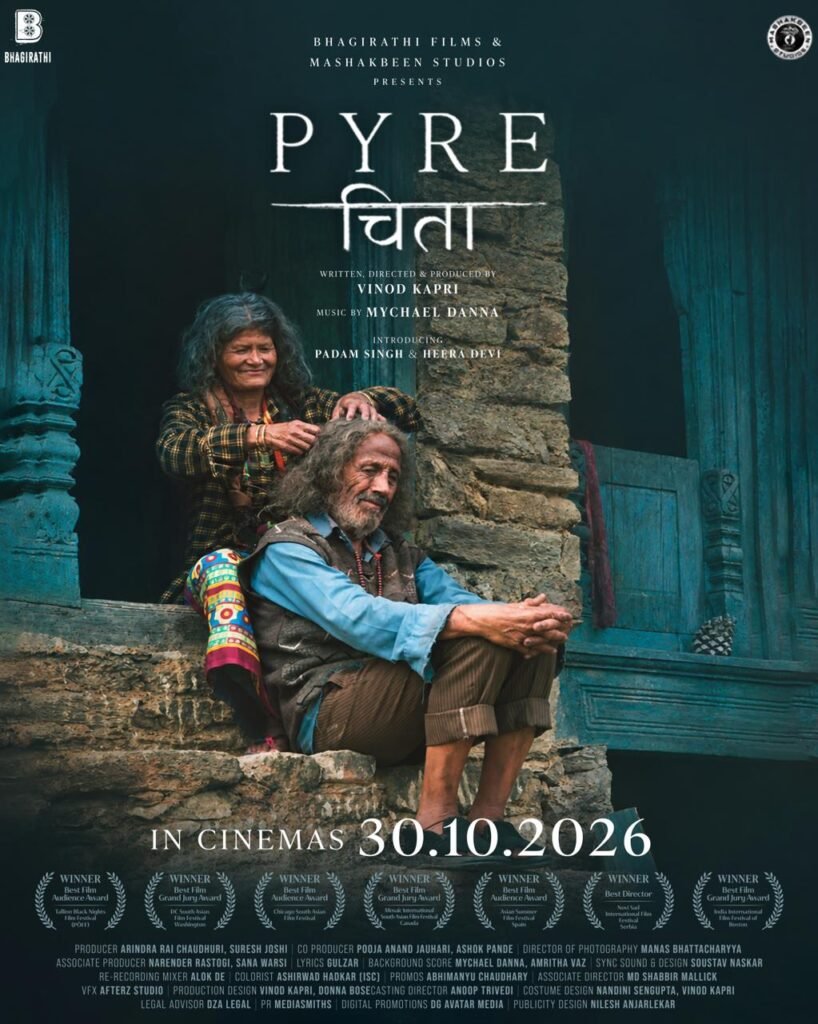
What happens when this loneliness takes a physical form in a remote Uttarakhand village grappling with mass migration? What if someone has no relatives or children in the city to go to? This is the premise of Vinod Kapri’s latest film Pyre, where an old Kumaoni couple cannot keep up with losing their community.
Padam and Tulsi, in a lot of ways, are a very conventional couple. Their bond is a habit cultivated over decades, their banter natural to couples who have been married for a long time. Hariya, their only son, hasn’t returned to the village for twenty-eight years. Tulsi’s health gets worse, leading to more frequent visits to the nearest health centre. In a village so isolated that electricity and roads haven’t reached it, this means that two young-men have to carry her on their shoulders every time she falls sick. They are also the only two young-men left in the village. And both are eager to leave for jobs and opportunities. Padam knows that he cannot make them stay for long, yet he tries. As a man of meagre means, he does not have a lot to give but his livestock as incentive. So he sneaks out of his wife’s sight to deliver goats to the houses that remain without locks on their doors.
There is also a promise of returning every time someone leaves. But it is a false promise – one can almost see through it. A character in the film remarks, ‘In our hills, once a lock comes up on the door, it doesn’t go away’.
This holds true on ground as well. To arrest this exodus from villages, the Uttarakhand government has come up with schemes like the Deendayal Upadhyay Home Stay Development Scheme and Mukhyamantri Palayan Roktham Yojana to curb migration and induce reverse migration. According to the state government, such initiatives have also seen some success, with an estimated 6500 people returning to their native villages since 2020.
But Pyre isn’t looking at the thin silver lines. Its focus is the grim realities of Uttarakhand’s ghost villages – about 1700 of them as per a government report from 2018 – and more importantly, the elderly who are too old for jobs and opportunities, and to migrate for them.
Death, or rather the inevitability of it, is a recurring theme in Pyre. Every time Padam takes Tulsi to the doctor, they come across a burning pyre – as if to remind him of what lies ahead. As if he knows that it isn’t life he has to prepare for, but death. That death follows everything, even survival. After one point, it becomes less about who takes Tulsi to the doctor after everyone has left the village. A more haunting question arises – who will do her last rites, and his? A neighbour, waiting for his house in Haldwani (the largest city in Uttarakhand’s Kumaon region) to be completed, tells Padam, “You and your wife should die while we are here, so that you both can be properly cremated.” He also quotes a report from the newspaper – about old people dying unattended in the state’s ghost villages and their corpses rotting.
Such incidents aren’t unheard of, especially in the context of social isolation around the globe. But earlier this year, in Pithoragarh, 100-year-old Jhupa Devi died in the depopulated Tadigam village. With no young men left, personnel from the Sashastra Seema Bal carried her bier from the village to the crematorium and performed her last rites, local media reported.
The film is set in a serene Himalayan village untouched by commercialised tourism, with no plastic to spot or one of its view-points viral on Instagram. Kapri takes a conscious, but probably difficult choice to not romanticise this. Manas Bhattacharyya’s cinematography is splendid, but never exploitative of the landscape. The surrounding snow-capped mountains make cameos in the background, but the crises remain at the foreground.
Kapri, who shot the film entirely in his ancestral village of Berinag in Pithoragarh, told The Migration Story that the nearest healthcare centre is six hours away. He believes development in the hills has to fulfill basic necessities like electricity, healthcare and employment.
Why are people migrating from Uttarakhand’s villages?
The Migration Story in a previous report identified six major reasons: lack of employment opportunities, poor education facilities, inadequate healthcare, climate uncertainties and environmental vulnerability, human-animal conflict, and a lack of basic infrastructure and security. At one point, amid all these interdependent issues, migration becomes a necessity for survival, rather than simply an exercise in seeking better opportunities.
Rain is another recurring theme in the film – torrential and disruptive. In the fragile hills of Kumaon, it means landslides and being cut off from the rest of the world. Every time it rains, Padam and Tulsi’s world reduces to their small house, their lives coming to a standstill. Their house is also crumbling, with its roof leaking and parts of it collapsing with every downpour. In this way, it becomes a metaphor for death; they don’t know which episode of rain will be their last.
In parts, the film also starts to look like an O. Henry short story. In The Gift Of the Magi, a poor couple sell their most valuable possessions to buy Christmas gifts for each other. In Pyre, during one of Tulsi’s more serious bouts of illnesses, Padam takes a few of his goats to the doctor so that he will come to the village to treat her. He refuses, but Padam comes back with a sack full of medicines and one goat less.
In Vikramaditya Motwane’s 2013 Lootera (loosely inspired by O. Henry’s The Last Leaf), a tuberculosis-ridden writer believes she will die with the last leaf on the tree outside her window. Her troubled lover, a criminal on the run, risks his life to paint a leaf and attach it to the naked tree. He dies afterwards, but not without giving her the hope of life, and love. In Pyre, when Tulsi and Padam’s estranged son Hariya suddenly starts writing to them, a similar hope resurrects – that their budhape ki laathi will return and rescue them from this ghost village. That they will have someone who will take them to the city, look after them and cremate them properly when death arrives. Perhaps he will also have a room reserved for them in his Haldwani house.
A lot goes into preparing for his arrival – the house is cleaned, lice are removed from Padam’s matted hair, a new sari is taken out of the trunk for Tulsi, and a feast is prepared for the villagers. The village is emptied, but he doesn’t come.
Kapri’s inspiration for the film came from an elderly couple he met in Munsiyari, Pithoragarh, in 2018. The wife worried about who would cook for her husband if she died before him. The husband, in turn, worried about who would look after her if he died first. Kapri drew from this poignance to create Padam and Tulsi.
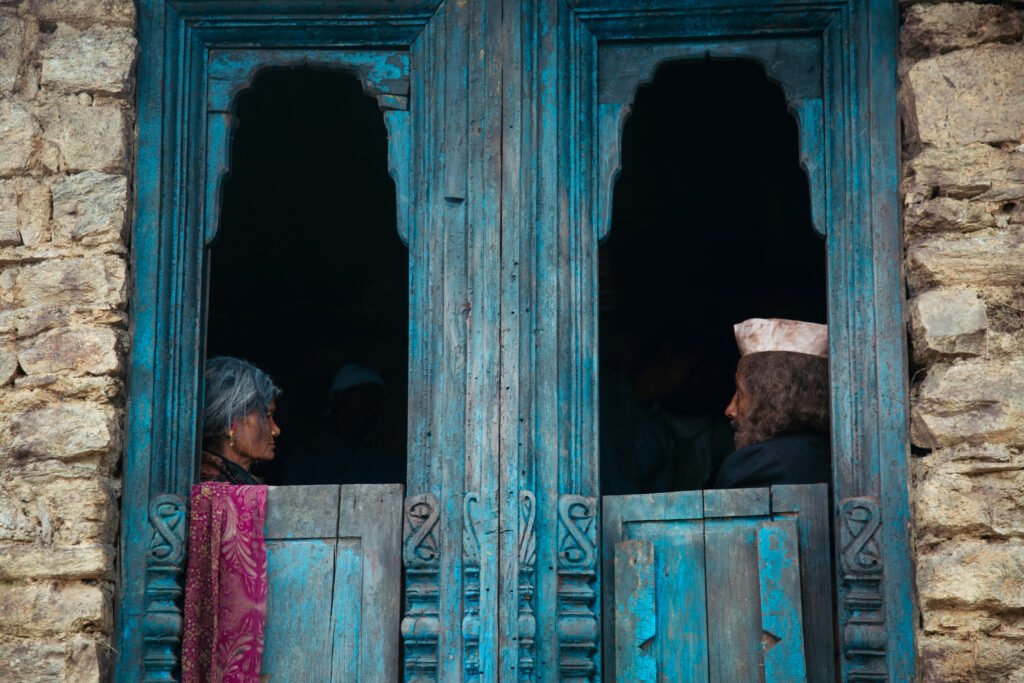
Their resilience in looking after each other might not be enough to defeat death, but it tries. Their humanity refuses to passively sit by the blue window of their traditional Pahadi house and watch the extenuating circumstances around them unfold. So Padam keeps an instrument that produces a sound when he blows into it, alerting people around him that there is an emergency. But what happens when there is nobody around to hear it? Or when Tulsi tries to use it and fails?
Interestingly, Kapri maintains that Pyre isn’t about Uttarakhand’s ghost villages. “It is about the loneliness plaguing India’s elderly,” he told The Migration Story.
“A Kumaoni couple’s loneliness cannot exist in a vacuum. The issues around them have a part to play, and cinema should reflect that. Many couples like Tulsi and Padam exist throughout the country; it is just that they are especially vulnerable because they live in a remote hamlet grappling with mass migration,” he added.
Kapri told The Migration Story that many people across ethnicities and backgrounds have reached out to him about how much they connected to Tulsi and Padam. A journalist from Karnataka told him that villages in his state are emptying too – leaving behind the elderly. In discussions with Kapri, Pyre’s music composer, Canadian national Mychael Danna, an Oscar winner for the best original score for the Life of Pi, shared that the coming years of his life will get lonelier – his concern a grim reflection of how loneliness is a universal epidemic.
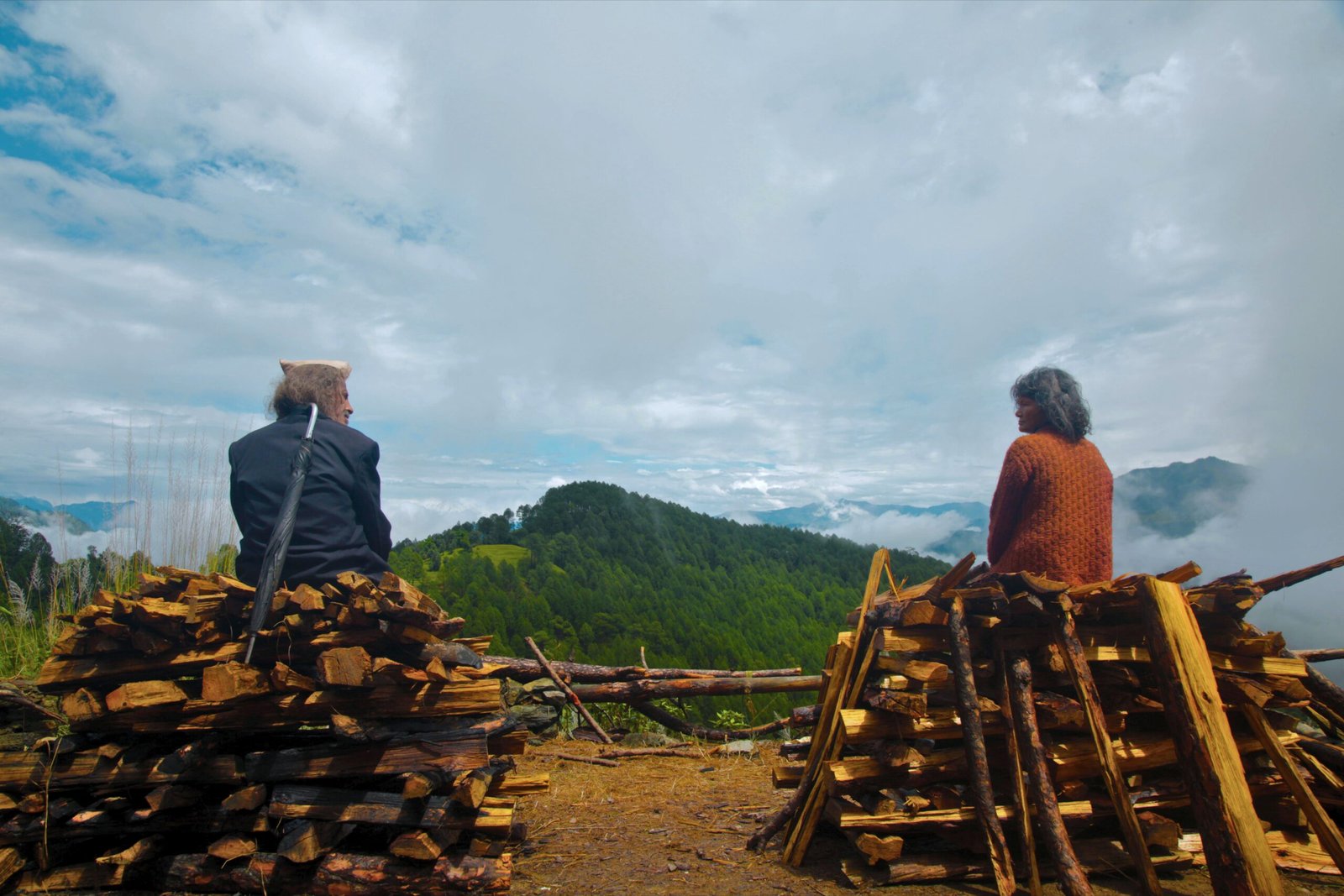
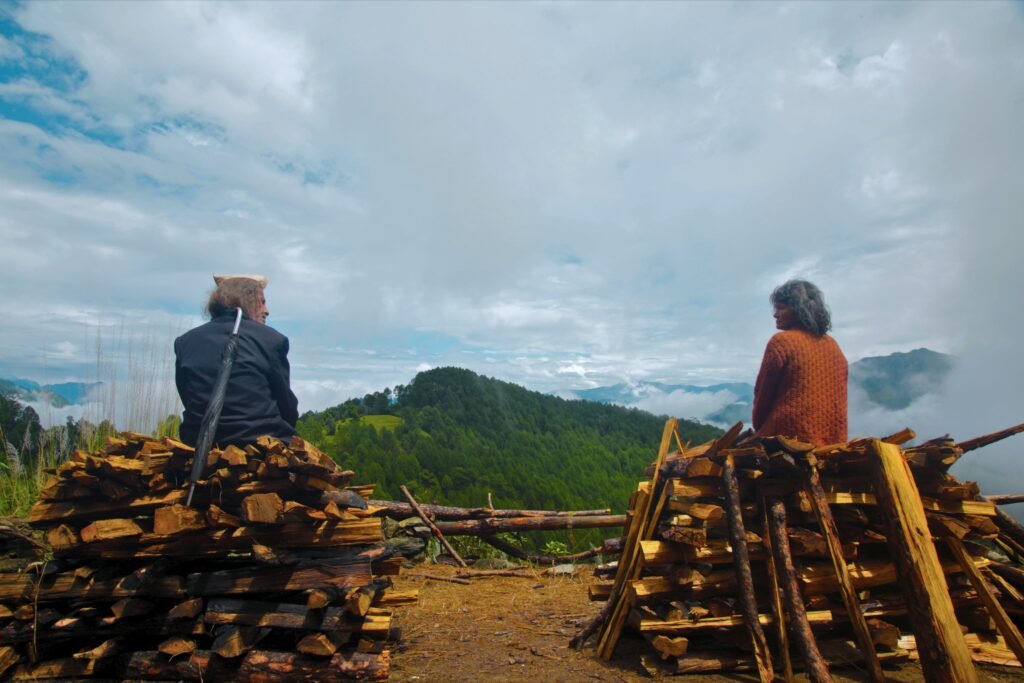
Left with no other choice, Padam builds two pyres, one for himself and the other for Tulsi. He accepts that if they die, nobody will come and take them to the nearest shamshaan ghat. Unlike a lot of films about star-crossed lovers, Pyre doesn’t entertain even an ounce of fantasy or magical realism, even when the atmosphere demands it. Tulsi and Padam do not die together. One of them outlives the other, forced to do their last rites in a ghost village. I wonder how many more haunting stories from these villages never make it to the news, and, in even rarer cases, to the silver screen.
Sarthak Parashar is a freelance journalist based in Delhi