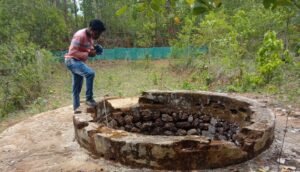

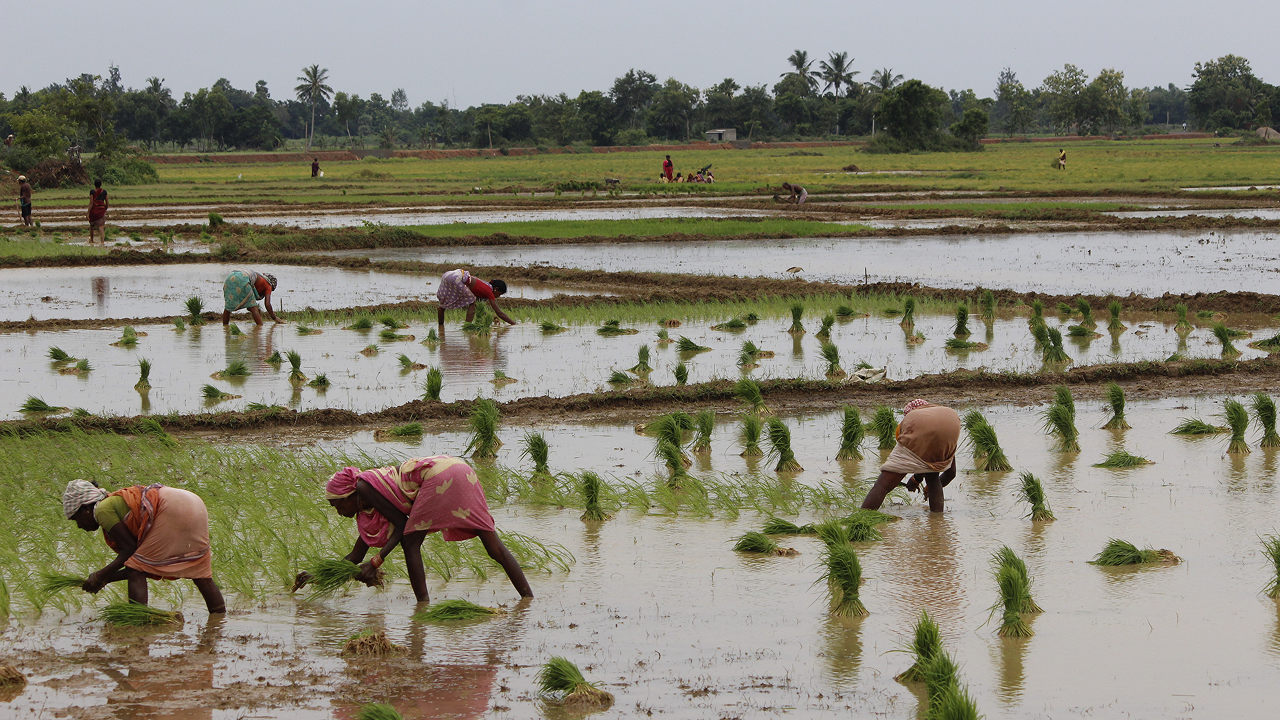
When Maheswar Nayak returned to his Gochha village in Odisha after nearly twenty years working in Kerala, it wasn’t just a simple homecoming. Using his savings, skills and the confidence he had gained, he started a small spice enterprise that now provides an assured livelihood for his family.
A few kilometres away, Lili Swain used remittances sent by her husband and son, both migrant workers, to set up a grocery shop. Over time, she expanded the business with formal credit and now runs additional services such as document printing and photocopying for her village.
But migration for many brings uncertainty instead of security.
Abhiram Majhi returned home to his village in Odisha without months of wages that he had rightfully earned working in a papad making factory in Kerala.
The families of Dillip Kumar Jena and Tiki Naik, both migrants from Odisha in Kerala who passed away there, were left to cope not only with the loss of a loved one but also with the practical challenges of bringing their mortal remains home and rebuilding their lives.
These journeys remind us that migration is not simply a journey between two places. It is a continuing relationship that links families, livelihoods, communities and institutions across the places people leave and the places where they work.
The Odisha-Kerala migration corridor has evolved over the years and continues to change. But what would it look like 20 years from now given the mounting pressures of a fickle climate, coupled with growing aspirations of a generation trying to break free from farms and the cycle of distress migration?
A JOURNEY THAT IS CHANGING
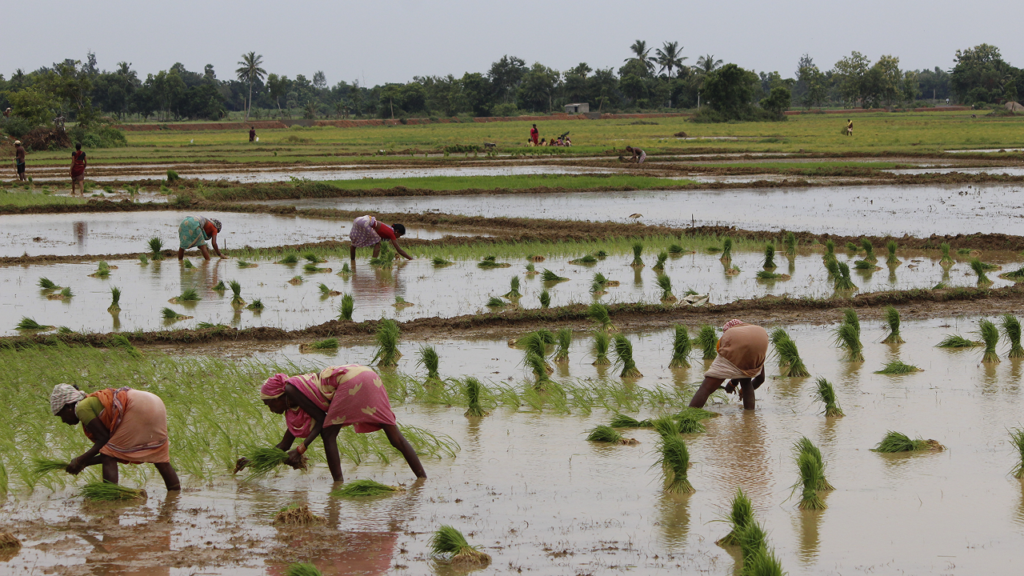
Across the Eastern Ghats region of southern Odisha, villages have been changing in ways that are both visible and subtle. Agriculture has become less dependable as climate uncertainties have grown. Roads, education, mobile connectivity and access to information have expanded people’s horizons, while young people increasingly aspire to livelihoods beyond farming. Yet local employment has not kept pace. Mechanisation has reduced the demand for labour, non-farm opportunities remain limited, and for many households the challenge is no longer simply finding work, but finding work that is regular enough to build a predictable future.
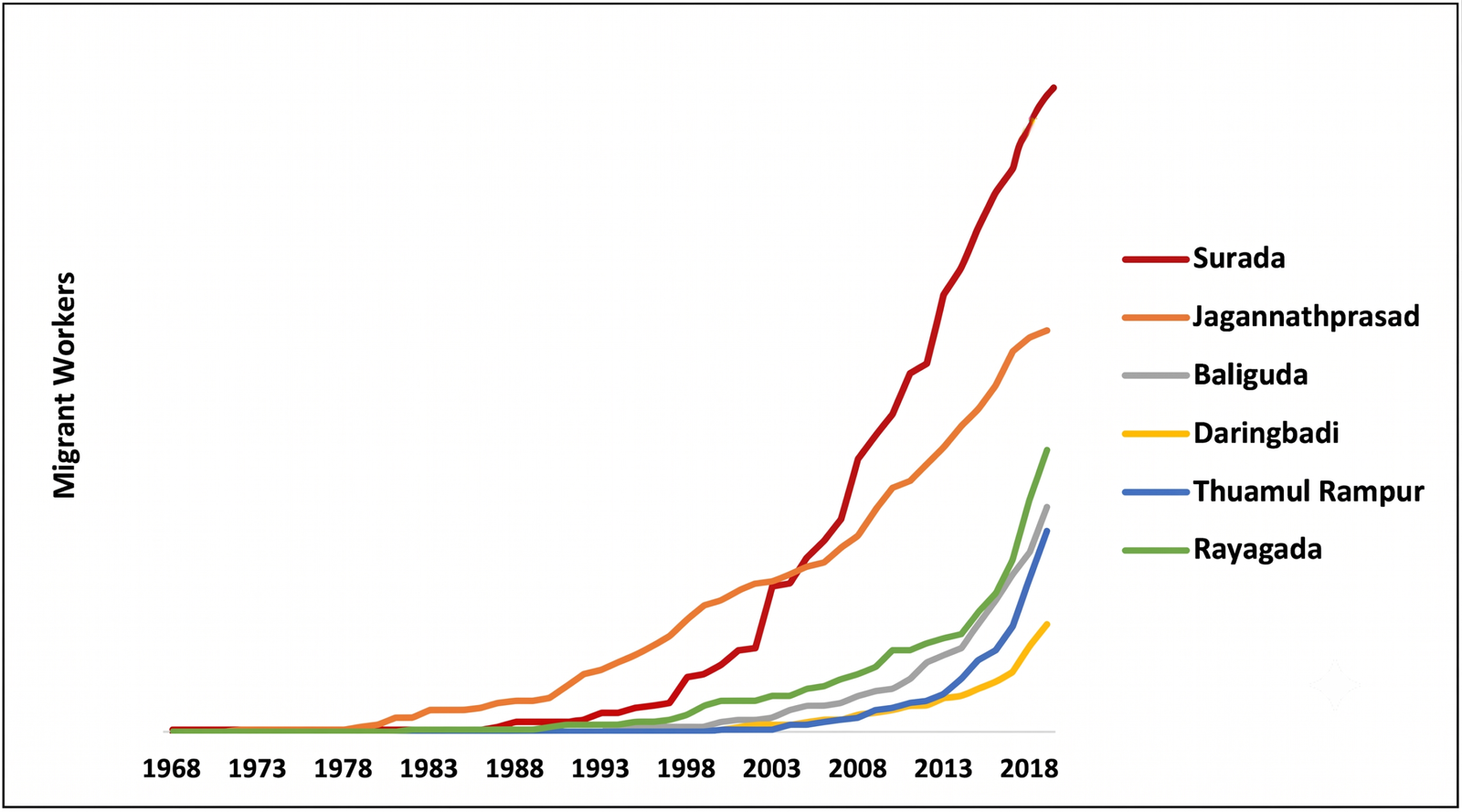
Against this backdrop, labour migration has evolved from an occasional response to hardship into one of the region’s most important livelihood strategies. What began as movement within Odisha and to neighbouring states gradually expanded into a network of migration corridors across Southern and Western India. The pace of this transformation has varied across southern Odisha, reflecting changing livelihood opportunities, social networks and labour demand.
Migration has grown steadily over the past five decades, although the timing and pace have varied considerably
Yet the story does not end here. The migration corridors that have emerged over the past five decades are themselves changing. Climate change, demographic transitions, changing aspirations and evolving labour markets are reshaping both the places people leave and the places they travel to. Among these, the Odisha-Kerala corridor offers a particularly compelling lens through which to explore the future of migration in a changing climate. What might this relationship look like in 2047? More importantly, what choices do we need to make today to ensure that migration remains safe, dignified and resilient?
Why Think About Migration Through a Corridor?
Migration is often understood as a journey from one place to another. But the movement of workers is only one part of a much larger story. Along the way travel remittances, information, ideas, skills, aspirations and relationships that reshape lives at both ends. Families make decisions together, social networks influence where people go, labour intermediaries connect workers to employers, and transport and communication keep households linked across long distances. For many families, migration has become part of everyday life, with some members remaining in the village while others live and work elsewhere.
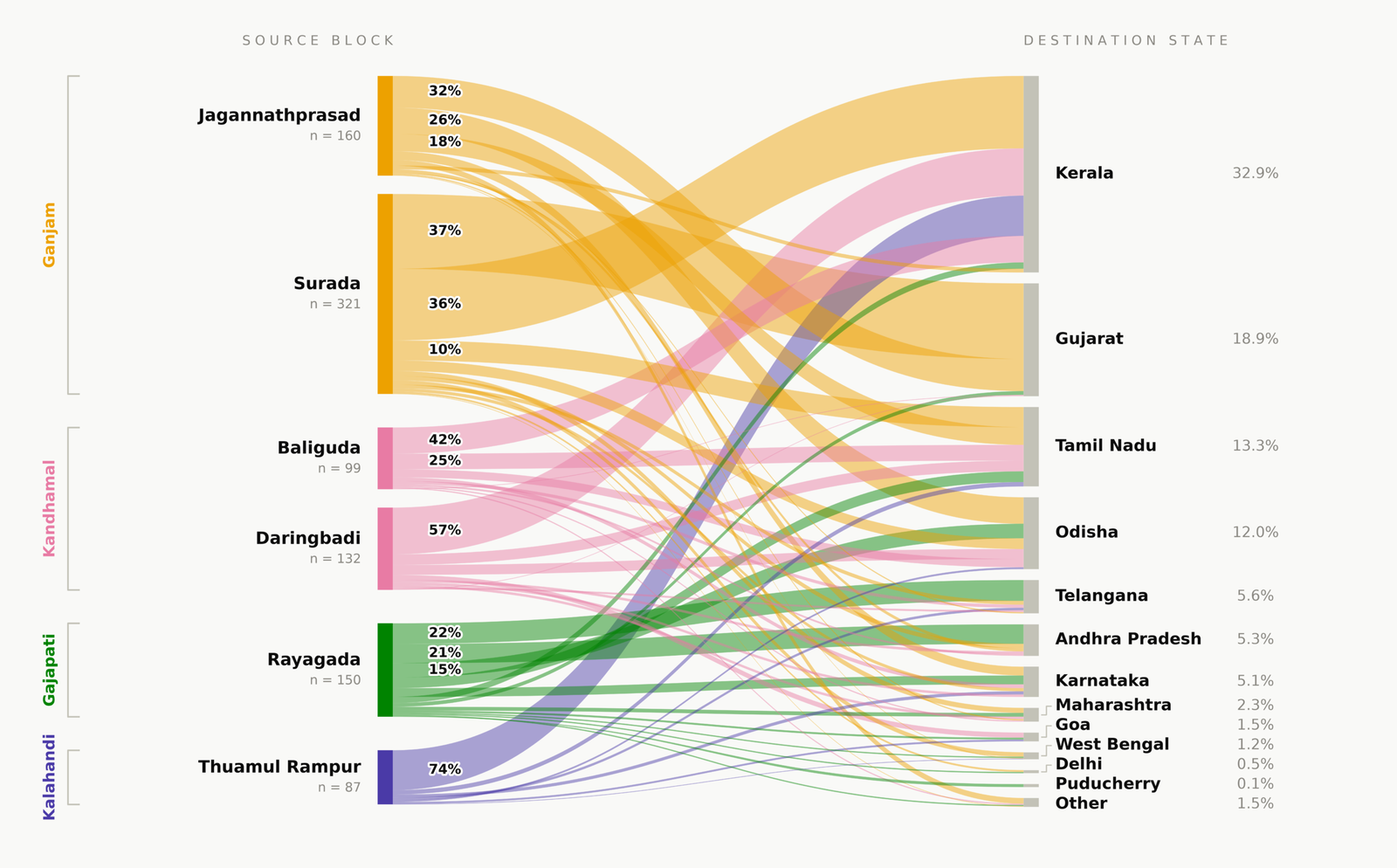
Seen in this way, the Odisha-Kerala migration corridor is not simply a connection between two states. It is an interconnected social, economic and institutional system in which changes at one end inevitably influence outcomes at the other. Looking at migration through the lens of a corridor shifts attention from isolated places and individual journeys to the relationships that sustain mobility over time. It also changes how governments need to respond. Worker safety, access to social protection, disaster preparedness, emergency response and labour market governance all depend on institutions working across the corridor rather than within state boundaries alone. It is this broader perspective that makes it possible to ask not only how migration works today, but how it may evolve in the decades ahead.
Why Look Twenty Years Ahead?
The migration corridor linking southern Odisha and Kerala has evolved over the past two to three decades. Yet its future will not simply be an extension of its past. The forces that have shaped this relationship continue to evolve, while new ones are emerging. Understanding where the corridor is heading therefore requires looking beyond present-day migration patterns to the wider transitions taking place at both source and destination.
It was this realisation that brought Gram Vikas, the Centre for Migration and Inclusive Development (CMID), and the Indian Institute for Human Settlements (IIHS) together through the Climate Change Local Adaptation Pathways (CLAPs) initiative. As part of this collaboration, the three organisations convened researchers, government representatives, migrant support organisations, media professionals and practitioners from Odisha and Kerala around a shared question: What is the future of safe, dignified, resilient and inclusive livelihood choices along migration corridors in the context of climate change?
The emphasis on livelihood choices was deliberate. Migration is only one of the ways in which people adapt to changing circumstances. To explore how these choices might evolve, the partners adopted a foresight approach. Rather than attempting to predict a single future, foresight explores multiple plausible futures and then works backwards to identify the institutions, partnerships and policy choices needed to create the most desirable one.
Applied for the first time to an interstate migration corridor in India, this approach invited participants to think beyond immediate challenges and consider how migration, livelihoods and governance might evolve over the coming decades. The exercise explored how livelihood choices could change under different futures, and what institutions would be needed to expand rather than constrain them.
A CORRIDOR UNDERGOING MULTIPLE TRANSITIONS
Kerala’s comparatively high wages have been one of the strongest drivers of migration from southern Odisha. As the State has undergone an advanced demographic transition, an ageing population and expanding economy have created a sustained demand for workers in the informal economy. But wages alone do not explain why the Odisha-Kerala corridor has continued to strengthen. Many migrant workers, particularly those from socially disadvantaged backgrounds, describe other reasons for preferring Kerala over traditional destinations such as Surat. They speak of steadier employment, relatively better housing, more respectful workplaces and fewer experiences of discrimination. These experiences have strengthened social networks, encouraging more workers to follow the same migration pathways over time.
The corridor has undoubtedly expanded livelihood opportunities, but it has also revealed the vulnerabilities that accompany migration. Employment remains largely informal, wages often remain below those of local workers, and workplace accidents and deaths can have devastating consequences for households back home. When difficulties arise, obtaining compensation, accessing social protection or seeking legal support is rarely straightforward. These realities underline the need for institutions that support workers and their families throughout the migration journey.
For many households, migration has become a predictable part of life rather than an occasional response to hardship. Regular movement between home and destination provides a more reliable source of income that supports farming, housing, education and savings, strengthening resilience to climatic and livelihood uncertainties. Increasingly, migration is becoming part of how families adapt, rather than simply how they survive.
At the same time, both ends of the corridor continue to evolve. Climate variability, changing agriculture, education and rising aspirations are reshaping villages across southern Odisha, while demographic change, labour shortages and emerging sectors such as the care economy are transforming Kerala’s labour market. The future of the corridor will therefore be shaped not by climate change alone, but by the interaction of environmental, demographic, economic and social change unfolding simultaneously at both source and destination.
Imagining a Better Future
Across the different futures that were explored as part of CLAPs research, two priorities consistently stood out: greater job security and more proactive management of climate risks. As one participant observed, when both the source and destination are prepared and employment remains stable, even a cyclone may cost the corridor only a few days of work rather than an entire year’s livelihood.
The future that emerged was not one without migration, but one in which migration had become safer, more informed and more dignified. People continued to move in search of opportunities, supported by institutions that enabled them to prepare for the journey, travel safely, access assistance when needed and return home with confidence. Migration remained an important livelihood choice, but no longer depended solely on the resilience of individual workers and their families.
This vision extended far beyond employment, recognising that a resilient migration system must connect changing livelihoods at the source with safer travel, stronger institutions and better services along the journey, and decent work and social protection at the destination. It acknowledged that such a system cannot be built at one end of the corridor alone, but must be strengthened across the entire migration pathway.
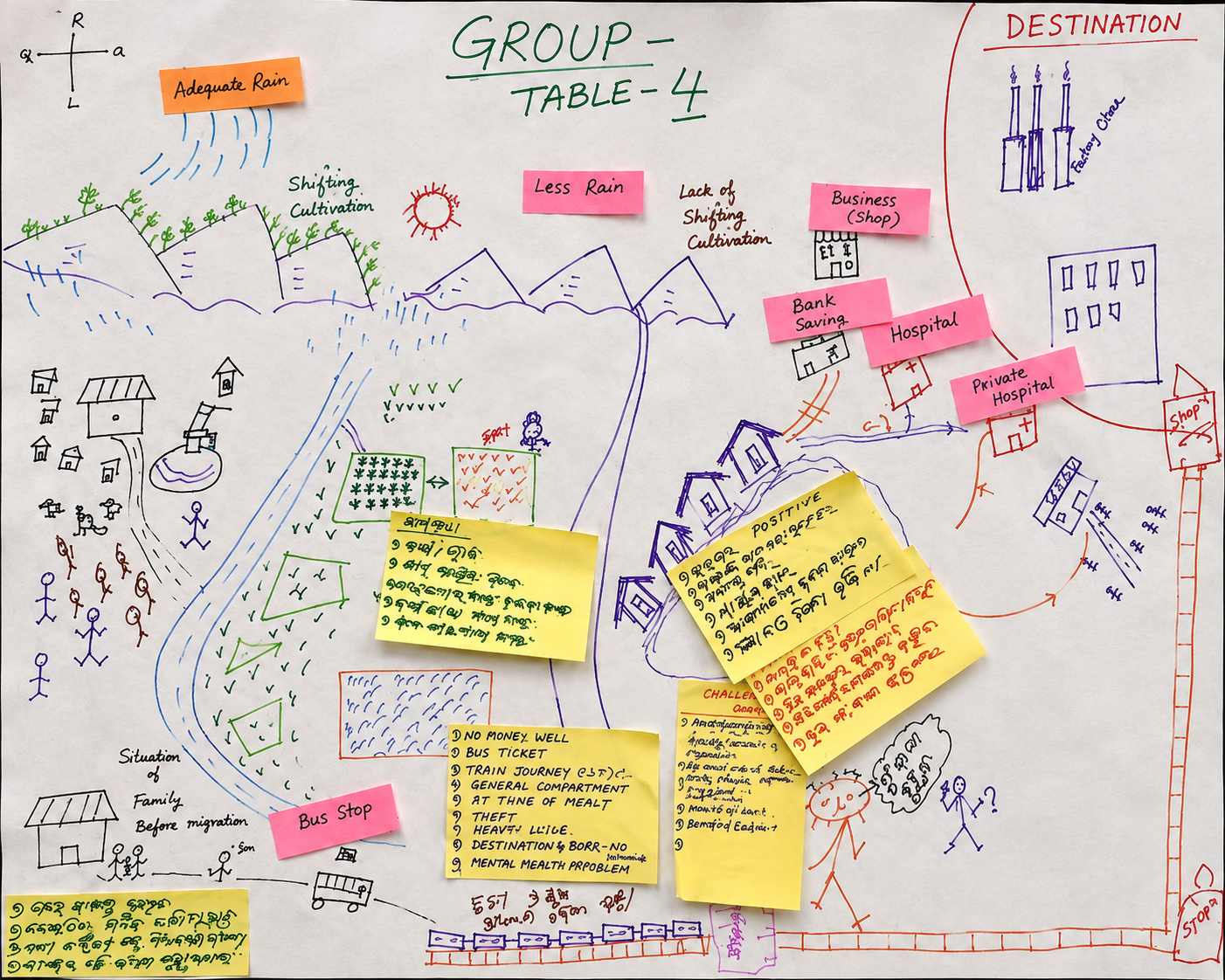
The discussions undertaken as part of CLAPs work consistently pointed towards a migration system that is coordinated rather than fragmented. Governments, employers, civil society organisations and migrant communities each have distinct roles, but their efforts are connected across the migration pathway. Information, social protection, grievance redressal, skills, financial services and emergency support are no longer treated as isolated interventions, but as parts of a single system that enables workers to move safely, build secure livelihoods and contribute to the wellbeing of both source and destination communities.
THE FUTURE IS SOMETHING WE BUILD
The Odisha-Kerala corridor reminds us that migration is not simply about moving from one place to another. It is about how people respond to change, how families build more secure futures, and how institutions adapt to support them. Looking at migration through the lens of a corridor allows us to see these relationships more clearly, and to prepare for the changes that still lie ahead.
The foresight exercise demonstrated that the future of this corridor will depend not only on economic opportunities, but also on the institutions, partnerships and relationships that connect people across it. Safe and dignified migration cannot be achieved by any one department, organisation or state acting alone. It requires collaboration across the entire migration pathway, linking livelihoods with social protection, climate adaptation and regional development.
Ultimately, the value of the corridor will not be measured by the number of people who move between Odisha and Kerala. It will be measured by whether migration helps families build assets, expand opportunities for their children and create pathways towards greater dignity, resilience and intergenerational social mobility.
Benoy Peter is one of the co-founders and the executive director of the Centre for Migration and Inclusive Development (CMID).
Chandni Singh is an Associate Professor, School of Environment & Sustainability, IIHS. She leads the Climate Change Local Adaptation Pathways (CLAPs) project and works at the intersection of climate change adaptation, livelihood transformations, and rural and urban development.
Liby T Johnson is the Executive Director of non-profit Gram Vikas, Odisha. He has led large-scale, impactful efforts over nearly three decades in the community development sector in India with civil society and governments.