In December, 2019, 65-year-old Nisar Sheikh left his home in Telangana for Vadodara in Gujarat to earn a living. He never returned home.
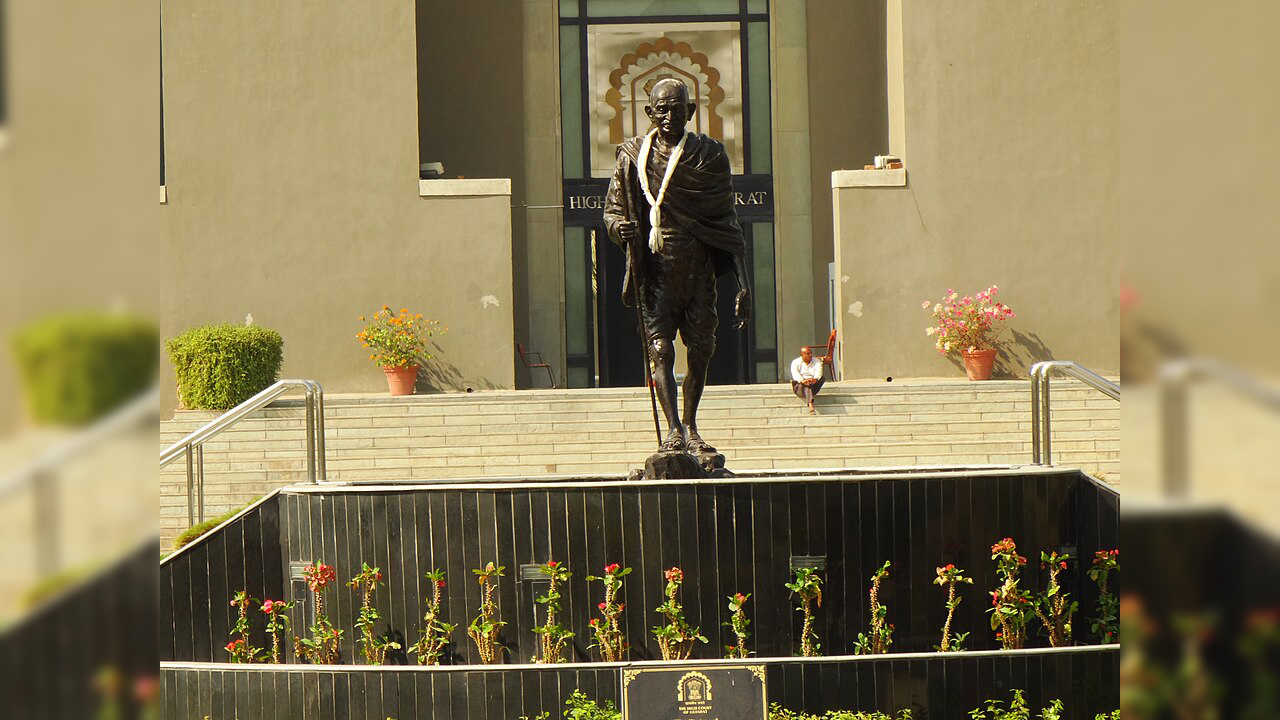
His youngest son, Salim Sheikh undertook multiple journeys to look for his father in an alien city, going from police stations to government offices, searching for him. He eventually approached the Gujarat High Court with a habeas corpus petition seeking answers about his missing father.
The search for a missing migrant worker is riddled with challenges for their families.
“When a migrant worker goes missing, families often do not know who to approach or how to navigate authorities in another state,” said Arindam Banerjee, co-founder, Policy and Development Advisory Group (PDAG), which helmed the Jharkhand Migration Survey.
“States need dedicated, widely publicised helplines or control rooms for migrant workers, with the authority to coordinate directly with destination states. Such mechanisms can, at the very least, help mitigate the crisis and ensure that a missing worker’s trail is not lost,” he said, adding that in the longer term, there is a need for panchayat-level mobility data.
“Panchayats are closest to migrant households and can act as custodians of basic information on who has migrated and where.”
It’s been seven years since Salim’s father went missing, and he now seeks closure.
My name is Salim Sheikh. I am around 40 years old. I am the youngest of eight children of my parents. I am a native of Kamareddy district in Telangana, but like my father before me, I now live away from home for work. I currently live in Nanded in Maharashtra with my wife, daughter, and son, where I run a small scrap business and earn around 20,000 rupees a month.
In December 2019, my world turned upside down when my father went missing. My father’s name was Babu Nisar Shaikh. He was 65 years old when he went missing from Vadodara city in Gujarat.
As far as my memory goes, he sold saris and bedsheets, riding a rented bicycle across cities near Kamareddy. I was very young, maybe five years or so, when my father had already started migrating for work. I saw him rarely, our interactions were limited. But my mother would always tell us how hard he worked to provide for us and meet our needs. When I grew up, I understood him more. His relentless care and support for the family and the responsibilities he shouldered all by himself for our family of ten.
When my eldest brother suddenly died in 2018, my father felt he had to work more to provide for the family. He wanted all of us to settle down and not move from one place to another doing odd jobs.
He learned about the textile industry in Gujarat and decided to move to Gujarat in early 2019, to make a living. He worked at textile units in Ahmedabad and travelled between Ahmedabad, Surat and Vadodara to sell saris.
In Ahmedabad, he rented a room near Shah Alam Dargah. Once he understood the work a little better, he asked my brother-in-law to join him. My father wanted us to eventually set up a shop in our native place and sell saris and other fabrics there. That was his plan. He trusted my brother-in-law with helping him make this happen.
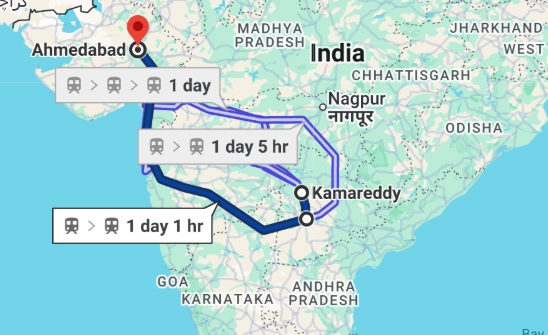
On December 9, 2019, my father and my brother-in-law boarded a train to Ahmedabad from Hyderabad. I still have a copy of their train ticket with me. From Ahmedabad, they went to Vadodara on December 10 because my father wanted to sell some bedsheets there. My father got down and asked my brother-in-law to meet him at a famous food joint in the city, after a few hours.
My brother-in-law waited for him, but my father did not return. My father never carried a phone. He was 65 years old, he did not understand these new age phones, even the most basic ones and always felt that carrying a phone would mean extra responsibility to keep it safe. So we did not speak a lot when he was away from home, which was most of the time. He remembered our phone numbers though, and would call us from other people’s phones.
My brother-in-law thought my father might have gone back to Ahmedabad on his own. So, he also returned to Ahmedabad. But my father was not there.
It was my brother-in-law’s first time in Gujarat, in a new city. He did not know what to do and so he called me.
We did not think that something untoward may have happened to my father. He used to travel for work and we thought he might have gone somewhere.
I booked a general train ticket from Kamareddy to Ahmedabad. It was a 25-hour-long journey. I did not know back then that this would be the first of many such journeys for me. I had never been to Gujarat before; this was the first time. I did not know Gujarati; the place did not feel familiar.
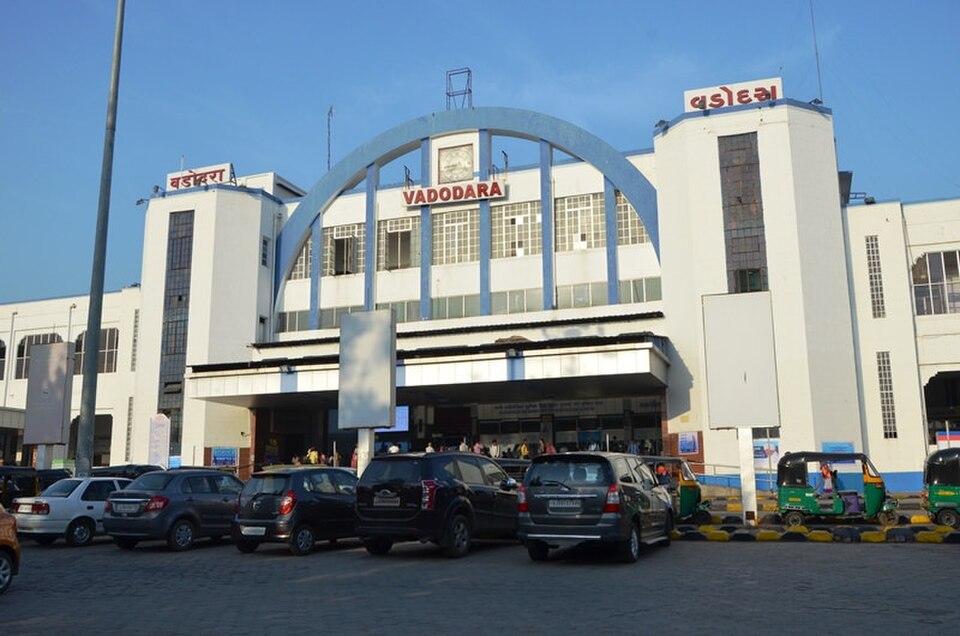
For the first five days, I travelled to Vadodara every day from Ahmedabad – where my father had rented a place – boarding a daily passenger train and searching for my father. Almost eight hours of commuting every day, to and fro and as many hours of looking for him.
I first went to Sayaji Hospital. I checked every ward in the hospital. I spoke to the security guards, nurses and patients. I carried a photograph of my father and showed it to everyone.
I would ask them if they had seen him, but the answer was always no. I looked for him at the bus stop and on the footpaths, but we could not find him.
After five days, I ran out of money and returned to Kamareddy. At that time, we still thought that my father might have gone to a relative’s house. We called our relatives and asked them. But nobody had seen him.
When people in my neighbourhood in Kamareddy learned that my father was missing, they helped us. People from all backgrounds, all religions, local leaders, and everybody pooled in money to send us back to Gujarat so that I could resume my search again.
We collected around 32,000 rupees and returned to Gujarat.
Back then I would fumble in taking the names of the places in the city because they sounded different. Today, I am well-versed with them.
I came back to Ahmedabad. This time, my mother also joined me.
Every morning, we would leave Ahmedabad for Vadodara. My mother would pack food in a tiffin and travel with me. My mother knew that home-cooked food could help, just to still feel homely in this foreign land, while looking for a lost loved one.
Before leaving the room in Ahmedabad, we would leave the key with our neighbours. We told them that if my father returned, they should give him the key. We were always hopeful that he would return.
I would take the morning train and go to Vadodara. I searched at the bus stand, hospitals, the mental hospital and shelters for homeless people.
I tried to find out about unidentified people who had died on railway tracks.
Wherever somebody told me to go, I went.
I did not know Vadodara well. We were from outside and I did not know which places to search.
During this time, I met an autorickshaw driver named Zayed. He was also a migrant from Uttar Pradesh. He spoke Hindi well and knew Vadodara.
He became my go-to person. I would call him minutes before our train reached Vadodara station and he would come to the railway station. I would make a list of all the places I wanted to visit in a day, and he would take me there. He also suggested places where I could search for my father.
Depending on the distance, I would pay him 300 rupees to 500 rupees a day.
I did this for 22 days. And then I could not do it any more.
On January 28, 2020, I went to Sayajigunj police station in Vadodara to file a missing person’s report. I had been to the police station before just to check if my father had been there. But this was the first time I was stepping inside the police station, feeling like a helpless son.
When you have large families, the love gets divided, but I was the youngest and I got extra love and care from everyone. I remember from whatever little time I spent with my father, if I would lose something, I always reached out to him. A pencil, a toy, a ball. He always found it for me.
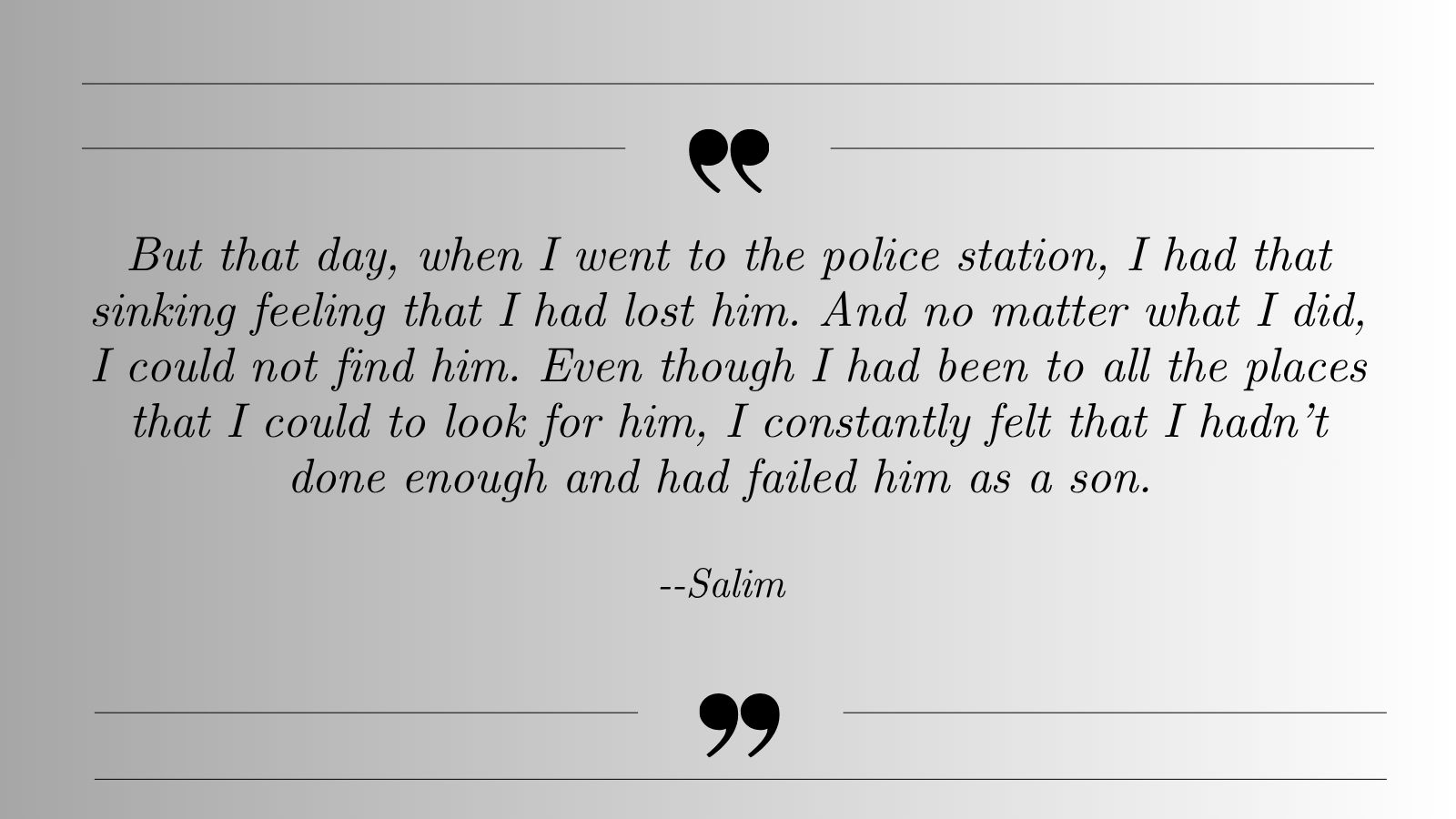
But that day, when I went to the police station, I had that sinking feeling that I had lost him. And no matter what I did, I could not find him. Even though I had been to all the places that I could to look for him, I constantly felt that I hadn’t done enough and had failed him as a son.
The police asked me to bring a photograph of my father. I just had one photograph of him. A passport size photograph. Blue shirt, spectacles, his happy yet tired face from all the hard work he had been doing. That is all that is left for me.
The police told me they would first check CCTV footage from the place where my father was last seen and then file the missing person’s report. In the CCTV footage, my father was seen moving on his bicycle towards Fatehgunj area. I identified him and based on his last spotting, a missing person’s report was filed.
We continued searching independently as well.
We went to Ahmedabad again and published information about my father in a newspaper. At Ahmedabad railway station, we pasted photographs of him with a message in Gujarati for people to understand and contact us.
Our visits to the police station had become routine by now. Around a month or so after filing the missing person’s report and our repeated follow ups with the police, someone at the police station told us that an inquiry was underway at Fatehgunj police station.
We also learned that my father had allegedly been brought to the police station the day he went missing. We went there and asked the police about him. They only said that an inquiry was underway.
I asked for the CCTV footage from December 10, 2019 of the police station. But till today, we do not have that CCTV footage nor do we know why he was brought to Fatehgunj police station.
We weren’t sure what had happened, but we thought maybe he was arrested for something, but then why weren’t we informed? Is that how it works?
There was one policeman at the police station, with a moustache, who I can’t forget.
He told me, “Jab Allah aur Ishwar ek ho jayenge, tab tumhare pitaji mil jayenge. (When Muslim and Hindu gods unite, you will find your father). ”
Until that point, I was hopeful that my father was somewhere. I thought maybe he was not well. Maybe he was injured. But I believed he was alive. After the policeman said this, we felt that something had happened to my father.
I got the contact of a lawyer from a person who saw me making multiple visits to the police station. In June 2020, I filed the Habeas Corpus petition at the Gujarat High Court, with guidance from the lawyer about my missing father. Police investigations into the missing person’s report revealed that my father was picked up in a case of theft by the Fatehgunj police the day he went missing. The police registered an FIR in July 2020 and the investigations that followed revealed what we had dreaded: he was tortured in custody and was no longer alive.
His body was never found. We could never say a final goodbye to him.
In August the case was transferred to the CID.
But progress on the case slowed down owing to the pandemic lockdown.
After learning about my father’s death, my uncles asked us to divide the house in Kamareddy where we stayed. It belonged to the brothers; it was a small house, and families were now expanding. We had to walk out because we also needed the money from our share to fight the case. I moved to Nanded, because Maharashtra offers better opportunities for migrant workers like us.
I have two other brothers, both daily wage workers. I have been involved in the case since the very beginning so I am still fighting. But we all pool in money for any legal expenses that we have to incur. So far we have taken a loan of 3 lakh rupees.
If I get a call about the case, I take a general ticket and leave, whenever I am expected to be there. I have lost count of the number of times I have made this journey so far.
Every time I have to go to Gujarat, I shut down my shop. Then I have to pay for the train ticket, food and local travel.
We manage our expenses, because the legal expense is our priority until we get justice, only then my father will rest in peace, only then we will get closure.
But I am pretty sure that I do not wish to migrate to any city of Gujarat and work there.
My heart does not say that I should work there.
Whenever I take the train to Ahmedabad for the court case and the train crosses Vadodara, I can see the antenna on top of Fatehgunj police station.
It is visible from the train.
Whenever I see it, my heart hurts.
I have children. My eldest daughter is 11 years old.
I want to be like my father to them – I want to work to ensure that they get to live a better life than I have lived. But I want to be more present too, with them, so they can make more memories and cherish them too.
My children do not know what happened to their grandfather. But now they are growing up and hear conversations and probably have questions. I will answer them some day.
I do not want them to lose trust in the system. I want them to study really hard and make a good living and not struggle the way we did.
There are things that you realise only after a person is gone. I wish I had sat down with him more, even as we worked to make ends meet, to talk a little more about our lives. I wish I had more than just a photograph of him. I wish I hadn’t let him travel all the way to Gujarat alone. I wish I had hugged him one last time when he boarded the train to Ahmedabad. But how would I have known that it was the last time I was seeing him.
Migration has been a part of my family’s life for years. We have moved from one city to another in search of work and better earnings.
But after my father’s disappearance, however, migration took on a completely different meaning for us. For years now, I have travelled the same routes he once took for work, only I travel to search for answers and fight for justice.
Aishwarya Mohanty is special correspondent with The Migration Story
The case is currently ongoing in the Gujarat High Court