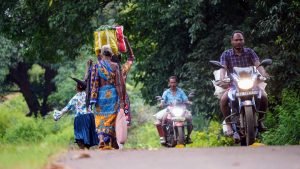
UDAIPUR, Rajasthan: At 7 am every morning, Soni Gameti,43, boards a white private bus from Nal Moti village in Jhadol block of Udaipur district in Rajasthan. Her daughter, Santosh, 18, joins her.
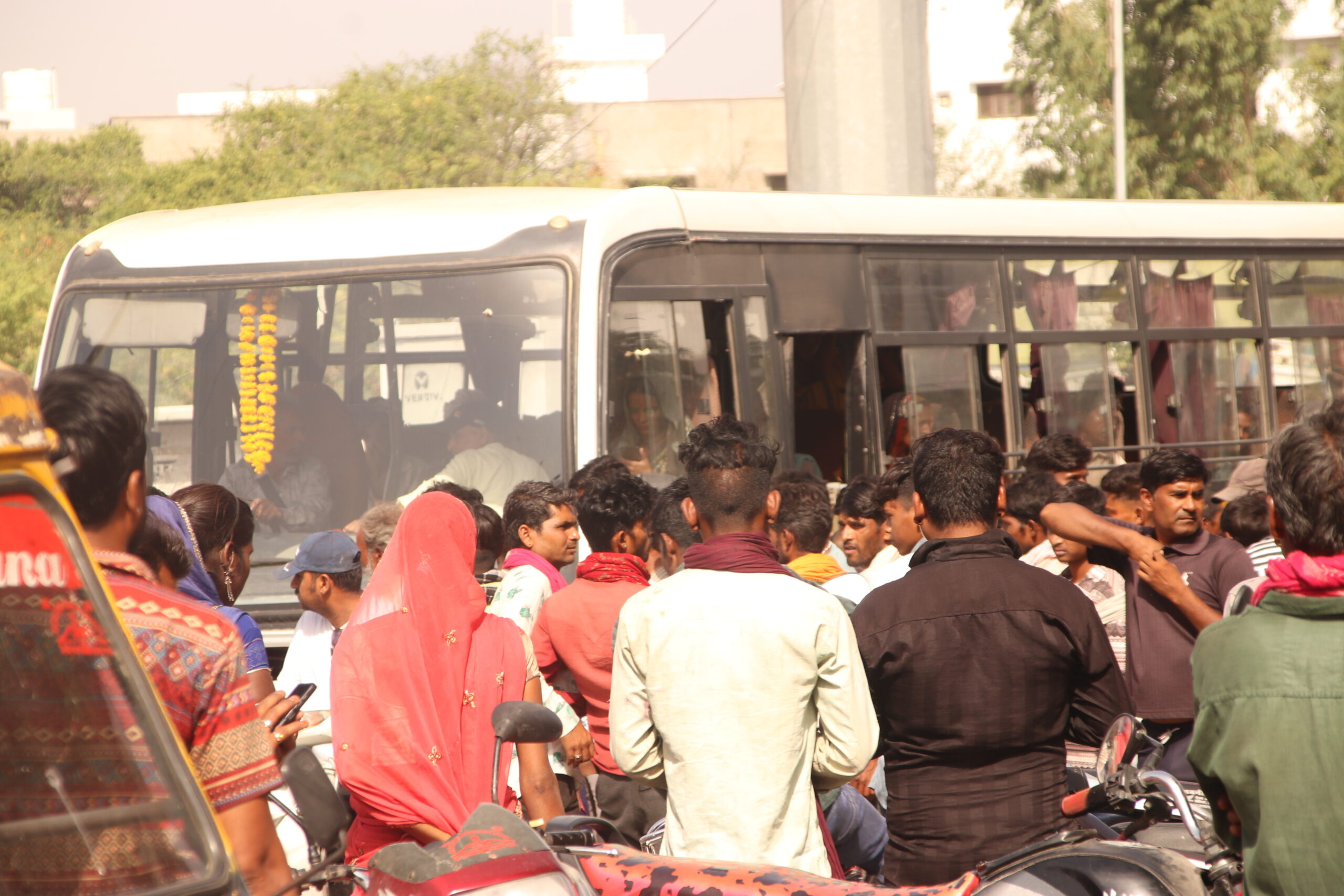
Its windows are crowded with faces, its seats long filled. Marigold garlands hang from the windshield while workers cluster around its doors, waiting for a place inside. The mother-daughter duo board the bus everyday to commute to Udaipur city for work, 60 kms away.
By the time it reaches the city, it has gathered passengers from dozens of hamlets scattered across the hills. This is one of more than 30 buses that ply daily between villages, often connected by narrow interior roads, from different blocks of Udaipur district to the main city of Udaipur.
For Soni and her daughter – the bus determines whether they get work, how long they can remain at work and whether they return home that night.
In the evening, the same bus leaves Udaipur at around 5 pm.
Miss it, and there is no way back home.
As India continues to experience increasing temperatures, public advisories issued during heatwaves by the Centre, states and districts, routinely urge people to stay indoors between noon and 3 pm, warning that these are the most dangerous hours of the day.
For Soni, however, those three hours are often the busiest part of her workday, like many others.
“If I stop work between 12 and 3 in the afternoon, I might have to put in additional hours in the evening to complete a seven-hour work day. But how can I do that when my bus leaves at 5 pm everyday and I have to wind up work by 4:30 pm to catch the bus,” Soni said, as she and her daughter step onto a crowded road leading towards Syphon Square, one of Udaipur’s busiest labour pick-up points, where their workday begins.
“If I take unnecessary breaks, my wage will be cut and I can not afford that,” she added.
The bus service is their only reliable link between home and the city where they earn a living. The bus also helped people like Soni to stop migrating to far off cities, instead finding work in Udaipur itself.
But as temperatures rise and authorities advise workers to avoid the hottest hours of the day, fixed transport schedules leave little room for them to adapt, the workers said.
Years ago, the commute from these distant villages looked different.
“Earlier we had open jeeps that took us to the markets. We had very few buses,” said Vagtaram Gameti (60), who started commuting for work to Udaipur this year and works at the same site as Soni.
Until last year, Vagtaram migrated to work at stone quarries, but after developing health issues he wanted to look for work closer to home.
“I have two sons who have migrated to Rajkot and Ahmedabad for work, with their families. I have four daughters to raise and there is no other earning member than me,” he said.
“I take five pills a day for my health that pulls me through the day. I have no choice,” he added, showing a small pouch with the medicines that he carries everyday to work.
“Jeeps did not feel safe, there were accidents on the highway. But slowly, the number of these buses increased, around 15 years ago and since then it became easier,” he added.
To meet this demand, the transit corridor adapted. In the morning, there are at least two private buses running for every single village, maximizing transit when workers need to reach the city.
Dinesh Sen, who has been driving one of these routes for years, said the number of buses connecting remote villages to Udaipur has steadily increased over time. But whether more buses led to more commuters or growing demand encouraged operators to add more buses is difficult to say.
“Both happened together,” he said. “There are many more people travelling for work now, and there are also more buses than before. It is difficult to say which came first.”
According to Sen, a few buses continue operating after 6 pm, but they are of little use to many labourers travelling from remote villages.
“The later buses mostly serve shorter routes and do not go to every village. People from faraway villages cannot depend on them,” he said.
Drivers and conductors know their regular passengers personally.
When cash is short, they permit labourers to travel on credit, tracking fares until wages come in.
“There is no monthly pass as such, but now I know my passengers. If they do not have money, I know they will pay whenever they are paid their wages. We take care of each other,” he added.
State transport buses also continue to operate, even after 5 pm, but they rarely meet the needs of workers travelling from distant villages.
“State buses typically drop passengers only at a central block-level hub. From there, we have to walk long distances or wait for some other vehicle. With my young daughter with me, I can not take that risk,” Soni said.
Dharmraj Gurjar, block coordinator of Gogunda, at Ajjevika Bureau, a public service organisation, working for migrant workers in India said these buses are often the only option for a lot of families. “We get distress calls a lot of times when they miss a bus and either hitch hike or take a state transport bus and reach the block headquarters, but their villages are still far off and they can’t travel at night. We make arrangements to help them spend the night at the block headquarters in such a case,” Gurjar said.
For her, securing work usually means earning around 1000 rupees for the day, including her daughter’s wage. For the last ten days she has been working at the same construction site. That money keeps her family afloat.
Until five years ago, Soni and her husband migrated to different cities in Gujarat, finding work at construction sites for at least eight months in a year. But a return during the COVID-19 pandemic, prompted them to stay back in the village. The bus service provided a livelihood lifeline.
“My husband had been keeping unwell and we started looking for work nearby, but two years ago, he met with an accident and has been unable to work since then,” she said, adjusting her white and blue dupatta covering her head.
“I have four daughters including Santosh, the other three are younger and go to school. I have an elder son, who migrates to Gujarat for work. But we can not support such a large family with just his income. So If I do not work everyday, how will we manage food and other basic supplies for the family,” she added.
Her house is the last house on a small hillock without a motorable road. Closer to her home, on the sloped hill, her family owns less than one acre of land. “During the monsoon we grow maize and peanuts. We use that for the family, there isn’t enough to sell,” she said.
“But apart from those three four months of monsoon, our land remains barren. There isn’t anything that we can grow. So, there is no other option but to look for work outside the village. And I can not travel to other states now because I have to return home to take care of my husband who needs constant care after the accident,” she added.
In difficult months, the family sometimes barters produce for essentials with other villagers.
Across large parts of Southern Rajasthan, seasonal agriculture is no longer enough to sustain households throughout the year, leading to out migration mainly to different cities in Gujarat and Maharashtra.
“During summers our village empties out. Everybody migrates for work either to Gujarat, Mumbai ir Udaipur as the farmlands are dry and there is no work in the village,” Soni said.
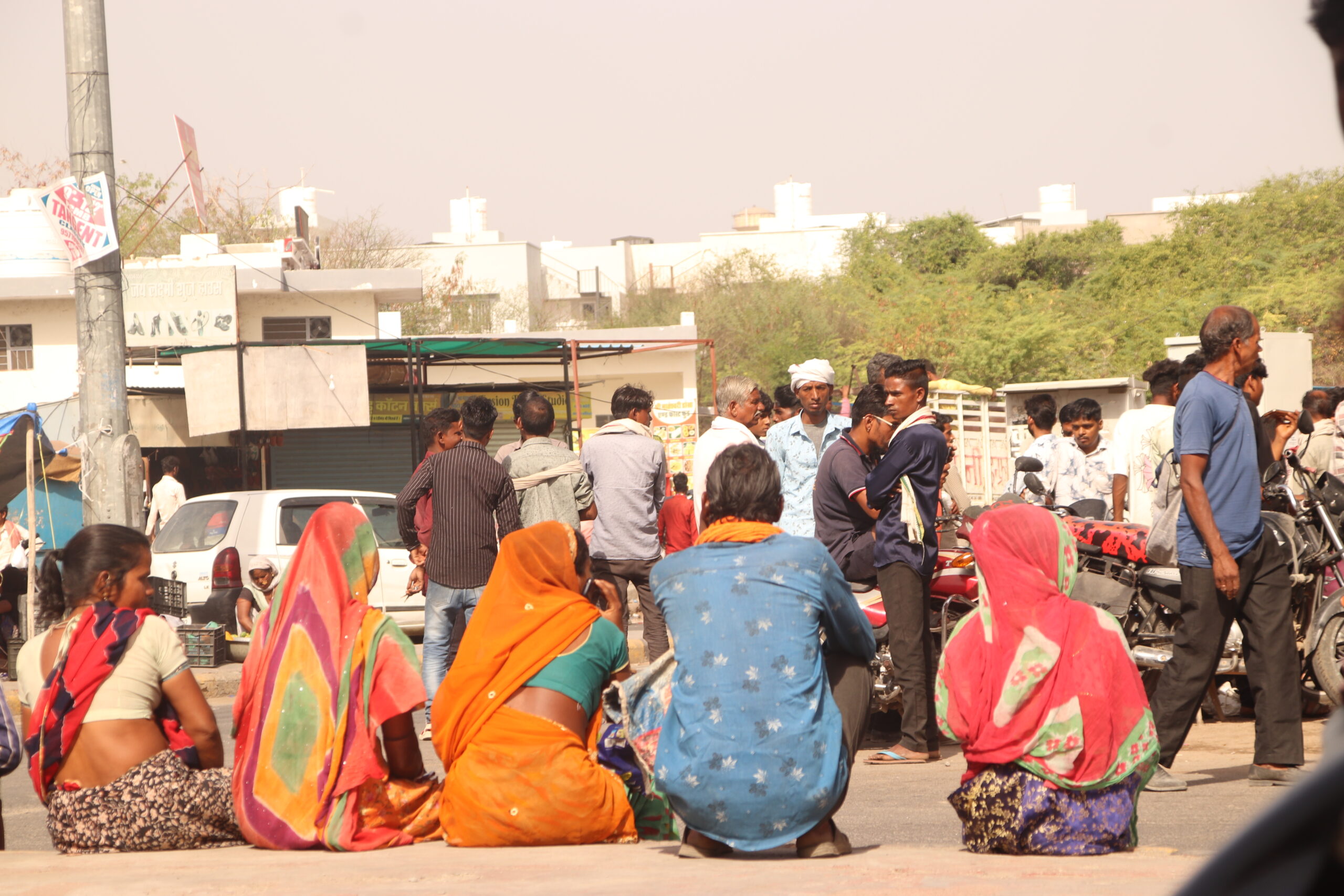
By 8 am every morning, seven days a week, the buses empty out at Syphon Square, one of Udaipur’s busiest labour pick-up points. The square resembles an open-air labour market.
It’s busier during peak summer months.
At the crossroad, men stand in groups with gamchas wrapped around their heads to shield themselves from the sun.
Women wearing bright skirts, colourful dupattas and silver jewellery wait beside them. Their hair neatly braided, kohl lining their eyes, cloth bags with a small tiffin and bottle hanging from their shoulders.
They keep scanning the road anxiously – some gathered in a corner, others lined up on the divider, waiting to be picked up for a day job.
Near a vegetable shop, three water cans have become an informal public service. Workers refill bottles and steel tumblers from them before heading out to work.
Every few minutes, a motorcycle, tractor, autorickshaw or car pulls over.
Potential employers step out and begin negotiating.
“How many labourers?”, “What work?”, “What is the wage?”
The workers are determined to bargain for a 1000 rupees per day wage, but they are able to negotiate for 700-800 rupees for men and 500 rupees for women so far.
Some workers leave within minutes. Others wait for hours.
Those who fail to find work return home by 12 noon having spent nearly Rs 100 on transport without earning anything.
Lalu Ram, from Dodawali village of Girwa block, arrives at the same crossroad everyday with his wife. It has been more than 10 years of him doing so and he has only witnessed an increasing footfall of people seeking work.
“The work in Udaipur has increased. There is more construction work and so everybody comes here from the village. But the number of people seeking work has also proportionally increased,” he said, as he went on to negotiate with a tractor driver for the day’s work.
“People who go on tractors are often paid not more than 200 rupees for three hours of work. The work is limited. But that is our last resort,” he added as he mentioned that the summer months were extremely crucial.
“If I do not get work it means no vegetables for dinner, just dal. There is nothing that we can harvest from our farm as well. So our meals depend on our wage ,” he added as he patiently waited to be picked up for work.
In the crowd, are also a group of young men who migrated to Ahmedabad for work, but returned to Udaipur after temperatures became unbearably high, making shorter-distance commuting to Udaipur a more attractive option, even if wages are sometimes lower.
Dilip Gameti, 21, waiting at the crossroads with his group of friends, said, “I returned from Ahmedabad a few days ago. I worked at a construction site there. But the heat is unbearable. Udaipur is comparatively better and I know I can return home every evening. We could hardly sleep or manage water in Ahmedabad, due to increasing temperatures.”
By 12 noon, temperatures touch 40 degrees.
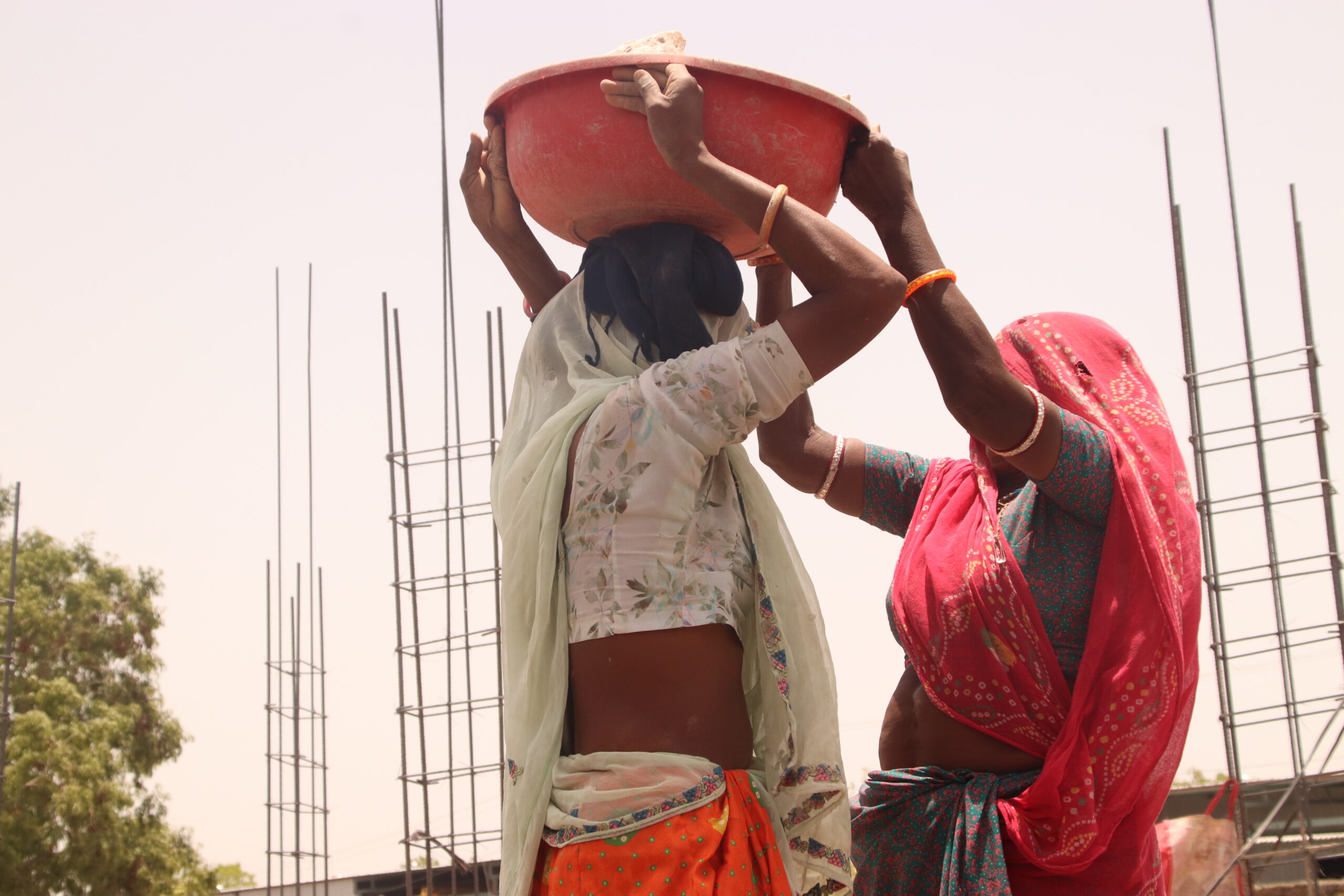
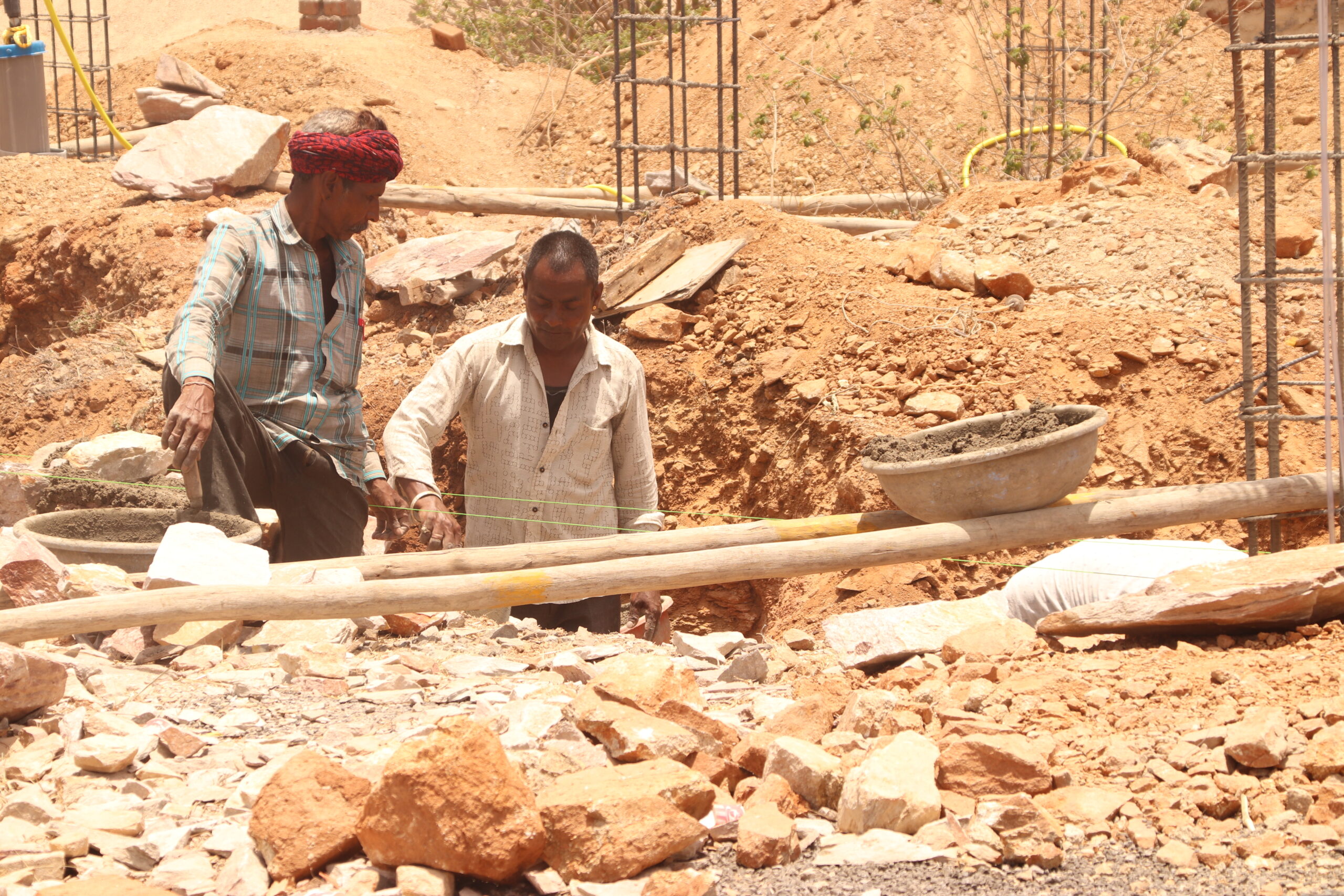
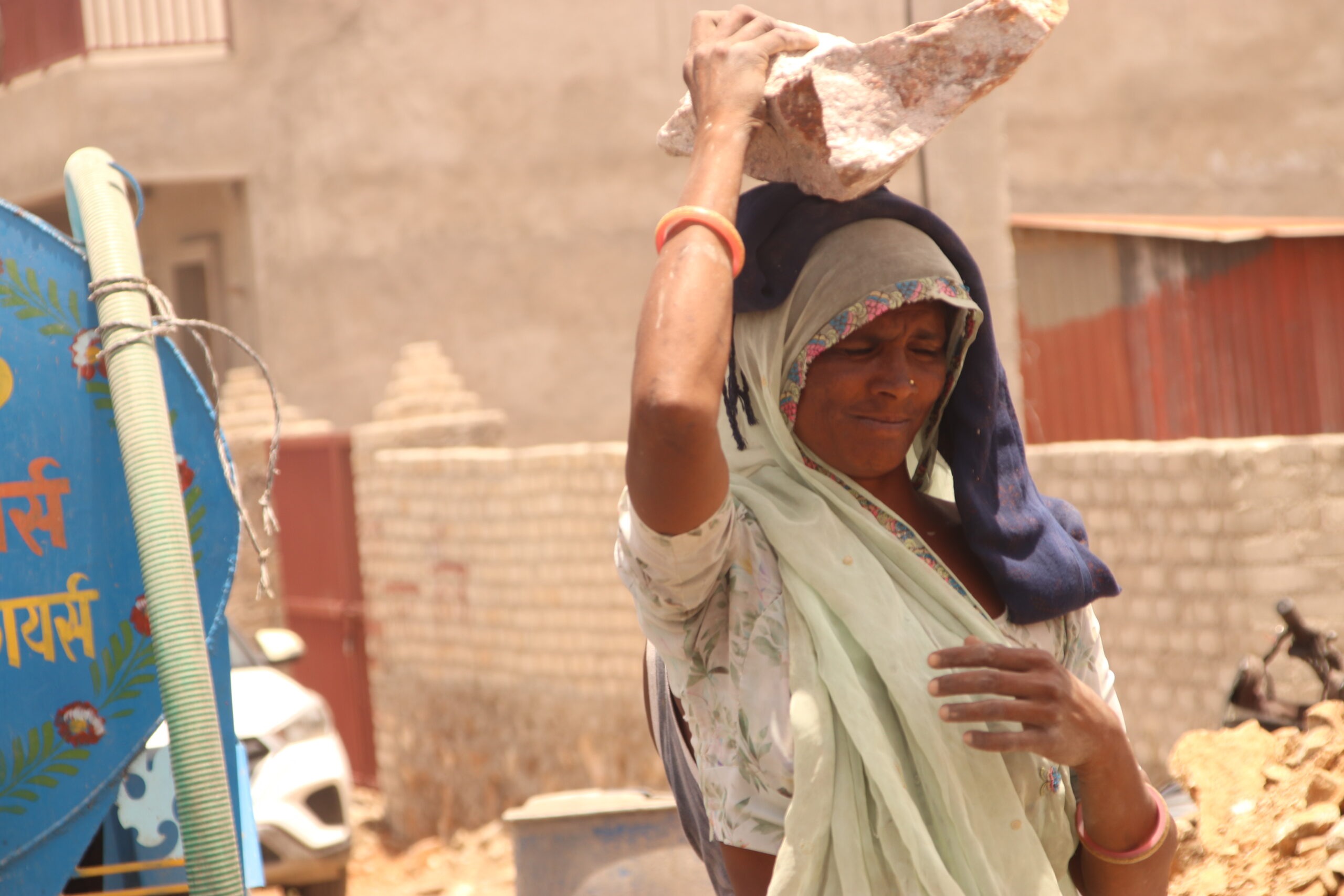
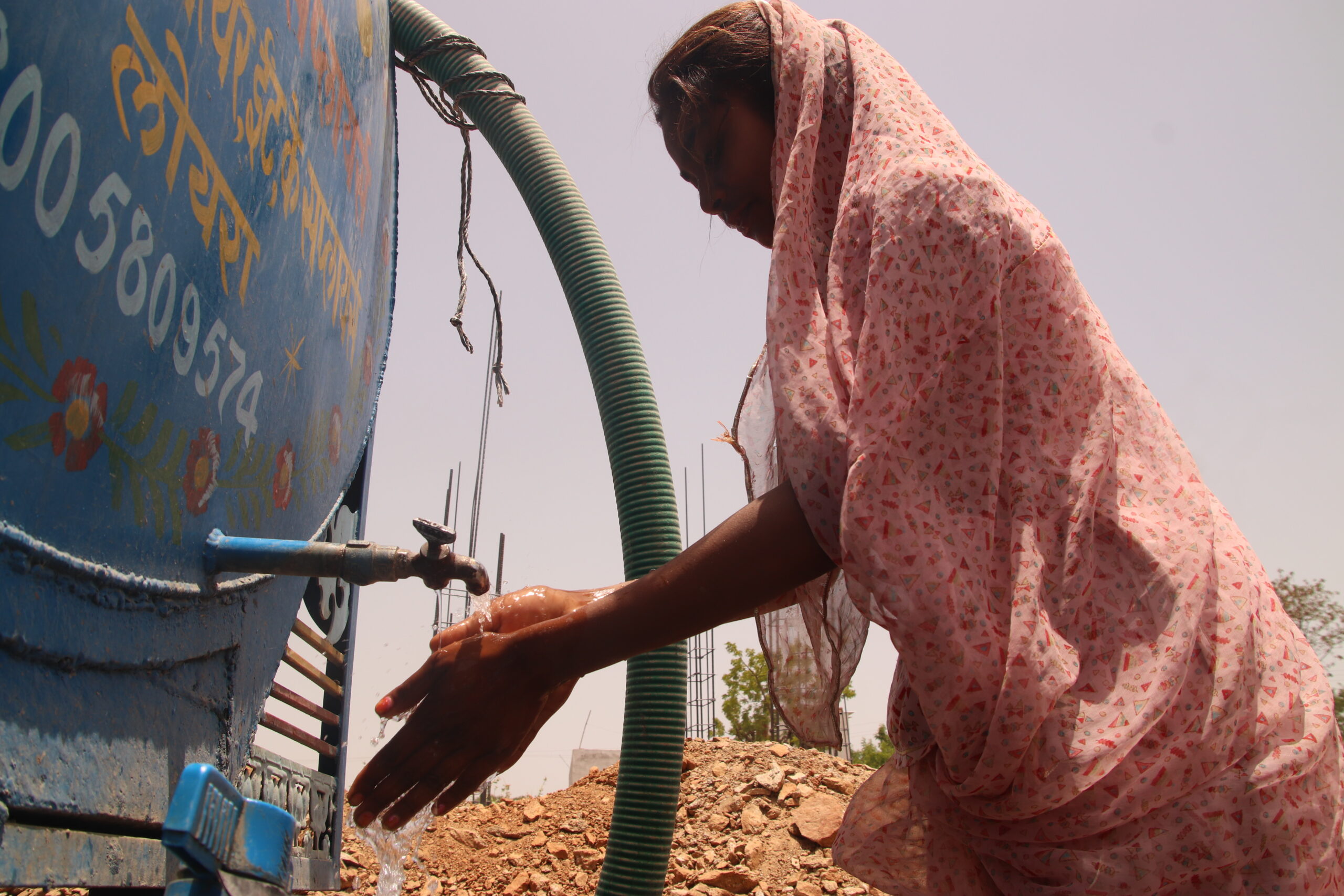
“Ye patthar, sariya, subah thik lagta hai, din chadta hai, sab tez garam ho jata hai, chu nahi sakte, par hume adat ho gayi hai (These stones and iron rods are fine in the morning. But as the day progresses, they become scorching hot. You can barely touch them. We’ve gotten used to it now.),” she said, taking a break to wash her face and resuming work again.
She spent most of the day moving roughly cut stone pieces on her head, that will form the foundation of the under construction building. “Touch it and see how warm it is,” she said as she lifted one of them to mount it on her head.
At 1 noon, the group takes a lunch break. The ten people working at the site have a small 6 feet * 5 feet of space to rest before they resume work.
“We do not lie down. How can we lie down here? We just sit for sometime,” she said as she opened her tiffin to check if the potato and bean subzi she packed for lunch was still edible.
“I pack lunch everyday but whether or not we can eat it is difficult to say. Many days the subzi is spoiled and we have to throw it away. We eat chappatis with onions and get butter milk from the nearby shop,” she said.
The small space made with stacked bricks, a tarpaulin and a tin shade hardly offers any relief. A small fan mounted on the wall ventilates warmer air.
“I feel dizzy and unwell a lot of times. The head feels heavy and the skin burns. Everytime that happens, I soak my dupatta in water and keep it over my head,” she said.
“We only rest between 1 to 2 pm but it depends on us if we wish to shift the break timings. But it is not more than an hour,” she said as she prepared to resume her work after the hour-long break.
“If I take longer breaks, how would I go home, since there is no other way to commute back home after the last bus. So it isn’t something that we can even ask for,” she said.
Even as Heat Action Plans increasingly cover informal workers, circumstantial roadblocks also continue to exist.
“We need to understand that no work between 12 to 3 is more advisory in nature than regulatory. In a lot of cases, there is no shade to rest or one has to go home and come back which also adds additional expenditures for workers specifically at construction sites. This particular advisory is not feasible for workers until and unless it is made mandatory,” Vipul Pandya, General Secretary of Bandhkam Mazdoor Sangathan, a Construction Labour Union in Western India, told The Migration Story.
Officials however assert that they conduct inspections at larger construction sites during the summer months to monitor compliance with heat-related safety measures.
“We do try to ensure that workers, particularly at bigger sites, are given adequate rest during peak summer hours. Our inspectors regularly visit sites during summers to check whether such measures are being followed,” said Mahendra Singh Rathore, Assistant Labour Commissioner, Udaipur.
On the limited transportation options available, he said, “State transport buses usually leave even after 6 pm which can be used after completing the full shift,” adding that all village routes might not be covered.
By evening, the crossroads are bustling again. The same buses that brought them to the city in the morning now carry them back through the hills.
The journey home is quieter. Many passengers are asleep before the bus leaves the city limits. Others stare silently out of the windows with barren hills on each side of the road.
And between these two journeys of coming to the city and leaving again lie the hottest hours of the day, that they can not afford to let go.
Aishwarya Mohanty is special correspondent with The Migration Story