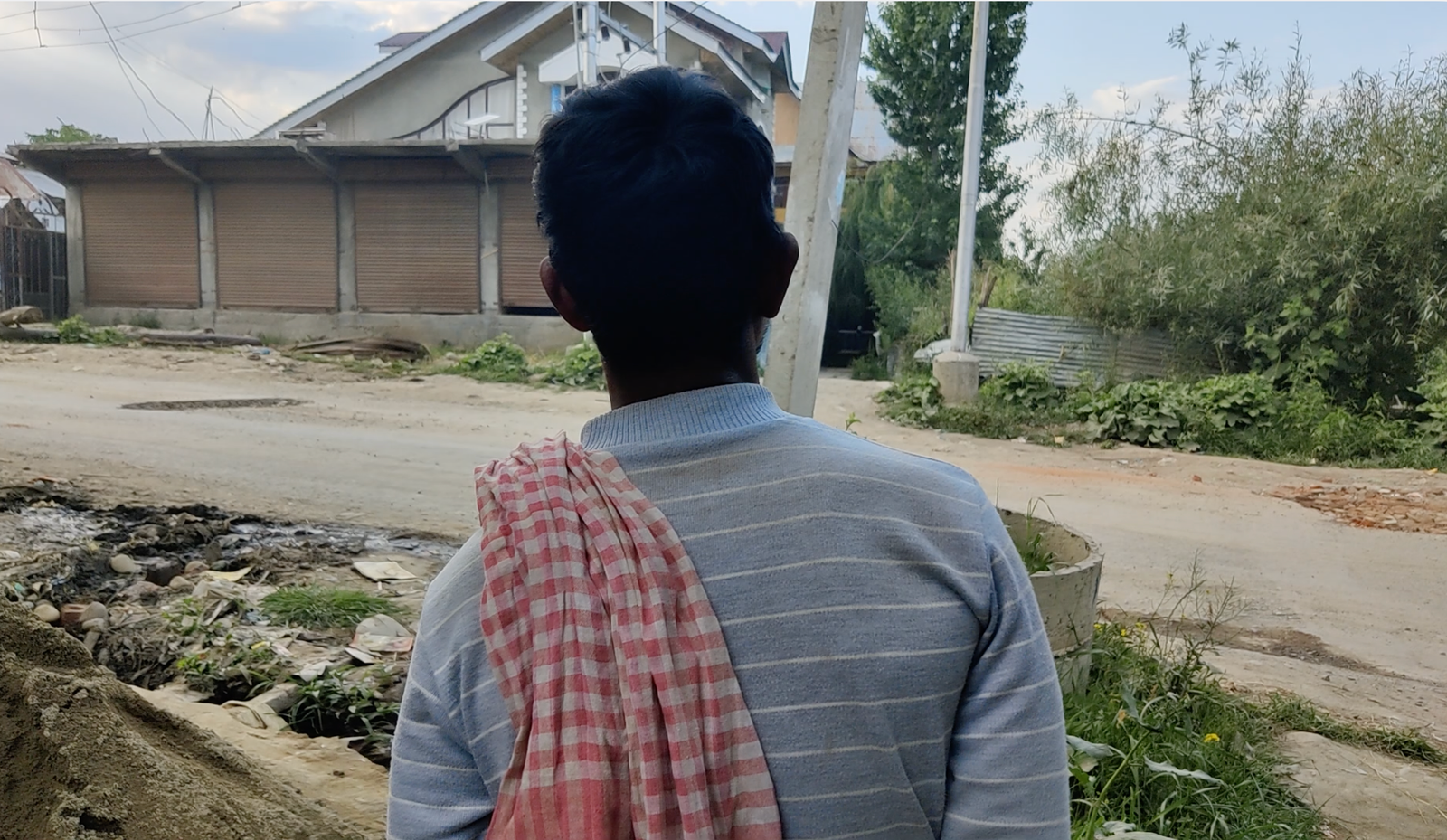
NEW DELHI: On July 31, two migrant labourers from Chhattisgarh’s Raipur district were shot dead by militants at a brick kiln in South Kashmir’s Kulgam district. The modus operandi was the same as that used in the Pahalgam attack on tourists in April 2025: the Kulgam gunmen reportedly enquired about the identity and religion of their targets before shooting them at close range.
One of the labourers, 24-year-old Deepak Ratray, died on the spot; the other, 28-year-old Bhupendra Bhaina succumbed to his injuries at a Srinagar hospital on August 1. Ratray, who was the sole breadwinner of his family comprising his wife, disabled brother and mother, had been seasonally migrating to Kashmir for the last five years. For Bhaina, it was the first time—he travelled to Kashmir in March 2026 with his wife, leaving his young son with his sister in Chhattisgarh.
Migrant workers have been militant targets in the valley for several years, but a string of attacks has been recorded in recent years.
The government told the parliament in 2022 that 28 migrants were killed between 2017 and 2022. Over 30 migrant workers have died between 2019 and 2026, a scan of media reports by The Migration Story shows.
According to a study by the Combating Terrorism Center at West Point, an academic and research institution at the United States Military Academy in New York, the repeal of Article 370 led to an initial decline in attacks but was followed by an upward trend – with targeted killings of targeted victims “mainly Kashmiri (Hindu) Pandits, migrant workers, non-Muslim teachers, and elected local self-government members”.
In the immediate post-2019 period, The Resistance Front (TRF), the Pakistan-based Lashkar-e-Taiba (LeT) and other militant factions killed several civilians, including truckers, apple traders, and migrant labourers in the districts of Kulgam and Shopian districts, the 2025 study noted. TRF, which was formed two months after the abrogation, took credit for the attack on tourists in Pahalgam.
Security analysts and experts believe that these unremitting attacks on easy prey like migrant workers are carried out to counter the narrative of “normalcy” in Kashmir.
“Migrant labourers, junior political party leaders and minorities who cannot avail of security from the State are sitting ducks for the militants, whose primary aim is to create an impression of abnormalcy in Kashmir,” Sameer Patil, director of the Centre for Security Strategy and Technology at the Observer Research Foundation, told The Migration Story. “Most of these attacks were in spring and summer (March to October), because this is the peak time when tourists, pilgrims and even migrant workers come to Kashmir.”
Patil said the central government, following the repeal of Article 370, maintained a heightened security profile in the valley.
“However, the militants, as a counter to this, carried out sustained low- or high-key attacks almost every year after 2019,” he said. “This was meant to achieve two things. One, to project the militants’ presence in Kashmir and show that they still have some heft; and two, to undermine New Delhi’s narrative of ‘normalcy’ in Kashmir. Not that it was undermined. Elections were held, there was a huge tourist inflow, curfews and stone-pelting ceased. And migrant workers continue to flock to Kashmir.”
A former senior security official in Kashmir, speaking on condition of anonymity, said that such attacks were largely designed to instil fear and psychological unease among non-locals living in the Valley. “The reason for the recent attacks is that the militant groups want to be in the news and dispel the narrative that all is well in Kashmir,” he said, adding that the latest attacks were deliberately communal in nature so that their impact rippled outward into other Indian states.
STILL A MAGNET FOR MIGRANT LABOUR
Despite the recurring violence, Jammu and Kashmir continues to draw enormous numbers of workers from across India. According to data shared by the ministry of labour and employment in the Rajya Sabha in December 2025, J&K recorded 36,12,778 total registrations of unorganised and migrant workers on the government’s e-Shram portal.
The Migration Story has previously reported on workers migrating to Kashmir specifically to escape the extreme heat back home and also opportunities in the valley.
But that’s only one reason. There are three other motivators that drive migrant labourers from Uttar Pradesh, Bihar, West Bengal, Punjab, Haryana, Himachal Pradesh, Rajasthan and Madhya Pradesh to work in Kashmir: better wages, shortage of local labour and the ‘weather window’ factor.
According to a paper by Aijaz Ahmed Turrey, an academic associate at the Indian Institute of Management, Ahmedabad, Kashmir offers higher wages and is often described as a “second Gulf”.
Migrant workers in Kashmir typically earn Rs 600-700 a day, roughly two to three times what the same work pays in most other Indian states, according to local media reports. Workers also often receive extras: tobacco or cigarettes, two meals a day and tea, perks rarely offered elsewhere. Counting these add-ons, a day’s effective earnings are close to Rs 1,000.
Secondly, the shortage of local labour in Kashmir makes it a place where migrants are more in demand. Local workers are often perceived as less interested and less productive besides being more expensive. Migrant workers, who are cheaper and considered more hardworking and willing to do all kinds of work for longer hours, are preferred by employers.
Thirdly, the harsh winters in Kashmir force most cultivation and construction work into a short window from April to November. This creates intense seasonal demand for labour, which is met by short-term migrants, especially from Bihar, Uttar Pradesh, and West Bengal.
Migrant labour in J&K spans multiple sectors such as construction, farming and the service sector, but it is the enhanced wages, brought about by decades of local labour-market realignment, which continues to draw hundreds of thousands of workers into the Valley each year even as the targeted violence against them continues.
KASHMIR’S HISTORY OF DEPENDENCE ON MIGRANTS
According to Professor Nisar Ali, a noted economist and former dean of the faculty of social sciences at the University of Kashmir, the roots of Kashmir’s dependence on outside labour trace back to the region’s development rather than decline.
“The rise of the middle class in Jammu and Kashmir happened because of free education, after the first prime minister Sheikh Abdullah introduced sweeping education reforms such as making education free from primary school up to university and significantly raising teachers’ salaries,” Ali told The Migration Story. “This gradually created a new educated class, which mostly preferred to either work in government jobs, move out for better opportunities or go into business.”
After the 1980s, Jammu and Kashmir became a hub first for labour from Haryana and Himachal Pradesh and later from Uttar Pradesh, Madhya Pradesh, Bihar, Rajasthan and Odisha. The labourers were spread across sectors such as agriculture, manufacturing, construction and brick kilns, barbering and hawking.
Ali explained that the pattern went back even further to Kashmir’s construction and public-works boom of the 1970s, which created a sustained demand for specific skills such as masonry, carpentry and iron fabrication that local labour alone could not meet.
“The labour market is governed by supply and demand,” he said. “Workers will move to places where there is a demand for labour and out of places where there is a surplus. So Kashmir, as a result of construction programmes from the 1970s onwards, saw a lot of demand, particularly for different skills in the construction industry. Labourers would seasonally migrate here and even bring their children or grandchildren with them.”
DO MIGRANT WORKERS STILL HAVE A FUTURE IN KASHMIR?
Several reports indicate that migrant workers have preferred to continue to work in Kashmir through the killing of their co-workers and even after the latest attack accompanied by religious profiling.
“Wherever there is a risk factor attached to any job, the profitability is high for a worker,” ORF’s Sameer Patil said. “We can see this in the case of the Strait of Hormuz blockage, and how companies are ready to pay thousands of dollars to workers to undertake the perilous voyage. Similarly, there are risks in Kashmir but migrant labourers perceive this as an opportunity to earn more money.”
Economist Nisar Ali agreed that many migrant workers choose to stay in Kashmir even during the most precarious times, like the 1990s when militancy was at its peak, leading to a massive overnight exodus of threatened Kashmiri Pandits. “Many of them stay because Kashmir remains a great place for them to work,” he said. “Also, their local networks are solid and Kashmiris depend on them a lot.”
The Migration Story previously reported how migrants from states like Bihar and Uttar Pradesh handled grading, sorting, and packing at massive facilities at the apple cold storage hub in Pulwama’s Industrial Growth Centre. Many migrants also power kitchens and sweet shops during Ramzan and Eid to make traditional sweets. Women from states such as UP and West Bengal migrate to Kashmir to work as bridal makeup artists and henna designers, slowly reshaping local beauty and wedding cultures.
Economist Ali also pointed to another factor which he believed led migrant workers to stay on in Kashmir.
“Just 20 minutes away from my place in the downtown area of Srinagar—which was considered highly dangerous in the 1990s—you will find a lot of migrants working, mainly in the construction industry,” he said.
“I have seen that they remain fairly detached about troublesome situations in general—for instance, whenever there is an attack on migrants in Kashmir, which is now frequent, they seem to remain unaffected. So an all-out exit of migrant labourers from here, whatever the provocation, is something that is unlikely to happen.”
Edited by Radha Rajadhyaksha
Sajid Ali Mir is a Delhi-based journalist who hails from Jammu and Kashmir’s Pulwama district