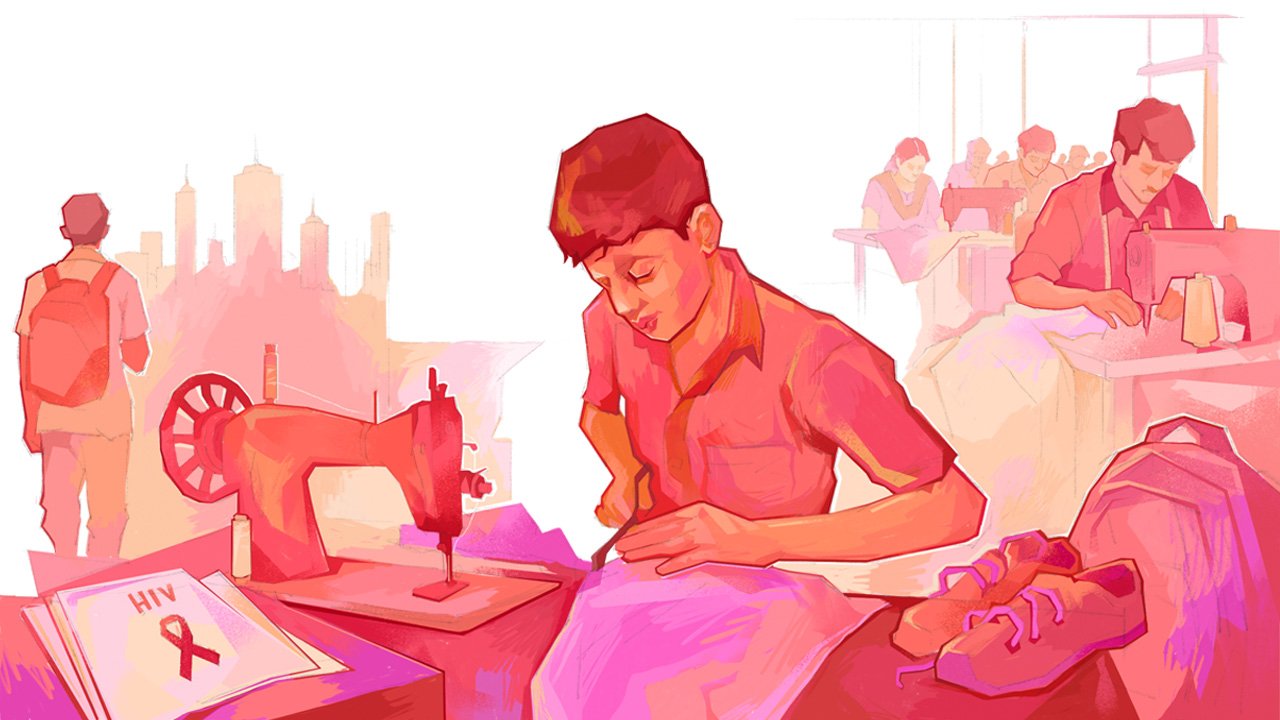
BENGALURU, Karnataka: When he was sacked by his employer on July 31, 29-year-old Bishnu* saw the life he had painstakingly built for himself turned upside down once again.
A native of Assam’s Nemuguri village, Bishnu was allegedly fired from his job at a garment factory in Bengaluru, Karnataka, after his employers found out that he was a person living with HIV.
Bishnu’s friend Samir*, 30, a native of a village near Patna, in Bihar, lost his job at the garment factory on the same day. A few days later, the same garment factory fired another worker, Tapan*, 28, from Dimapur, Nagaland. They were also persons living with HIV.
Along with the trio, five other migrant workers – all friends and HIV-positive – lost their jobs at different garment factories in the city.
“All this happened in a week. We all lost our jobs because we are HIV-positive. Is this a crime?” asked Bishnu.
Manohar Elavarthi, founder of Sangama, a Bengaluru-based organisation that has worked for sexual minorities and sex workers’ rights for two decades, said poor migrant workers were the most vulnerable to discrimination due to HIV.
“First, they are poor; second, they are migrants and have no say in the system. They all suffer in silence,” he said.
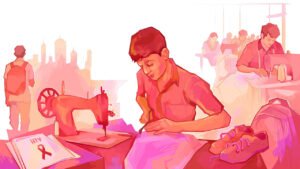
Bishnu, Samir, and Tapan worked as tailors at Vrudhi Garments, a manufacturing and export entity located in Yelachenahalli Village, Bengaluru.
Samir suspected that an acquaintance told their employers about their HIV-positive status.
“I vividly recall our co-workers refused to even look at us when we went to work on July 31. We were surprised at their behaviour. Later, our production manager told us that we can’t work in the factory anymore. They even withheld our July salary,” said Samir.
“After repeated requests, they (the management of Vrudhi Garments) gave us 1,300 rupees (out of a 22,000 rupee salary a month). They asked us to sign a handwritten letter. It stated that we were resigning from our jobs as we had to go to our villages. It was a lie. We signed, nonetheless, as we were told that we would get our full salary for July. But we did not,” alleged Bishnu.
The management of the garment factory declined to speak to The Migration Story when contacted by phone, stating that the case was under investigation.
“We try our best to hide our HIV-positive status. We keep it a secret as we know the stigma attached to it. We know the heart-crushing harassment and discrimination faced by HIV-positive people. We are poor people and have been forced to travel thousands of kilometres to Bengaluru to work and earn a livelihood,” said Bishnu.
Thamanna, Deputy Labour Commissioner, Policy and Statistics, Karnataka, said that his department was not apprised of the termination of migrant workers from their jobs.
“However, under the India Employment and Labour Laws and Regulations, 2026, employers cannot terminate, demote, or deny jobs to any person solely because they are HIV-positive. These protections come from the HIV and AIDS (Prevention and Control) Act, 2017, and the Rights of Persons with Disabilities (RPwD) Act, 2016, as HIV-positive individuals fall under disability protection,” he added.
The HIV and AIDS (Prevention and Control) Act also protects individuals from pre-employment screening and ensures confidentiality when handling their cases.
After they lost their jobs, their landlord asked all eight to vacate their rented accommodation. All eight migrant workers shared a single room with seven others at a housing society in HN Halli, in the south-east part of the city.
The worst was yet to come. On August 18, one of the migrant workers died by suicide. The 51-year-old was from Guwahati, Assam. The next day, another worker died by suicide. The 28-year-old was from Barpeta, Assam.
“The 51-year-old was working with Radha Krishna Garments and the 28-year-old was working with Amba Garments,” said Bishnu.
Repeated attempts to get in touch with the management of Radha Krishna Garments and Amba Garments did not elicit a response.
Around 200 other garment factory workers lived in the same housing society as these migrants. Each room was shared by 12 to 15 people. Within a radius of eight to 10 kilometres of HN Halli lie Kudlu and Bommanahalli, two prominent garment manufacturing and textile hubs in Bengaluru. Peenya Industrial Area, Yeshwantpur, and Magadi Road are the other centres.
“We were depressed after we lost our jobs. We had no money, no food, and no roof over our heads. During that period, we friends parted our ways, and in the midst of this chaos, two died by suicide,” added Bishnu.
Out of the eight migrants, five were from Assam. They all came to work in Bengaluru in late 2025.
“I was the one who encouraged four others to come with me to work in Bengaluru. We met at Shantidan in Guwahati, where we underwent treatment for HIV and were nursed back to health. That is how we became friends,” recalled Bishnu.
Shantidan is a specialised shelter and care centre for HIV/AIDS patients run by the Missionaries of Charity in Guwahati.
A VALIANT FIGHT AGAINST ALL ODDS
Bishnu has been searching for a place to call home since birth.
He grew up in Nemuguri village in a family that adopted him as an infant after his biological parents abandoned him. Nemuguri, in Sivasagar district, is one of the hundred villages left ravaged by the floods that hit the northeastern state of Assam in late July.
However, Bishnu’s ties with his village were severed almost two years before the floods destroyed houses and agricultural land in Nemuguri.
“It is a long story. In 2024, after I tested positive for HIV, village elders decided that I should never set foot in the place where I grew up. My adoptive family also supported the decision. They feared that my presence itself would transmit HIV to everyone,” Bishnu told The Migration Story.
Bishnu first left home to work in Bengaluru after finishing Class 12 in 2014. He was 17 then.
“My adoptive family was very poor. So, I decided to work to add income to our household. I came to Bengaluru to fulfil my dream of earning a decent livelihood,” he said.
From 2014 to 2024, Bishnu worked as an office boy at a multinational company in Bengaluru. He started with 5,000 rupees a month. This grew to 15,000 rupees a month by the time he left the job in early 2024 after he was diagnosed with HIV.
Over the years, Bengaluru became his second home. He learnt Kannada, Tamil, and Telugu and tried to become one among the locals in the cosmopolitan milieu that Bengaluru offered. He speaks these languages as fluently as his mother tongue, Assamese.
“I also learnt English. But it is not that good,” he laughed.
Since he had to send money to his family back in Assam, Bishnu learnt new skills like tailoring and hairstyling and worked second jobs, enabling him to send back 5,000-8,000 rupees a month.
Meanwhile, Bishnu fell in love with a Telugu woman. “We got married when I was 21. We set up our home. We were very happy. We were blessed with a beautiful daughter,” he said.
However, tragedy struck when his child developed a severe cough and cold and died in 2022. “She was just two years old,” said Bishnu.
The death of their child caused enormous grief to the couple. “My wife and I drifted apart. We decided to stay separately,” he said.
FADING HEALTH AND DWINDLING FINANCES
Bishnu was not yet ready to give up and began to work towards building a “new home” once more. This dream was shattered when he fell seriously ill in January 2024.
“I had become very weak. I started fainting. I vomited a lot too and lost my appetite. In the hospital, I was tested HIV-positive. I also had tuberculosis and an infection in the kidney,” he recalled.
Bishnu alleged government-run hospitals in Bengaluru denied him treatment. Several ART (Antiretroviral Therapy, which is a combination of daily medications used to treat and suppress HIV) centres and Integrated Counselling and Testing Centres (ICTC) run by the government provide free HIV treatment, counselling and ART in Bengaluru. This includes Victoria Hospital, Bowring and Lady Curzon Hospital, KC General Hospital, and the Indira Gandhi Institute of Child Health, among others.
“I was made to run from one hospital to another. Finally, I was admitted to PES University Institute of Medical Sciences and Research (a private institute) in Electronic City. I was treated in their intensive care unit, followed by a general ward for almost a month. I was alone at the hospital fighting for my life. Initially, a few friends came to meet me. But they too stopped after a while,” he said.
His treatment drained all his savings. “My hospital bill was around two lakh rupees,” he said.
His family in Nemuguri village was till then not aware of his HIV-positive status. He did not tell anyone as he himself was processing the trauma.
“My family knew I was unwell, and my adoptive father insisted I come to my village. So I went,” Bishnu said.
“It was during my treatment at Assam Medical College and Hospital, Dibrugarh (around 60 kilometres from Nemuguri), that my family and village people came to know that I was HIV-positive. They decided to abandon me, and I became homeless,” he added.
During his stay at the hospital in Dibrugarh, a nurse told him about the Assam Network of Positive People (ANP+). The ANP+ works for people living with HIV/AIDS in Assam. ANP+ is a non-government organisation formed with the help of the India Network of People Living with HIV in 2003. The network has around 8,000 members in the state.
Jahnabi Goswami, president of ANP+, recalled her first meeting with Bishnu at her office in Guwahati.
“He was severely malnourished. We thought he wouldn’t survive. He was less than 30 kilograms. He was walking with the help of a stick. We took it as a challenge to give Bishnu a new lease of life. Once he was slightly better after treatment, he stayed at Shantidan,” Goswami said.
After his health improved and he became fully functional after a year at Shantidan, Bishnu decided to return to Bengaluru to earn a livelihood. This time, unlike when he was 17, he did not come alone. He came with a group of four other men.
The migrants’ desire to be productive members of society, however, came undone when the garment factories terminated their employment.
DIALLING BACK HOME FOR HELP
Immediately after losing his job, a distraught Bishnu contacted the ANP+ for help.
Goswami told The Migration Story that the factories unlawfully terminated the workers and withheld their salaries.
“I know all five Assamese workers. They are/were part of our network. Our network facilitated their treatment in Guwahati before they moved to Bengaluru for work,” said Goswami.
Goswami said that after she spoke with Bishnu, the ANP+ wrote a formal complaint to the Karnataka State AIDS Prevention Society (KSAPS) and Karnataka Network of Positive People (KNP+) on August 11 for intervention, almost a week before the two workers died by suicide. The ANP+ again wrote to them on August 20
“Bishnu went to these offices with his complaints. Unfortunately, the issue was not taken seriously. Probably, we could have saved those two lives,” added Goswami.
A copy of the complaint is with The Migration Story.
“The reported deaths of two affected workers have made the matter extremely serious and urgent. We respectfully request the competent authorities to independently verify all facts, including the circumstances preceding the deaths, the alleged termination of employment, withholding of wages, and any discrimination or harassment faced by the workers,” Goswami wrote in her complaint.
Shan Sihimogge, KNP+ Board Director, confirmed to The Migration Story that both Bishnu and Samir visited their office.
“Bishnu’s mental health condition was fragile. Since they had no money, we provided them with food. We gave counselling to Bishnu. After hearing their side of the story, we have started our investigation. We are speaking to the garment factory owners to know their side of the story. Justice will be done,” said Sihimogge.
Project Director of KSAPS Padma Basavanthappa told The Migration Story that the complaint was forwarded to the Ombudsman, KSAPS, for investigation.
“The case has been duly registered and is currently under process,” she added.
Indranoshee Das, Project Director, Assam State AIDS Control Society, said that her department was in touch with KSAPS to help the migrant workers get justice.
Sihimogge of KNP+ spoke to Vrudhi Garments officials. “Their version is different from the migrant workers’. They have accused their employees of dereliction of duties. But it is also true that eight workers lost their jobs and two died by suicide,” said Sihimogge.
STIGMA AND DISCRIMINATION IN THE WORKPLACE
Around 25 lakh people in India are living with HIV, according to the National AIDS Control Organisation (NACO) and Goswami said that the treatment of the HIV-positive workers in a major city like Bengaluru indicates that the situation is worse in smaller cities like Guwahati. There are an estimated 1.5 to 2 lakh Assamese migrants in Bengaluru.
The “National Policy on HIV/AIDS and the World of Work” published by the Ministry of Labour and Employment mentions the nature of discrimination and stigmatisation faced by people living with HIV in their workplace.
“HIV/AIDS affects fundamental rights at work, particularly with respect to discrimination and stigmatisation of workers and people living with and affected by HIV/AIDS. Stigma and discrimination at the workplace get reflected in the form of loss of employment and livelihood opportunities in addition to ostracism and seclusion faced by workers either due to known or presumed HIV status.”
Forty-nine-year-old Bharathi H.J., a labour rights activist and a garment factory worker from Bengaluru, alleged that garment factories across Karnataka were infamous for violating labour rights.
The reasons are caste, religion, gender and even health issues like tuberculosis and HIV/AIDS.
“The employers take advantage of workers’ desperate need to work and earn. The workers are paid abysmal low wages, have long and strenuous working hours, and women employees (who form the bulk of the labour force) face frequent sexual harassment, to name a few,” said Bharathi.
According to the Garment and Textile Workers Union (GATWU), an independent trade union of garment workers in Karnataka, the southern state employs around 5 lakh garment workers. Most of them work in Bengaluru.
Rukmini V.P., president and founder of the Garment Labour Union (GLU) from Bengaluru, told The Migration Story that migrant workers – both intra-state and inter-state – formed the backbone of Bengaluru’s garment sector.
“There are an estimated 1,200 garment factories across Karnataka. They mostly employ migrants and women,” she added.
India is the world’s second-largest garment-exporting country. At least 45 million people work in the textile and garment industry. It is the third-largest employment-generating sector. Around 20% of the country’s garments are produced in Karnataka.
Bishnu is now back in Guwahati again, as are the other two Assamese migrants from the group. Samir has returned to his village in Patna.
Bishnu said they had lost contact with the remaining migrants from their group.
“I am wondering how and where to start my life afresh. I am still looking for my home,” he said.
*The names of people living with HIV have been changed.
Maitreyee Boruah is an independent journalist and reports from Assam and Karnataka.